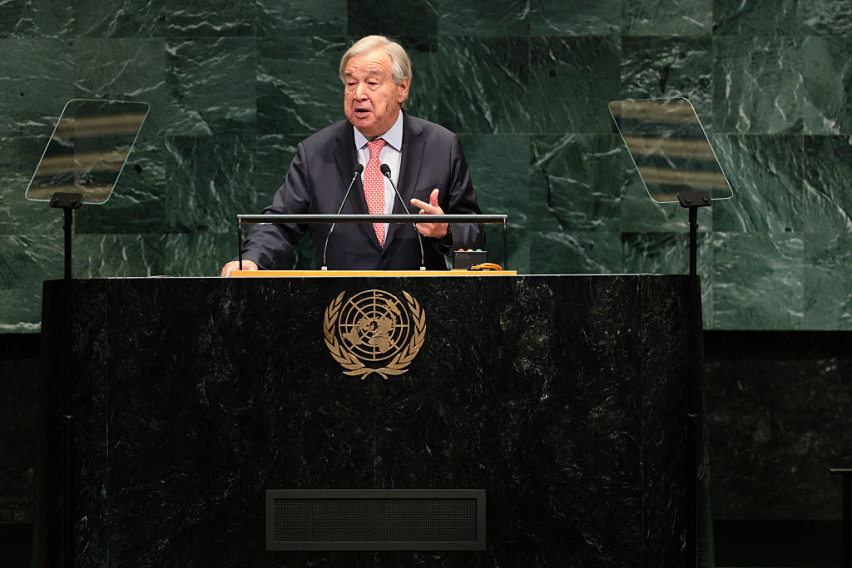
UN Secretary-General António Guterres said the human rights situation in North Korea has deteriorated in many respects over the past decade and called for those responsible for human rights violations to be investigated and punished.
In a new report, he called for political prison camps to be dismantled and forced labor to end. He also raised concerns about the surveillance of residents using advanced technology and about restrictions on access to food.
The report, "Situation of Human Rights in the Democratic People's Republic of Korea," was released Oct. 1, Voice of America (VOA) Korea reported. It covers developments in North Korea from June 1, 2025, to May 31, 2026, and was submitted to the 81st session of the UN General Assembly.
The General Assembly has adopted a resolution on North Korean human rights at the end of each year, condemning the North's systematic and widespread human rights violations and calling for accountability. A resolution is expected to be adopted again this year.
Guterres said North Korean authorities must investigate and prosecute perpetrators of human rights violations and bring them to justice in accordance with international law, including international human rights law. He said accountability must also cover acts that may amount to international crimes.
He also said victims and their families have a right to the truth. He urged the authorities to "ensure that victims and their families are able to know the truth about the crimes and human rights violations that have been committed."
13 recommendations, including closing political prison camps and ending forced labor
The report sets out 13 recommendations for North Korean authorities, including the punishment of perpetrators. Among them are demands to dismantle all political prison camps and to stop arbitrarily arresting residents for their political opinions or family background, known as songbun.
The report also recommended a moratorium on executions with a view to abolishing the death penalty as soon as possible, and an immediate end to torture and ill-treatment.
Citing the "youth shock brigades" mobilized to work in coal mines and on construction sites, as well as the dispatch of workers overseas, the report said all forms of forced labor prohibited under international law must end.
The recommendations also include allowing separated families to contact one another by telephone, video call and letter. The report urged authorities to immediately confirm the fate and whereabouts of abductees and victims of enforced disappearance and to repatriate their remains.
In assessing the human rights situation, the report cited a report by the UN High Commissioner for Human Rights released September 2025. That report examined the 10 years since the 2014 report of the UN Commission of Inquiry on Human Rights in the Democratic People's Republic of Korea. It concluded that "despite some extremely limited improvements, the overall human rights situation has deteriorated in many respects over the past 10 years."
Expanded AI and facial-recognition surveillance; military-first priorities criticized
The report identified tighter legal and institutional controls and the use of advanced surveillance technology as major concerns. It said the spread of digital technologies, including artificial intelligence, could increase the state's capacity for surveillance and monitoring, with a serious impact on residents' human rights.
According to the report, North Korean authorities are installing high-performance surveillance cameras with facial-recognition capabilities in various locations, including workplaces. It also cited reports of extensive monitoring of mobile phone use, including through regular screen captures, and expressed concern about possible violations of privacy.
The report criticized the allocation of resources to defense and nuclear programs. It noted that at the Ninth Congress of the Workers' Party of Korea in February, North Korea formally designated South Korea a "hostile state" and its "immutable principal enemy," and reaffirmed the priority of its defense and nuclear programs.
With state resources concentrated on the military, the report said, residents' rights to basic needs — including health, food and education — are being seriously violated.
On food, the report distinguished between how much is produced and how much residents can actually obtain. Citing data from the Food and Agriculture Organization of the United Nations, it said favorable weather last year produced good harvests of major grains, but food shortages continued.
The report attributed this to the sharp fall in the value of the North Korean won, soaring food prices and strict controls on private economic activity. It said the state's total control over food distribution also limits ordinary residents' practical access to food.
Trafficking of North Korean women; call to uphold non-refoulement
The report said that since North Korea's border closure in 2020, about 200 North Korean defectors a year have entered South Korea — roughly 20% of pre-COVID-19 levels.
Of the 170 defectors who arrived in South Korea between July 2025 and March 2026, 151 were women who had been subjected to human trafficking or forced marriage in China, the report said.
It said defectors arrested in China or other transit countries and sent back to North Korea face a high risk of torture and arbitrary detention. It urged all UN member states to strictly uphold the principle of non-refoulement.