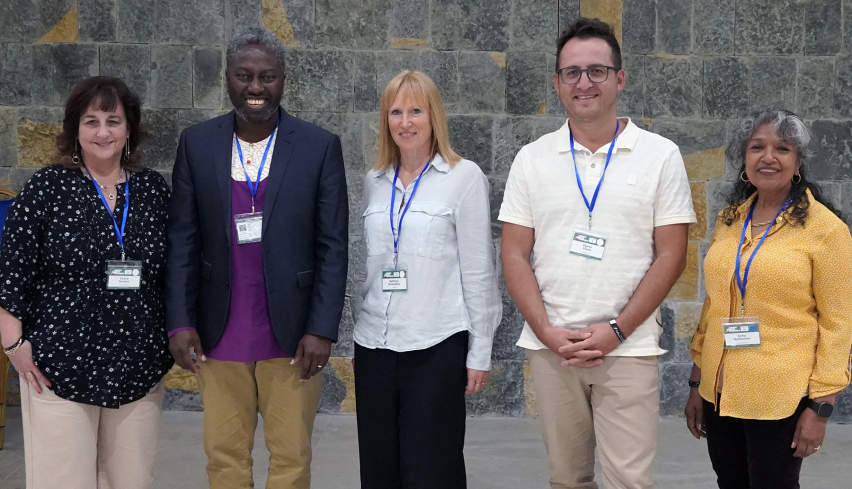
The European Evangelical Alliance has launched a new network aimed at helping diaspora and indigenous European churches work together as one body, as debates over migration intensify across the continent.
The One People Network was officially launched at Hope for Europe 2026, the five-day gathering of about 250 evangelical leaders taking place in Golem, Albania, through Friday, Oct. 9, under the theme "Hope in Uncertain Times."
The network is coordinated by the Rev. Dr. Israel Oluwole Olofinjana, founding director of the Centre for Missionaries from the Majority World. In an interview, he told Christian Daily International that the idea had been discussed for years and that its timing now carries particular significance.
"It's been a conversation in the pipeline for some time, at least as far back as five, six years," Olofinjana said. "And I'm glad that it's happening for such a time as this, to use that reference from Esther. Because we're having these debates about migration in Europe. And so to have a network that wants to focus on diaspora, how diaspora work together with indigenous Europeans or Europeans, is critical."
From Nigeria to English Baptist pulpits
Olofinjana came to the United Kingdom from Nigeria as a missionary in 2004. From the outset, he said, he chose not to lead a congregation defined by a single diaspora community.
"Since then, I've gone intentionally on a journey of not leading what would be described as a diaspora church or a Nigerian church or an African church," he said. "I've worked among the English Baptists as a Baptist minister, and I've led three Baptist churches and one independent charismatic church."
He described those congregations as multicultural, including one white-majority church.
Alongside pastoral ministry, Olofinjana founded the Centre for Missionaries from the Majority World, which provides contextual training for missionaries arriving in Europe. He has also written academically on African diaspora Christianity and African missions in Europe.
Successive waves of migration
Over more than two decades, Olofinjana has watched several distinct waves of migration reshape churches in the UK and across Europe.
When he arrived in 2004, he said, he later recognized a pattern: a number of missionaries had come to the U.K. at the same time, intentionally, from South Korea, Zimbabwe, China and Nigeria.
Around 2014 and 2015, a further wave followed. "Iranians coming in because of some of the conflicts going on in the Middle East," he said. "So now some of the largest or fastest-growing churches in the UK and other parts of Europe are Iranian churches."
Shortly before the COVID-19 pandemic came migration from Hong Kong, driven by political tensions there. Some pastors from Hong Kong, Olofinjana said, "have decided not to be in a Chinese or Hong Kong church, but to integrate within other churches and spheres."
Russia's war in Ukraine has since brought Ukrainians into European churches, "engaging in different ways and in different spaces," he said.
"So there's been different moves, successive waves of migration with different characteristics," he said.
Beyond 'landlord and tenant'
Asked about relations between migrant churches and established European congregations, Olofinjana pointed to several models of good practice.
One of the most common is building sharing, in which a migrant congregation meets in a Lutheran, Baptist or other church building. In some cases, he said, the arrangement goes no further than a lease.
"Some of them are landlord-tenant relationships. So the congregation is just renting the building and that's it. Nothing else goes further," he said. "But others are intentionally building relationships and are going beyond just landlord-tenant and actually doing joint services together, or running some missions together, or discipleship together."
National evangelical alliances offer another route. Olofinjana cited Switzerland and the U.K. as examples, as both have employed a diaspora or intercultural leader to work across communities. Egzon Shala fills that role at the Swiss Evangelical Alliance, he said, while Olofinjana himself previously served in a similar capacity with the Evangelical Alliance of the U.K.
'Contested migration is a big barrier'
Asked what he sees as the greatest obstacle to closer relationships, Olofinjana pointed to the way migration is currently viewed in Europe, both in society and in the church.
"I think at the moment, while society is agitating around what that means for us, people in the churches as well are asking those questions, and they are not sure whether this is good or bad," he said. "And so many in our churches are not fully convinced that migration is a force for good."
That uncertainty, he said, shapes life inside congregations.
"If people are not fully convinced that migration is a force for good, then we will have people sitting in the church alongside refugees and asylum seekers, but internally they are not sure about what this dynamic means for them," he said. "So it's a barrier. Contested migration is a big barrier."
His answer to that barrier is discipleship, specifically teaching a theology of migration grounded in Scripture.
"Discipleship is key to navigate those barriers," he said. "And what I mean by that discipleship is how people are taught about the theology of migration, to unpack Scriptures to help people understand that this is not just a political issue. What does the Scripture have to say about this topic and this subject?"
'Every tribe, nation and language'
The One People Network is inspired by the picture in Revelation 7:9. "Our vision is to see how Europe can be transformed by the Revelation vision of every tribe, nation and language," Olofinjana said.
According to the European Evangelical Alliance, the network's vision is for evangelical churches across Europe to flourish as one. Its stated purposes include acknowledging the national and ethnic diversity within EEA church communities, and promoting a message of unity to nations and their leaders. It will also encourage the alliance to speak on emerging issues with new voices, and it hopes to broaden EEA membership among emerging ethnic churches in Europe, especially among youth and young adults.
Olofinjana said the network plans to pursue these aims primarily through conferences, consultations bringing key leaders together, intergenerational conversations and research.
"We want to do that through intergenerational conversation, because you cannot separate the intercultural and intergenerational," he said. "We want to do some research to find out more of the dynamics of what's going on."
Theological reflection is another focus. "We want to engage theologizing, how we do theology," he said. "How do we teach pastors how to handle a multicultural congregation?"
The network also intends to provide practical resources for church leaders. "A lot of pastors are asking, 'How do I lead? What books do I read? What things do I need to do?'" Olofinjana said.
The network will serve national alliances, diaspora networks and movements, and intercultural networks.
"We want to connect the dots, have an overview and bring them together," he said. "That is our hope and dream."
Start from Scripture
Asked what he would advise pastors who are unsure how to approach migration amid political polarization, Olofinjana urged to start with the Bible rather than in public debates or on social media.
"I would say they need to look at Scripture. They need not to follow the algorithms that are saying, 'Oh, migrants are coming on the boat,'" he said. "Okay, that's a reality we cannot ignore. Yes, they are coming, but then how should we as Christians respond?"
He acknowledged the distinction between legal and illegal migration, but said the Christian response should begin elsewhere.
"What does the Bible say about the stranger? How should we welcome the stranger? Hospitality, what does that mean?" he said. "That should be our starting point, not the politics of migration, but the discipleship and the welcoming and hospitality."
A church that does this well, he said, affirms the dignity of others and takes part in the Great Commission without leaving its own community.
"It means you are recognizing the humanity of other people. It means you are recognizing that other people different from us are created in God's image, and you are putting that into practice," Olofinjana said. "And you are engaging in cross-cultural mission by doing that, because you'd be welcoming people from all over the world into your church."
"We should go and make disciples of all nations," he added. "So you'll be doing that literally by welcoming and providing hospitality for different people."