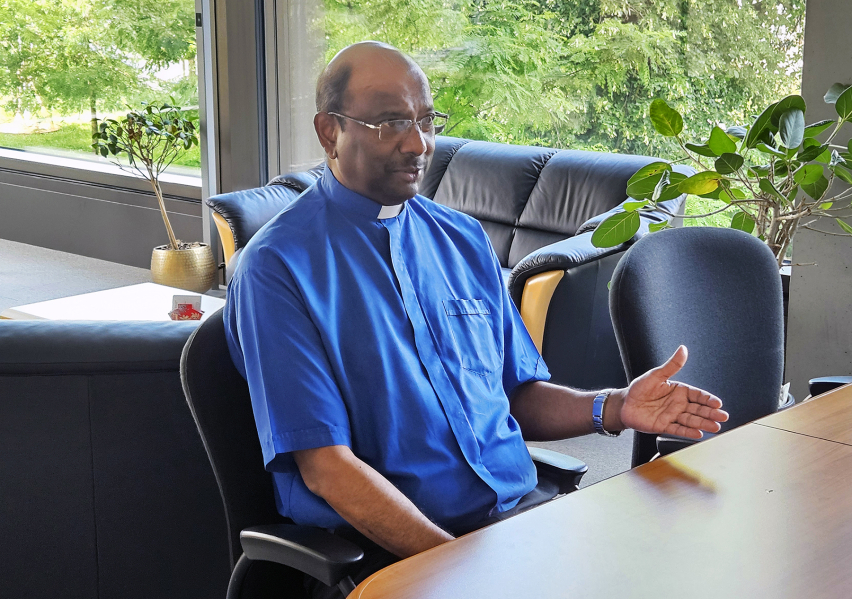
At the Ecumenical Centre on the Chemin du Pommier in Geneva — home to the World Council of Churches (WCC) since 1966 — Christian Daily International sat down with Rev. Prof. Dr Jerry Pillay for an exclusive and wide-ranging conversation. As General Secretary of the WCC, Pillay leads a fellowship of 356 member churches representing more than 600 million Christians across over 120 countries. It stands as one of the three primary world church bodies next to the Vatican and the World Evangelical Alliance.
Pillay, who began his tenure on Jan. 1, 2023, is the ninth person to hold that office since the body was founded in 1948. A South African theologian, ordained minister in the Uniting Presbyterian Church in Southern Africa, and former dean of the Faculty of Theology and Religion at the University of Pretoria, Pillay has been formally involved with the WCC since 2006.
The topics covered in the conversation ranged from the historic demographic shift of Christianity toward the Global South, the deepening relationship between the WCC and the evangelical movement, the delicate management of theological tensions over sexuality and human dignity, the challenge of religious persecution, and the question of the Russian Orthodox Church's continued membership in the wake of Russia's war in Ukraine.
Christianity's Center of Gravity Has Moved South
The interview began with a focus on the fundamental shift that has reshaped global Christianity over the past few decades: the remarkable southward move of the faith's demographic center of gravity. When the WCC was founded in the aftermath of the Second World War, it was overwhelmingly an institution of the Global North — European state churches, North American mainline denominations, and their theological assumptions shaped its agenda, its language, and its self-understanding. That world, Pillay observed, has fundamentally changed.
"We are very mindful of the shift of Christianity to the Global South," he said, "and the WCC is very proactive in ensuring that we take a lot more of our epistemologies, our learnings, our theological insights and understandings and information from churches and church life from the context of the global south."
In his view, this is not merely a matter of demographics or representation. It reflects a substantive theological reorientation. At the WCC's 2022 General Assembly in Karlsruhe, Germany, the body adopted a deliberate focus on decolonization. The goal, as Pillay described it, is to move beyond the inherited assumption that northern European theological frameworks are normative for global Christianity, and to ask instead what the global south's theologians and communities can contribute.
Part of what the south brings, he suggested, is a more holistic understanding of faith — one in which religion is not detached from economics, politics, or culture. "In the context of the global south, religion is not something that is separated from the way of living," he explained. "Culture, religion, politics, economics — everything in a sense is intertwined. And so, for a person believing in that context, faith speaks to everything."
He also noted that the southern voice brings a particular intensity around questions of justice. "Justice and unity have been big, but the focus on justice is a big issue for the global south because of historical experiences and the way life has been within that context itself."
Evangelicals Increasingly Open to Cooperation
Closely connected to the southward shift is another development Pillay took note of: an increasing openness to the WCC from evangelical and Pentecostal movements that for decades regarded the ecumenical movement with deep suspicion.
Historically, many evangelical churches kept their distance from the WCC, associating it with a perceived embrace of the "social gospel," progressive politics, and theological relativism. Pillay acknowledged that history. "In the past," he said, "there's been a lot of criticisms of the WCC because there was this view of the social gospel and politics and so forth."
But he argued that global crises — climate, conflict, inequality, and pandemic — have compelled a pragmatic rethinking. "The way the world has changed, and the big global issues has made many people realize that you cannot separate faith from life and politics and economics." The result, he said, is that the WCC is now receiving many of its membership applications from evangelical and even Pentecostal backgrounds.
They are drawn toward ecumenical cooperation as they discover common ground on shared concerns around social issues. "Many of them," he said, speaking of evangelicals who engage the WCC, "say, 'But we've been saying that too. Why can't we talk together?'"
Pillay himself maintains active relationships across traditional divides. He participates in the roundtable convened by the Pentecostal World Fellowship, recently received World Evangelical Alliance Secretary General Butros Mansour at the Ecumenical Centre, and deliberately seeks out spaces where conversations across traditions can occur.
"I believe that real ecumenism is on the ground," he said. "That's where people really live their ecumenical spirit at its best."
Managing Theological Tension Through a Consensus Model
A great diversity of member churches within the WCC's orbit, however, brings with it challenges — particularly around questions of human sexuality and the ordination of women. The fractures within some of the WCC's own member churches have made the challenge acutely visible.
The United Methodist Church recently experienced a formal split, with the theologically conservative Global Methodist Church departing over the denomination's evolving stance on same-sex marriage. The Anglican Communion is navigating its own rupture, with the Global Anglican Future Conference (GAFCON) having drawn a significant number of Global South Anglican churches away from the Canterbury axis over similar issues.
Asked directly how the WCC navigates such fault lines, Pillay acknowledged the tensions that the theological diversity of its constituency brings with it.
"Virtually every church has liberals and conservative people," he said. "It's not like we can just label one group being conservative and the other liberal." He pointed to churches within the fellowship as holding deeply conservative positions on sexuality and the ordination of women. "The WCC has a mixture of all of that."
The WCC's approach, as Pillay described it, is not to adjudicate between competing theological positions but to reorient the conversation toward shared commitments: the love of God, the dignity of every human person, and the example of Jesus. "When we talk from the perspective of justice, when we talk from the perspective of human dignity and rights and when we talk about the love that Jesus speaks about and the desire and the need to love people no matter what — those are the kind of things that we try to teach."
The WCC has also institutionalized a decision-making process designed to prevent theological disagreement from rupturing fellowship: the consensus model. Rather than majority voting, the WCC uses a card system — blue for disagreement, orange for agreement — that keeps disputed items in deliberation until sufficient consensus emerges. "We don't make a decision by majority vote. We make a decision by consensus," Pillay explained. "And of course there are people who disagree, but in the end, they may give consent for us to move on."
This approach, he argued, has allowed the WCC to hold together its 356 member churches across centuries of Christian tradition without experiencing institutional schism. "The mystery and the joy of coming together as God's people is really profound and overwhelming," he said. "Even in the midst of disagreements, we need to talk about what is our unity meaning in Christ, who brings us together and makes us one through the work of the Holy Spirit."
Political Polarization as a Key Challenge for Today’s Church
When asked whether the WCC has noticed a movement within its membership toward either more conservative or more liberal theological positions in recent years, Pillay sought to avoid such labels.
He declined to characterize the overall movement as straightforwardly more conservative or more liberal, preferring to describe a trend toward "more engaged theological thinking" and a more open-minded approach to certain questions. However, he identified a complicating factor: the instrumentalization of religion by political actors.
"Politicians have entered into the fray and they are instrumentalizing religion for their own benefits," he said. "This kind of sense of exclusionary nationalism and politicization of religion has taken some steps backward because they have made the churches become more conservative in their thinking."
He pointed to the influence of both far-left and far-right political movements as destabilizing forces within church communities, producing a "big polarization" in which religious allegiances and political allegiances become deeply entangled. The WCC's response, in his view, is to insist on returning to the gospel itself as the orienting question: "The task of the church is to say, what does Jesus say? Let's not get influenced by any particular background or persuasion, but let's be true to the gospel message."
He acknowledged that this call is not always easy to receive, particularly in contexts where churches are closely bound to states or to political support structures.
Religious Persecution: What Lies at Its Roots?
Beyond the fractures within the church itself, the conversation then turned to another kind of pressure coming from outside. Pillay was asked how the WCC engages with the growing problem of religious persecution, particularly in countries like India and Nigeria where violence against Christian communities has intensified markedly in recent years.
Many evangelical advocates for the persecuted church — particularly organizations working in the religious freedom space — tend to view persecution primarily as an ideological or religious phenomenon: the systematic targeting of Christians because of their faith, driven by hostile religious or political ideologies.
Pillay, by contrast, emphasized the economic and political roots of what presents itself as religious violence. "Most of these violences and these persecutions are religiously inspired because they're motivated by the instrumentalization of religion," he said, "and politicians and governments use them wisely and wildly for their own advantage. Often these things are not religious issues. They are politics and economics under the disguise of religion — and that's the sad thing."
In Nigeria, where the WCC maintains an office in Kaduna specifically focused on Christian-Muslim relations, Pillay described what he sees as a pattern of mutual violence. "Christians are equally attacking Muslims in Nigeria," he said, while adding that "the other way around is worse where Muslims are attacking Christians." The WCC's approach there has been to create visible public partnerships between Christian and Muslim leaders — modeling at the institutional level the coexistence they hope to encourage at the community level.
On India, Pillay pointed to the political dimension of Hindu nationalist pressure on Christian communities. "You have a government leader, a prime minister who openly says he favors Hinduism at the expense of other religions," he said. "What happens in a context like that? People feel supported that they could do whatever they want to do and Christians are under attack. So, it becomes a politically based thing where people take advantage and resort to violence because political leaders do not proclaim a sense of harmony and working together."
When pressed specifically on the Rashtriya Swayamsevak Sangh (RSS) — the Hindu nationalist organization widely understood as the ideological parent of India's ruling Bharatiya Janata Party (BJP), and frequently cited by religious freedom advocates as a key driver of anti-Christian violence in India — Pillay acknowledged this reality: "Absolutely. Absolutely." He conceded that ideological movements of this kind are real and present. However, he maintained that even in such cases, a deeper structural analysis is essential. "If you go deeper, you will see most of these things are driven by other factors," including political power and economic competition.
His broader theological argument was that authentic religion, in any tradition, points toward peace rather than violence. "If we are inspired by true religion, then no matter what your religion, you should be talking peace," he said, adding that "Islam says it's a religion of peace. Judaism says it's a religion of Shalom. Christianity says it's a religion of peace. Hindus are among the most harmonizing, accepting religious people."
For Pillay, violence carried out in the name of religion thus reflects a distortion of faith, not its true character.
The Russian Orthodox Church: Dialogue or Exclusion?
Pillay was then asked about the Russian Orthodox Church (ROC) and its continued membership in the WCC since Russia's full-scale invasion of Ukraine in February 2022 — and particularly since Patriarch Kirill's repeated invocations of the conflict as a "holy war."
Pillay described his personal visit to Moscow, where he met with Patriarch Kirill face-to-face and delivered the WCC's position in unambiguous terms. "I spoke to Patriarch Kirill and very clearly outlined the WCC view and policy on holy war," he said. "We simply laid out that we do not accept that. There is no justification for that whatsoever as far as we understand it. I said that to Kirill."
The WCC's 2022 General Assembly took the deliberate decision not to suspend or expel the ROC — a decision that has attracted considerable criticism, particularly from European churches, Ukrainian church bodies, and others who argue that continued membership amounts to complicity. Pillay defended that decision on strategic grounds: "At that time it was the right decision because no other people or bodies were able to speak with them apart from ourselves."
He acknowledged that the situation has not fundamentally changed. Patriarch Kirill no longer uses the phrase "holy war" explicitly, but "he uses other words to give the same kind of implications." The WCC, Pillay said, has "systematically" called Russia's war on Ukraine "immoral and illegal" and has stood firmly by the Ukrainian people. The ROC continues to participate in WCC governance — including representation on its executive and central committee — while remaining in theological and political tension with the Council's stated positions.
The criticism from European churches and civil society, Pillay said, while understandable, reflects an incomplete picture. "They don't understand the dynamics of relationships. They are one-sided and biased in their own position and we accept that, we understand that, but I do think you need to step aside and have the whole picture." He called for critics to engage the WCC in direct dialogue rather than public pressure campaigns, suggesting that those who have done so have sometimes moderated their public positions once they understand the complexity of maintaining prophetic engagement from within rather than exclusion from without.
He emphasized, however, that continued membership is not unconditional: "We will not prolong our view on any matter because we are quite strong about membership must be indicating that you follow what the WCC proclaims together."
Looking Ahead: Cautious Optimism with the Right Leaders
In closing, Pillay was asked where he sees the relationship between the ecumenical movement and evangelicalism heading over the next five to ten years.
"I think it will get stronger. I can see the spirit of ecumenism is a lot wider and broader and recognized and accepted," he said. He pointed to the urgency created by global crises, including environmental, geopolitical, and social, as a powerful driver of cooperation across traditional divides. "We cannot do it alone. We need to do it together. We are stronger and better together and the unity of Christians and believers in Christ will make a difference."
He acknowledged that doctrinal and cultural tensions will not disappear, and that the polarizing political, ideological, and theological forces that currently fragment the Christian world will continue to exert pressure. But he described a growing sector of evangelical Christians who, once they come to understand what the ecumenical movement actually stands for, are willing to identify with it. "Not all evangelicals, but a growing sector of evangelicals when they understand what being ecumenical is all about will also subscribe to say, 'Yeah, that describes me too.'"
The quality of leadership, he suggested, remains decisive. "When church leaders are in good understanding and good relationship, it does well to move it to a different level. You get the wrong leaders; they do more harm than good. Our task is to bring glory to God."