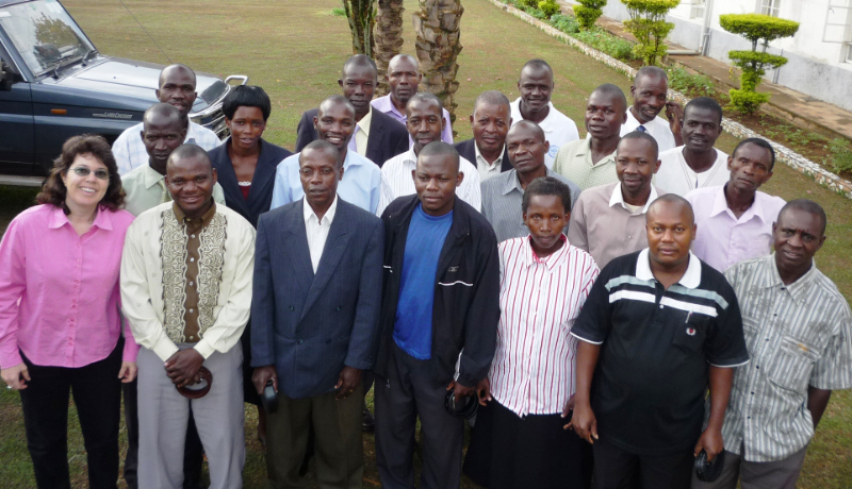
Robin Rempel was born into a family with two siblings. When her parents were young, they wanted to become missionaries to Bolivia, but God closed that door. Instead, her father became a teacher at LeTourneau and later went into business. Robin describes regularly attending church as a child and growing up in a Christian home where grandparents on both sides of the family were believers, and many aunts and uncles met at Bible college.
God called her and her siblings at a young age to be missionaries.
She laughed as she described regularly being “kicked out of her bedroom” when missionaries visited so they would have a place to stay. She didn’t mind though. It gave her the opportunity to meet many people who were serving around the globe. And through that loving and hospitable family environment, God called her and her siblings at a young age to be missionaries too.
Discerning God’s initial leading
As a child Robin sensed that she was supposed to be a missionary to Africa, but then she focused primarily on her education. It wasn’t until a missionary visited her university two weeks before she was preparing to graduate, that God spoke clearly to her heart that she should serve as a Bible translator.
She entrusted her steps to an amazing and powerful God.
She said, “I argued with God because I was fearful about language learning. I was not good at that. But God gave me the same answers He gave Moses when he began making his excuses.” Robin finally responded to God and said, “If you take care of the language issues, I’ll do it.” And that began the improbable journey of her life, as she entrusted her steps to an amazing and powerful God when He asked her to work in an area where she felt inadequate.
Working with many language groups
Initially Robin served for ten years in Papua New Guinea. At that time the primary model for doing Bible translation was for a couple missionaries to incarnate themselves into one language group, learn the language, develop a writing system/alphabet, begin translating the Bible, and start a literacy program (because literacy rates were very low). However, rather than focusing on one language group for many years, Robin’s role ended up being more itinerant in nature.
She worked with 70-80 more language communities in other parts of the world.
She came alongside many different teams, learning, training, and mentoring in more than 50 language groups. After her time in PNG, the Lord sent her to work in East Africa for 15 years with nationals from a couple dozen language communities. In the decade following that, she worked with 70-80 more language communities in other parts of the world.
She said that in Uganda there was a woman she worked with who dubbed her “Mamma of the nations.” Robin described that while serving she has tended toward a bird’s eye view to find ways to very practically empower nationals/insiders to be more independently involved and engaged in the work.
Initial innovations
While moving around the jungles and islands of Papua New Guinea, Robin worked creatively and developed several helpful innovations. One was a simple Alphabet Development Guide, the idea being to encourage local people who had been to school for a few years to try writing and reading stories in their own language.
This gave them opportunities to bump into sounds that they could not symbolize naturally from their exposure to other known languages. From there they could invent and test symbols for their unique sounds and begin to intuitively develop a writing and spelling system more quickly and with more ownership and acceptance than a linguist analyzing an alphabet from the outside.
Robin... innovated a simple, low-cost literacy model for undeveloped languages.
Robin also innovated a simple, low-cost literacy model for undeveloped languages. Reading and writing lessons could be outlined and drafted in just a few days by local writers to teach all the symbols of their newly written language.
Inexperienced locals could be trained in a week, and informal schools with minimal resources could be started which brought hundreds of kids and illiterate adults to read and write their own language in a much more effective manner. Years later Robin learned that people working in other countries and other missions had been using her literacy tool in many contexts around the world.
Fatigue was the mother of invention.
You know the proverb “necessity is the mother of invention.” Robin said, “For me, I think fatigue was the mother of invention.” Living for decades in the tropics, Robin was not spared the typical illnesses and parasites that impact many people. There were some years she was quite ill and battled chronic fatigue. “I think the Lord used those times of weakness to inspire and stimulate innovative solutions and easier paths to involve local people in the work; to more quickly spread His Word.”
The million dollar miracle
She began realizing the potential of apps.
After serving in the field for 30 years, Robin was assigned to work in a media department that provided technical support for Bible translation efforts around the globe. At that time as smart phones were becoming popular, she began realizing the potential of apps.
God gave her an idea for a new type of tool that ordinary people could use to translate, create and distribute Bible story videos even if scripture had not yet been translated into their language, and even if their language did not have an alphabet developed.
She shared the idea with colleagues and programmers both inside and outside of her organization. Many were excited about the idea and how it could work but they didn’t have the capacity to develop it. One software company had a number of Christians who were deeply interested in the impact it could have, but they said it would cost $1,000,000 to develop it.
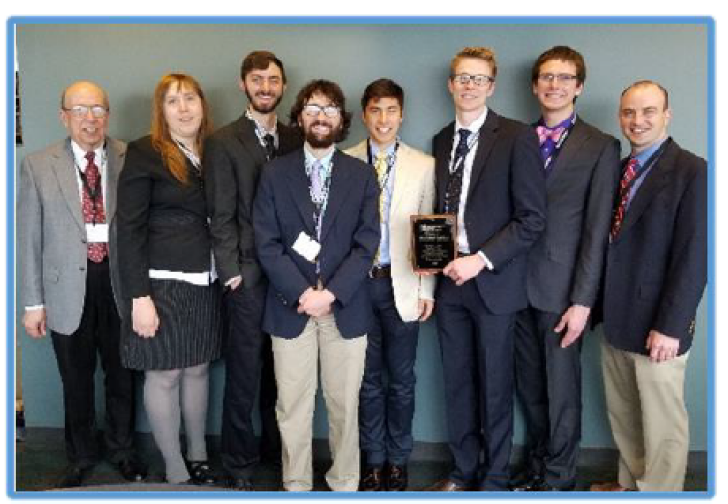
Robin was getting disheartened, but she kept praying that God would make it possible. Then out of nowhere an engineering professor, Dr. Seth Hamman from Cedarville University, contacted someone Robin knew. He was asking if there were any IT projects that his students could work on for their final senior engineering assignment.
That person then linked Dr. Seth to Robin. She shared her detailed vision and Dr. Seth and his students decided to accept the challenge. That school year, those engineering students did amazing, award-winning, million dollar work, and created for free the first functional version of the Story Publisher app (StoryPublisher.website) which makes creating Bible videos in local languages easy for non-techy people to do themselves with nothing but a low-end smart phone.
Another game changing app
After a few years, God gradually and organically put another more complicated innovation into Robin’s heart and mind: an app that would be embedded with everything needed for want-to-be local translators to be able to afford and do a whole Bible translation for their own people, no matter where they lived or the status of their language.
The “Easy To Translate” version of the Bible.
God has connected Robin to all the volunteer geniuses required to make this vision a reality. This includes a software development manager and people skilled to create the “Easy To Translate” version of the Bible from the original languages (e.g. Hebrew, Aramaic and Greek).
She said about the E2T version, “It’s not a natural English translation, but it is easy for creating accurate translations into other languages. For instance, we restrict ourselves from using the word “of” because it is ambiguous and very difficult to translate into many languages.”
It has a transparent workflow process that enables scripture to be aurally translated into a local language, checked, revised, approved, published and distributed all through this one app! It is an open source, user friendly tool that can greatly empower local church ownership in a way that is sustainable from start to finish.
Bible translation is certainly not an easy task to accomplish (and historically it has required many years of training, lots of money, elaborate tools, and extensive equipment). But this app makes Bible translation comparatively very easy and accessible to just about anybody. To learn more visit: https://www.honeybeeobt.com.
Final Thoughts
Often, we think we must be extraordinary people for God to use us, but that is not true. It is not about who we are but rather, who we are following. Robin said, “All these years later when I look back, I don’t think of myself as a remarkable person. I’m normal and average. God has led and provided in ways I never anticipated.
God is the sovereign orchestrator.
I never imagined, with my language phobias, that I would end up working with and touching so very many ethnic groups and language communities. God is the sovereign orchestrator who has brought everything together.” Truly our fears and weaknesses are nothing when placed in the hands of an Almighty God!
Mary Lederleitner has a MA in Intercultural Studies from Wheaton College and a PhD in Educational Studies from Trinity Evangelical Divinity School (TEDS). She has taught as an Adjunct Professor in the graduate programs at both institutions, and currently in the D.Min. Program at TEDS. Mary served for twenty years in a variety of global leadership roles with Wycliffe Global Alliance and SIL Global. She has authored books including Women in God’s Mission: Accepting the Invitation to Serve and Lead which won a book-of-the-year award from Christianity Today in the Missions / Global Church Category. Mary now serves as Associate Professor and Director of the Women’s Institute at William Carey International University.
William Carey International University (WCIU) seeks to provide innovative distance education to enhance the effectiveness of scholar-practitioners as they serve with others to develop transformational solutions to the roots of human problems around the world.