Africa's population has grown more than sixfold since 1950 and is projected to keep expanding through the end of the century — even as growth slows across most of the world — according to a Pew Research Center analysis published last week.
Drawing on United Nations population data, the report finds that the continent currently holds 19% of the global population but is home to 28% of all people under 25. That share is expected to rise sharply in the decades ahead.
Africa's population stood at roughly 230 million in 1950. It has since grown by approximately 1.3 billion people. Under the UN's middle-range projection, the continent's population will reach 3.8 billion by 2100 — though higher-fertility scenarios put that figure as high as 5.2 billion.
The continent's fertility rate of about 3.9 births per woman is currently the highest of any world region and the only one still above the global replacement level of around 2.1 births per woman, according to Pew. There is significant variation within the continent: Chad's rate stands at 5.8 births per woman, while Tunisia's is 1.8. Africa's rate is expected to decline to 2.8 by 2050 and to 2.0 by 2100 — down considerably from a peak of 6.7 births per woman recorded in 1972.
That falling fertility, combined with rising life expectancy, will reshape the continent's age profile over time. The median age in Africa is about 19 today. By 2100, Pew projects it will reach 35.
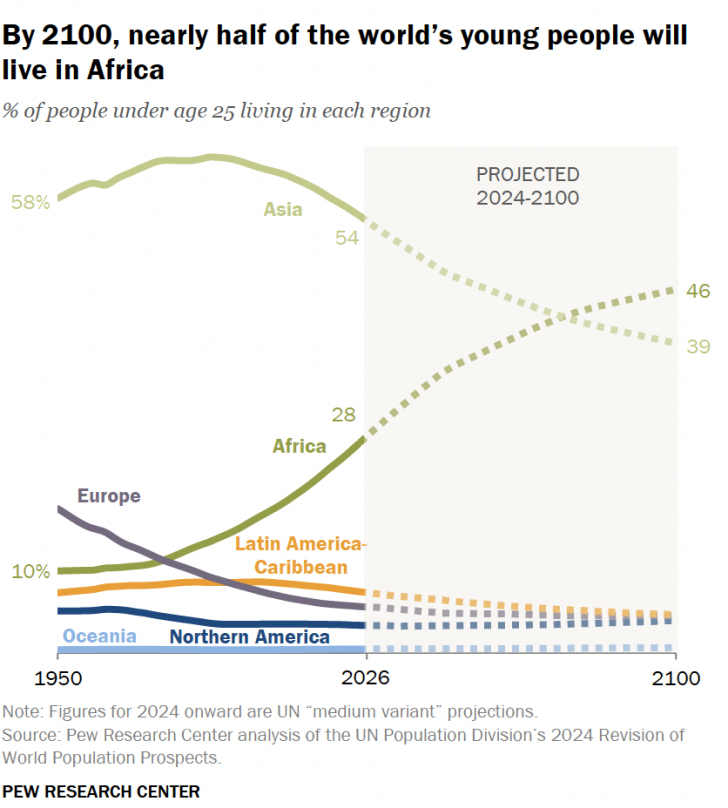
Despite that aging trend, Africa is on a trajectory to become the dominant home of the world's youth. By 2073, the continent is projected to surpass Asia — currently the largest home of young people — in its share of the global under-25 population. By the century's end, 46% of all people under 25 are expected to live in Africa, compared with 39% in Asia, the analysis found.
The demographic shift will also alter the map of the world's most populous nations. Nigeria, currently Africa's most populous country and the world's sixth-largest, is projected to become the fourth-most populous nation by 2100. The Democratic Republic of the Congo, Ethiopia and Tanzania are expected to rank fifth, seventh and ninth, respectively. Altogether, 12 of the world's 25 most populous countries are projected to be African by 2100, compared with six today.
Europe's representation on that list is expected to shrink considerably. Russia is projected to be the only European nation among the top 25 by 2100, dropping from ninth place today to 17th as its population declines. India and China are expected to remain the world's two most populous countries.
Within Africa itself, the proportion of residents under 25 — currently around 60% — is projected to fall to 35% by 2100. The share of adults ages 25 to 64 is expected to rise to 51%, while those 65 and older would grow from roughly 5% of the population today to 15%, according to Pew.
The analysis was published May 19 ahead of Africa Day on May 25, which marks the 1963 founding of the Organisation of African Unity. It is based on the UN's 2024 World Population Prospects, with figures from 2024 onward representing projections rather than recorded data.