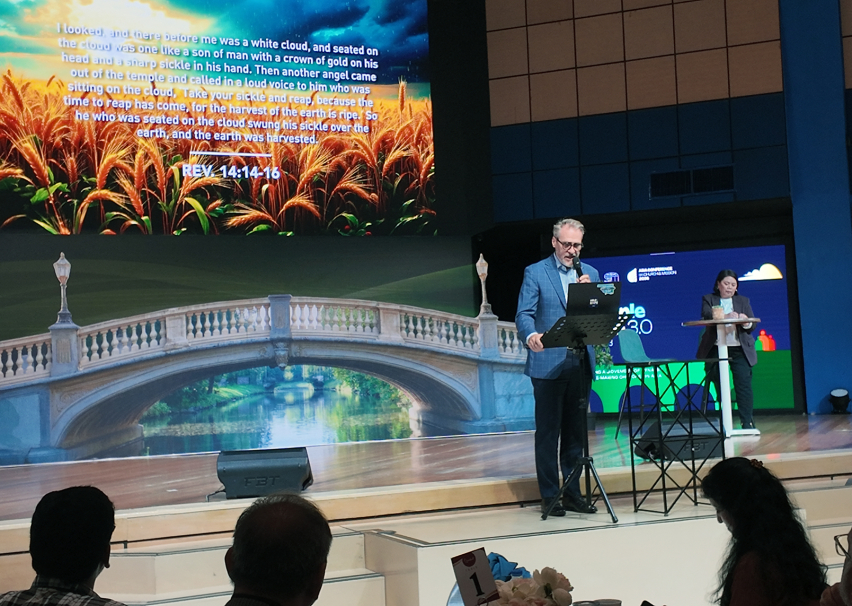
Three major thrusts for accelerating disciple-making across Asia — artificial intelligence, marketplace outreach and the empowerment of young leaders — took center stage during an afternoon panel discussion on the second day of the Asia Conference on Church & Mission (ACCM) 2026, held June 10 at GCF South Metro in Alabang, Metro Manila.
The panel, which drew on presentations by Mark McClendon, Regional Director of the Christian Broadcasting Network (CBN) for Southeast Asia and South Korea; Dr. Andrew I. Liuson, Chairman Emeritus of the Philippine Council of Evangelical Churches (PCEC) and Chairman of Cityland Development Corporation; and Ps. Keith Cote, Next Gen Summit Lead of the Global Leadership Network, addressed how evangelical churches across Asia can move from strategic conversation into measurable action — the stated ambition of this third edition of the "Disciple or Die" gathering.
The conference, organized by the Asia Evangelical Alliance (AEA) with the PCEC and hosted by Greenhills Christian Fellowship South Metro, brings together 210 delegates from 25 nations around a seven-year vision: to see a movement of disciple-making churches across the continent by 2033.
AI as the sickle, the internet as the cloud
McClendon opened the panel with a case for artificial intelligence as a strategic tool for completing the Great Commission, framing his argument through Revelation 14:14-16 — the image of one seated on a cloud, sickle in hand, reaping a ripe harvest.
Drawing on that passage, McClendon argued that the internet functions as the cloud on which the church is already seated, that tens of thousands of satellites now in orbit and rapidly multiplying form a global transmission network reaching every corner of the earth, and that artificial intelligence is the sharp, precise instrument placed in the church's hands at this exact moment in history.
"The entire harvest infrastructure — internet, satellites, artificial intelligence — is not being built," McClendon said. "It's already in place."
He acknowledged the hesitation he sensed among delegates. "I'm not saying AI is holy. It's not holy. I'm not saying that it's not dangerous. It could be." But he pressed the point that in every generation — from the printing press to radio to television to the internet — God had taken tools built for commerce, entertainment and power and placed them in the hands of his church for the sake of the gospel. AI, he said, was next in that line.
McClendon pointed to three concrete applications any congregation could pursue immediately: using AI as a 24-hour discipleship companion for new believers; deploying AI to train members in how to share their faith, study Scripture and mentor others; and using AI to multiply outreach across multiple languages and platforms. He noted that across Southeast Asia alone, AI can now handle seven to ten major languages, with capability expanding every few weeks.
His sharpest challenge was directed at leaders. He said churches had a long history of letting promising tools quietly die on the shelf once initial energy faded, and called on those with authority to formally commission AI for mission, the same way they would commission a missionary. "The greatest enemy is the slow, comfortable drift of good intentions that never become decisions," he said.
McClendon closed with a three-step challenge: gather leadership within the next two weeks to spend one hour exploring an AI discipleship tool together; identify one discipleship or outreach process currently limited by capacity; then make a formal leadership decision to run a 90-day pilot, assigning a leader, setting a goal and measuring results.
Discipleship in the marketplace: reaching the kings
Liuson, speaking from decades of business and church leadership experience in the Philippines, framed the second major thrust around a single word drawn from the apostle Paul's commissioning in Acts 9: kings.
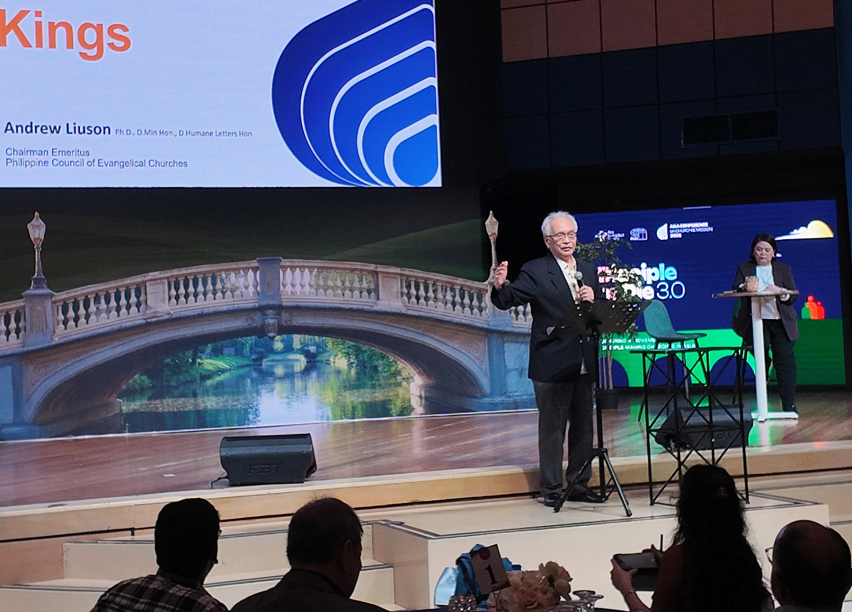
Liuson said he had long focused on the more accessible, the poor, the farmer, those at his own social level, and had largely overlooked the people positioned higher in society. He argued that the Lord's specific mention of "kings" alongside Gentiles and Jews in Paul's mandate was deliberate. "Kings are people who are around us who are more knowledgeable, more influential, more powerful, more educated," he said. "The president of a company is the king in the company. The little mayor in the small town is the king of that small town."
He traced biblical examples, such as Philip and the Ethiopian treasurer, Joseph in Egypt, Daniel and his friends before four successive kings, to show that God had consistently used ordinary people to reach those in positions of power. He then drew from his own story of joining a Manila rotary club in his thirties, deliberately and patiently building relationships with senior businessmen over years through small gestures, meals and eventually the sharing of the gospel through Evangelism Explosion.
Liuson described how that patient consistency eventually opened doors to share with mayors, senators, a vice president and several Philippine presidents. He acknowledged the intimidation that many church members feel at the prospect of approaching influential people and urged leaders to equip their congregations with confidence in their identity as ambassadors for Christ.
"Successful witnessing is taking the initiative to share Christ in the power of the Holy Spirit and leaving the results to God," he said.
Young leaders: bored, gifted and waiting to be trusted
Cote addressed the third major thrust: the next generation. He opened by asking delegates to name someone they were currently building into, calling that question a diagnostic for whether churches were genuinely committed to what they professed.
"I truly believe that the church is the hope of the world," Cote said, "but the hope of the local church is its young leaders."
He described a pattern he encountered among young leaders across the globe: they reported feeling frustrated, tired, stressed and anxious, but the word he heard most often was "bored." Not because they lacked activity, but because no one was calling them to do something significant for God. They wanted to be challenged, entrusted with real responsibility and coached, not managed, entertained or kept waiting until they were deemed old enough to matter.
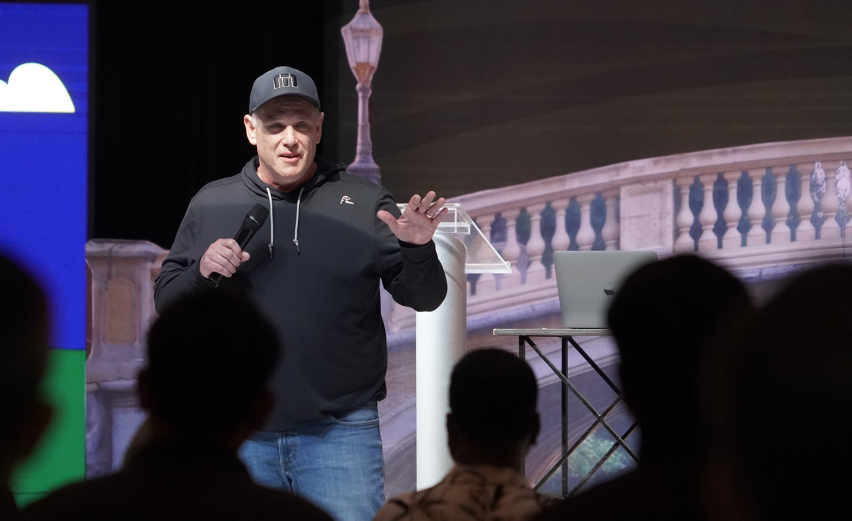
Cote offered seven questions he said every senior leader needed to sit with: Are you modeling discipleship? Are you calling young leaders out by name and letting them know they are needed? Are you releasing them to do things their way rather than requiring your own approach? Are you teaching them in the moment rather than waiting weeks for a formal debrief? Are you functioning as a "wow leader" — one who engages with a young person's idea and helps them work through it — rather than a "how leader" who reflexively explains why an idea will not work? Are you genuinely asking young leaders for their perspective on how to reach their own generation? And are you regularly reminding them of who God says they are — because many, he said, will preach those truths to others while privately dismissing them as inapplicable to themselves?
Cote cited a 23-year-old who now runs global operations for his organization and a 23-year-old from Brazil who leads all Latin American and Caribbean ministry in three languages. Both had been identified and invested in years earlier. He also described an 18-year-old worship leader who had been on the verge of quitting her local church before someone recognized her gifts and gave her real responsibility.
"They don't want to remove you from ministry," he told senior leaders. "They want to be empowered by leaders like you that says, 'Go do it. I trust you. I want to coach you.'"
He closed by pushing back against a consumer model of ministry development. Real investment in young leaders, he said, is not quick or formulaic. "Don't take the easy way. Don't get the McDonald's drive-through version."
From conversation to commitment
The session moderator noted that the three presentations — on AI, the marketplace and youth — together represented what God has placed in the church's hands: a tool, a platform and a generation. The closing question put to delegates was what they intended to do with all three.
The ACCM continues through June 12, with a final day bringing visiting delegates together with an estimated 1,000 Filipino pastors for a joint intensive day on intentional disciple-making.