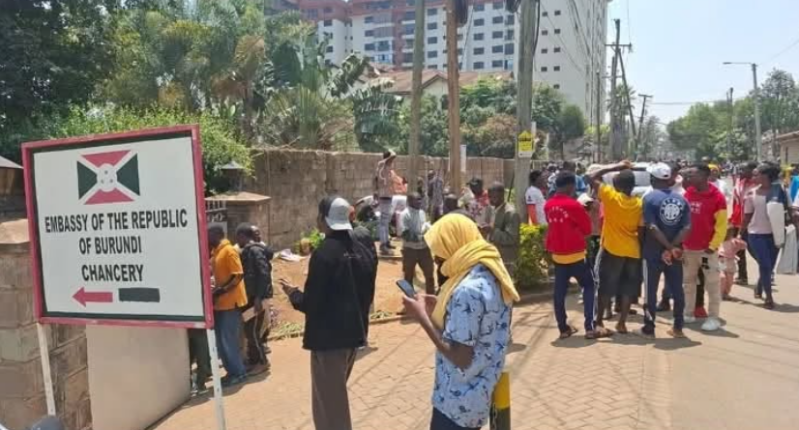
Hundreds of Burundians gathered outside their embassy in Nairobi carrying suitcases and personal belongings, some seeking travel documents to return home after President William Ruto ordered a crackdown on foreign nationals operating small-scale businesses in Kenya.
The directive by Ruto on Sept. 2, said small-scale trading should be reserved for Kenyans. It triggered confusion and fear among foreign traders, particularly Burundians who earn their living through hawking and other informal businesses.
By Monday, Sept. 7, long queues had formed outside the Burundi Embassy in Nairobi as some nationals sought help to leave the country. Reuters reported that some Burundians said they had been threatened and no longer felt safe, while others said they were leaving despite a government offer to regularize their status.In Mombasa a group of Burundi nationals sought refuge at a church, after they experienced harassment, following the directive. Most are now living in fear and are unable to go back to the communities they once called home.
The government later announced a 90-day period for foreign nationals to regularize immigration, work permit and business documents. Presidential spokesperson Hussein Mohamed said the exercise would be conducted with foreign embassies and warned against threats, harassment and intimidation of foreign businesspeople.
Foreign Affairs Principal Secretary Korir Sing'oei also visited Burundians at their embassy and apologized for what he described as a misunderstanding of the president's directive. He said the registration process was intended not only to establish who was working in Kenya but also to help authorities protect foreign residents.
But the episode has already exposed the human cost that can emerge when immigration enforcement collides with informal livelihoods.
Kenya hosts about 35,000 Burundian refugees and asylum seekers, according to the UNHCR. Many are involved in small-scale businesses and hawking in Nairobi and other cities in the country. Some told Reuters they had lived in Kenya for years and were now uncertain about whether they could continue working there.
The reaction among Kenyans has also been mixed. Some small-scale traders have welcomed the president's position, arguing that foreigners are competing for businesses and jobs that should be available to citizens. Others have responded with sympathy toward the Burundians.
Social media has become one outlet for that response, with Kenyans sharing images and accounts of Burundians seeking help and condemning harassment of foreign traders. Musician and activist Octopizzo publicly defended Burundians living in Kenya and called for them to be allowed to live and work peacefully while individuals who break the law are dealt with on a case-by-case basis.
Shrinking liberties for Africans in Africa
The developments in Kenya are part of a broader pattern across Africa, although governments are acting for different reasons.
In neighboring Tanzania, the government has tightened enforcement of rules barring foreigners from 15 categories of businesses reserved for Tanzanian citizens. The restrictions include wholesale and retail trade, mobile money agencies, salons, domestic tour guiding and cargo transportation. The government says the measures are intended to protect local businesses and employment.Just recently, the Tanzanian authorities arrested over 120 Burundian nationals in the country for violating immigration rules. The authorities say that they will conduct more of these raids in the coming weeks.
Kenya's move has now prompted Tanzania to examine whether the restrictions are compatible with the East African Community's Common Market Protocol, which provides for the movement of people, labor and services among member states. Tanzania introduced its own restrictions on foreign participation in certain businesses in 2025.
South Africa offers a different and more severe example of what can happen when migration tensions develop into a humanitarian crisis.
In June, the Association of Evangelicals in Africa joined the Evangelical Alliance of South Africa and the Africa Church Transformation Forum on a fact-finding mission to Johannesburg and KwaZulu-Natal following an unofficial deadline by anti-immigration groups demanding that foreign nationals leave.
The delegation found thousands of displaced people in Durban, including between 6,000 and 15,000 people, mostly Malawians, sheltering at one processing center. It also found 318 displaced Ghanaian nationals, including mothers and children, being sheltered by a church in Kempton Park.
The AEA said the crisis demonstrated the need to protect the dignity of both citizens and foreigners, regardless of their immigration status. Its secretary general, Dr. Master Matlhaope, said every person encountered during the crisis, whether documented or undocumented, was entitled to equal human dignity.
Other countries have also intensified immigration enforcement this year. Uganda detained at least 231 foreigners in April in operations targeting illegal migration, human trafficking and suspected cybercrime. Authorities said those detained included people from several African and Asian countries and were being assessed as possible trafficking victims, offenders or visa overstayers.
In Ghana, immigration authorities conducted an operation in April targeting what they described as exploitative street-begging networks. They rounded up 606 people, including 381 children, and said many were believed to be victims of trafficking or forced begging. Ghanaian authorities emphasized that the operation was aimed at criminal exploitation and irregularities rather than legitimate movement under the ECOWAS free-movement system.
Kenya’s 90-day regularization process now offers a chance to clarify who is legally entitled to work and trade in Kenya while protecting foreign nationals from harassment.