

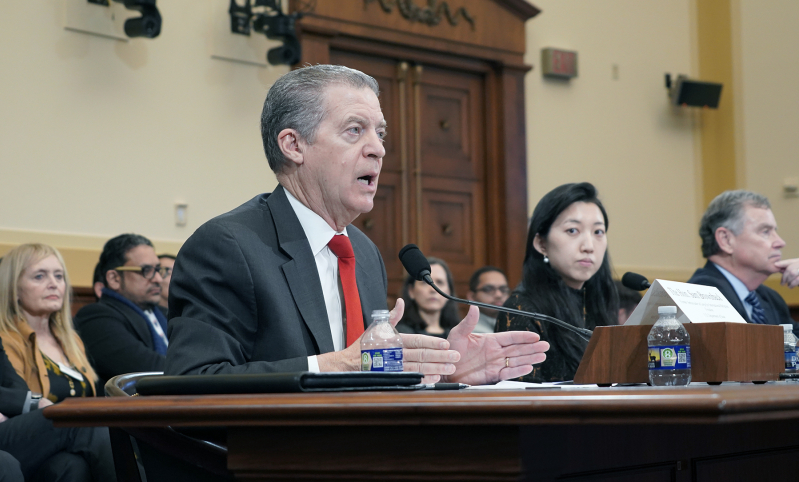
China is helping totalitarian regimes to repress religion around the world, even as the U.S. administration has cut or stalled programs vital for religious freedom globally, officials told a hearing of the U.S. House Foreign Affairs Committee.
At a joint hearing of the Africa and Western Hemisphere subcommittees on Wednesday (Feb. 4) following the International Religious Freedom summit in Washington, D.C., former Ambassador-at-Large for International Religious Freedom Sam Brownback said an alliance of countries has emerged that views religious freedom as the greatest internal threat to their dictatorial control.
“We are seeing something unprecedented really right now in the world, and I’ve been in this work and this space for some period of time,” Brownback said. “This alliance of communist, authoritarian, totalitarian regimes will literally stop at nothing to control people of faith. They see people of faith as a threat.”
This development presents an opportunity to look at religious freedom not as a humanitarian side issue or merely a human right but a major global security issue, he said.
Besides spending billions of dollars this year to suppress every religion within China, the communist regime has invested in sophisticated surveillance technology that it then shares it with other dictatorial regimes, he said.
“The community of faith has become the target of this dark alliance that we’re facing off against, and China is the puppet master behind all of it,” Brownback said. “And we should be deeply concerned about those issues, because that equipment then we’re going to face in multiple sets of countries, and they’re going to use that to maintain the dictatorships, the authoritarians that are standing against us that want to remove the United States leadership and the Western leadership.”
Brownback, who said he and others have written a book on China’s war on faith to be published in May, said the Nigerian government is seeking and/or receiving support from China, Russia, Turkey and Saudi Arabia.
“When the book had been written, it was in 80 countries, the various surveillance technologies and various iterations of it,” he said.
Promoting religious freedom as a bulwark against security threats is the best tool the West has to “go at these regimes and to attack them in return,” Brownback said.
“This is unprecedented – it is really unprecedented, and it’s a dark hour,” he said. “The U.S. and other freedom-loving nations must rise to this challenge that we’re facing today.”
The warning came amid criticisms of the Trump administration approach to religious freedom. Committee member Rep. Joaquin Castro (D-Texas) told the hearing that religious freedom is universal, not the domain of one faith, region or political party.
“Unfortunately, the White House has increasingly pursued a narrow, exclusionary vision of religious liberty, one that prioritizes Christian concerns to the near total neglect of other persecuted groups,” Castro said. “Last February, President Trump issued an executive order vowing to quote, ‘Eradicate anti-Christian bias’ in foreign policy. Discrimination against Christians, where it exists, should certainly be something our foreign policy confronts. To do so when we ignore anti-Muslim violence or the repression of indigenous spiritual traditions is religious favoritism, not religious freedom.”
The State Department in April ordered diplomats to report any instances of anti-Christian bias, excluding bias against adherents of other faiths, he said. Castro added that the State Department made a sweeping overhaul of its work on democracy, human rights, and labor, including explicitly integrating Western values into the mission of the department.
“When I asked them how they defined Western values, the administration defined it as based on Christianity and Christian theological concepts,” Castro said. “This is clearly unconstitutional and in violation of the First Amendment to the Constitution of the United States.”
At the same time, he said, persecuted minorities across the globe have been abandoned.
“The administration has deported members from religious minority communities in Iran back to a regime that imprisons and tortures people of faith,” he said. “It has all but halted public advocacy for the Uyghur Muslims of Xinjiang, ignoring clear evidence of mass internment, forced sterilizations and religious repression.”
The administration has withdrawn support for accountability mechanisms to counter genocide of ethnic Rohingya, a Muslim minority in Burma, and it has revoked temporary protective status for refugees from the country, stating that it’s safe for persecuted Rohingya to be sent back to a regime that has tried to exterminate them, he said.
“This selective silence is not accidental – it reflects a deliberate shift in priorities and it undermines both our credibility and our moral authority,” Castro said.
The policies are in stark contrast to how previous administrations, including the first Trump administration, approached international religious freedom, he said.
“And despite the rhetoric and prioritization of Christianity, the administration has prioritized other interests over protecting Christianity,” Castro said. “How else do you explain the spectacle of Tomahawk strikes in Nigeria in the name of protecting Christians while cutting assistance that would actually address discrimination against religious communities?”
The U.S. administration has taken the unusual step of deciding not to nominate an Ambassador at Large for International Religious Freedom as required by law and instead named a principal adviser for religious global religious freedom to lead the office, he said
“This raises serious questions,” Castro said. “The law is clear. The Ambassador-at- Large has the responsibility to serve as the principal adviser to the president and the secretary of state on matters of international religious freedom.”
The Trump administration is over a year late on releasing the annual religious freedom reports and, apart from Nigeria, has not designated Countries of Particular Concern as required by law, he said.
Committee member Rep. Sara Jacobs (D-Calif.) also noted the administration’s failure to nominate an international religious freedom ambassador, that the 2024 annual International Religious Freedom Report was due last May and that the administration is lagging behind on the 2025 report due in a few months.
“No country should get to cherry-pick what religions they favor or use religious freedom, religious persecution or even a crisis like the rise in anti-semitism
as a shield to discriminate or as a weapon,” she said. “So, while I’m glad that the Trump administration has supposedly shown its support for this issue, I’m concerned this interest will be shallow and narrowly confined to only a small subset of religious freedom issues that match the demographics of their political base. But I hope the administration proves me wrong.”
Jacobs said the administration has eliminated means for helping religious freedom defenders worldwide.
“As part of its foreign assistance review, the administration cut millions of dollars worth of foreign assistance related to international religious freedom,” she said. “For example, Freedom House has reported that the administration terminated its Asia religious and ethnic freedom program that was supporting 4,000 members of religious minority groups facing discrimination and persecution, including Christian minority groups, Uyghurs and others.”
The Trump administration also made cuts to a Non-Governmental Organization that left 400 cases undertaken by religious freedom defenders in limbo, she said.
“This means that this organization could no longer provide life-saving assistance to Afghan women who bravely ran for public office following the U.S. withdrawal, or Iranian journalists who were reporting on human rights violations by Iran’s regime, or Nicaraguan journalists who have been arrested and forced into exile by the regime, and many, many more,” Jacobs said.
In Nigeria, despite the administration’s voiced interest in addressing conflict and religious tensions, it has cut hundreds of millions of dollars in foreign assistance to the country, including assistance to faith leaders and communities suffering violence in the Middle Belt, she added.
“For example, Secretary [Marco] Rubio terminated a conflict resolution program, community initiatives to promote peace that trained religious and tribal leaders in northern Nigeria, which was already showing to be extremely effective at reducing violence in communities,” Jacobs said.
Violence in Nigeria is complex, affecting both Christians and Muslims, and the drivers of this violence are multifaceted and cannot be reduced to a single framing, she said.
“In fact, oversimplistic narratives can further inflame religious tensions in communities, and yet it is clear that President Trump only cares about Christians in Nigeria, and his only real action to address this problem. Military strikes over Christmas have not even done anything to materially help those communities.”
Jacobs asked Stephen Schneck, former chair of the U.S. Commission on International Religious Freedom (2024 to 2025), if he believed the strikes over Christmas effectively improved religious freedom. He said he did not.
“In fact, it it occurs to me that the cost of the Tomahawk missiles that were sent probably exceeded the amount of money that had previously been going to Nigeria to improve interfaith relations and provide humanitarian assistance,” Schneck said. “I suspect really that, you know, strikes like that to the extent that they have any effect at all would likely drive some of these more militant organizations together in greater unity and perhaps mobilize them in the future.”


