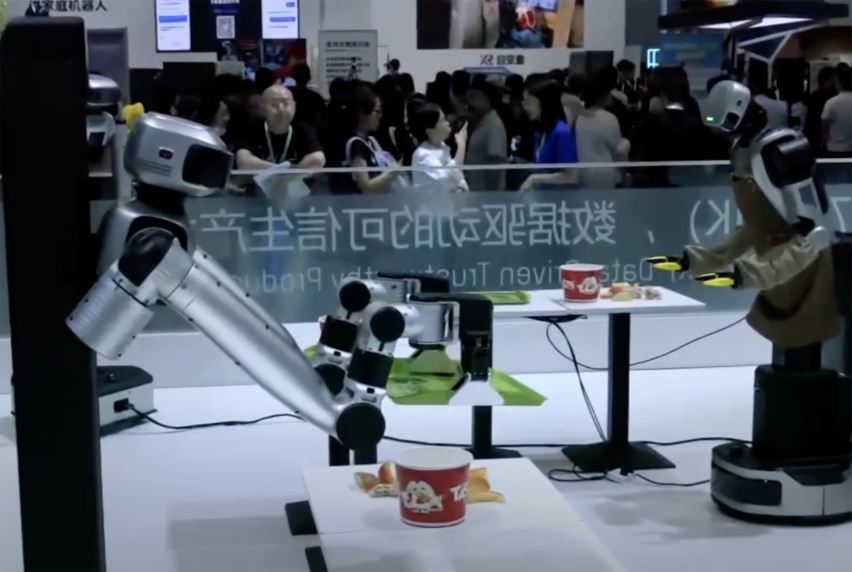
Humanoid robots sorting warehouse parcels, packing smartphones on factory assembly lines and helping with household chores took center stage at a major robotics conference in Beijing this week, as Chinese companies showed evidence that the machines are moving into practical, everyday use.
The World Robot Conference, which runs through Sunday, drew more than 300 mostly domestic companies and featured over 2,000 exhibits, according to reporting by Reuters. The displays reflected a broader shift in the industry: less emphasis on crowd-pleasing acrobatics, more on whether robots can actually do useful work reliably.
At one booth, Robotera demonstrated a humanoid torso sorting parcels. A company representative said the robot has been deployed at China Post logistics sites since last year and is now operating in 15 warehouses across the country. Nearby, Leju showed robots moving and sorting crates, with an official saying European factories and Chinese auto plants were already using them to handle boxes and load components.
DexForce drew attention with humanoid robots packing mobile phones into boxes on a live assembly line — a task the machines have been performing since early this year at a factory supplying Apple and Huawei. The robots work with millimetre-level accuracy and can detect when a phone is placed at an angle and correct it without human intervention.
"In theory, human beings are the most dexterous," said DexForce official Nicole Yang. "But many workers in factories are unwilling to do this kind of boring work."
In homes, the picture is more cautious. X Square Robot, which focuses on household tasks, said its longest real-world deployment has lasted one month. The company is testing robots in hundreds of homes this year, with gradual commercialization planned for next year.
Madison Huang, a senior executive at U.S. chip and software company Nvidia, made an unannounced visit to the conference. She oversees platforms used to simulate and train robots before they are put into physical environments — a step companies are increasingly relying on to prepare machines for unpredictable real-world conditions.
Mike Nielsen, chief marketing officer of RealSense, a U.S. maker of robot vision systems, said the companies most likely to succeed would be those able to move robots into active production settings. "The product cycles for robots are more like six to eight months, not three to four years," he told Reuters.