
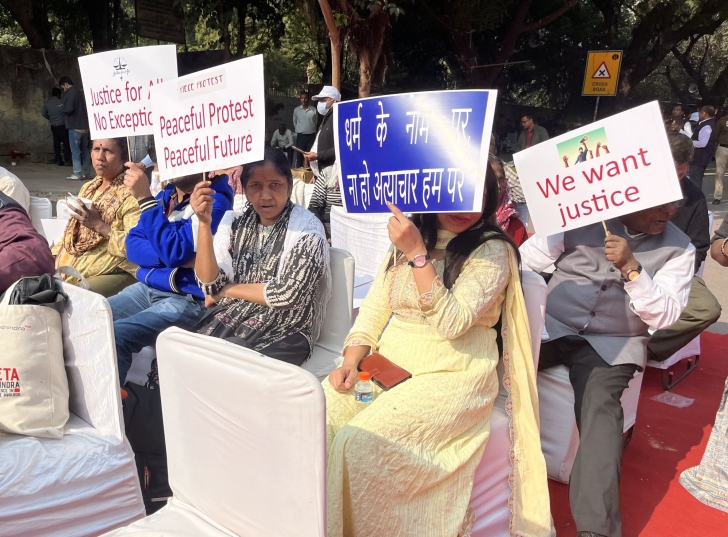
Church leaders, rights advocates and others at the National Christian Convention near India’s parliament building in New Delhi on Nov. 29 presented data showing attacks against Christians have increased dramatically since 2014.
Approximately 2,000 Christians representing more than 200 denominations gathered at Jantar Mantar in New Delhi to voice concerns about mounting violence against their community and call for legal protections under India’s constitution.
With legal experts and interfaith allies also attending, the gathering took place at a designated protest site 1 kilometer from India’s parliament building during the ongoing parliamentary session, which runs through Dec. 25. According to statistics from the United Christian Forum, documented anti-Christian incidents jumped from 139 cases in 2014 to 834 cases in 2024, a 500 percent increase.
The pattern has continued this, with organizations recording 579 separate incidents in just the first nine months. The attacks included destruction of church property, physical assaults on religious leaders and mob violence, frequently accompanied by accusations of forced religious conversions.
Five states account for more than three-quarters of all documented cases over the past decade. Uttar Pradesh, India’s most populous state, leads with 1,317 recorded incidents, followed by Chhattisgarh with 926, Tamil Nadu with 322, Karnataka with 321 and Madhya Pradesh with 319 cases.
Law enforcement’s failure to investigate these attacks remains a major concern. Community organizations reported that police filed First Information Reports (FIRs) in only 39 of the 579 incidents documented this year through September. FIRs are mandatory police complaints required under Indian law before any criminal investigation can begin.
This represents what organizers characterized as a 93 percent “justice gap” between reported violence and official police action. Without FIRs, victims have no legal recourse and perpetrators face no consequences.
“This protest, this gathering itself is a big victory, that people are ready to express their disagreement and raise their voice,” Annie Raja told Christian Daily International (CDI). “That itself is a victory for us.”
Raja, a member of the National Secretariat of Communist Party of India and former general secretary of National Federation of Indian Women, said the gathering demonstrated that efforts to silence India’s people have failed.
Climate of Fear
A coalition of several Christian organizations organized the event under the banner, “Towards a Self-Reliant, Progressive, and United India.” Support came from 22 Christian parliamentarians representing multiple political parties.
“I am sorry that we had to convert a protest into a convention, and that itself explains the amount of fear that the government has been able to sow in the hearts and minds of religious minorities, be they Christians, be they Sikhs, be they Muslims,” veteran journalist and human rights activist John Dayal told CDI.
Dayal, pokesperson of the All-India Catholic Union and member of India’s National Integration Council, said the timing of the convention became prophetic, coming less than a week after the Supreme Court of India upheld the dismissal of Lt. Samuel Kamalesan from military service for professing his Christian faith.
A.C. Michael, convenor of the United Christian Forum and former member of the Delhi Minorities Commission, told CDI the convention’s primary aim was raising awareness.
“Our intention is to create awareness among our own people, and to some extent we have succeeded,” Michael said. “Across India and beyond, people are talking about the issues.”
The convention drew an estimated 1,500 to 2,000 participants from 14 or 15 states, falling short of organizers’ hopes for 5,000 attendees. Michael acknowledged that not highlighting sectarian violence in Manipur state was a major oversight. The violence in Manipur in India’s northeast since May 2023 resulted in hundreds of people killed and more than 300 churches destroyed in clashes between the predominantly Christian Kuki tribe and the predominantly Hindu Meitei community. The lack of focus on Manipur during planning contributed to lower participation from northeastern states.
False Conversion Claims
Recurring accusations of forced conversions that often trigger these attacks were directly addressed at the convention. Michael pointed to a crucial Supreme Court exchange that exposed the lack of evidence behind such claims.
“The Chief Justice of India, on the 1st of September 2022, asked the government of India’s attorney to submit an action-taken report,” Michael told CDI. “The Attorney General told the CJI that Christians are being beaten up because they are conducting forceful conversions. He said, ‘If these are actually taking place, then what action have you taken as government? Submit that report along with a list of people who have been forcefully converted.’ Today, the government has not been able to submit such a list because there is no such list.”
Michael noted that the Supreme Court recently quashed more than 100 FIRs filed on false conversion allegations, most of them from Uttar Pradesh. The cases involved false accusations against Christian leaders and institutions.
Minakshi Singh, one of the key organizers of the convention, told CDI what they hoped to achieve.
“We wish that the atrocities against Christians would stop and that India would once again be known for our communal harmony as in the past,” Singh said.
The Christian population is not growing, according to census figures, yet Hindu nationalist groups keep claiming that forced conversions are happening everywhere, she said.
“We hope that the government will listen to our concerns. This is our eighth protest, but so far there has been no response from the government,” Singh added. “As citizens, we can only appeal to the government, which is what we are doing. What else can we do?”
Systematic Discrimination
Beyond the violence, convention speakers highlighted systematic discrimination that affects millions of Christians based on their caste and tribal status.
The Presidential Order of 1950 continues to deny Scheduled Caste benefits to Dalit Christians and Dalit Muslims based solely on their religious identity. Dalits, formerly known as “untouchables” in India’s caste hierarchy, face severe social and economic disadvantages. An estimated 8 million to 10 million Dalit Christians are denied access to the same affirmative action benefits that Hindu Dalits receive for education, employment and social programs.
The National Commission for Religious and Linguistic Minorities recommended delinking caste status from religion in 2007, but successive governments have not acted on this recommendation.
Speaking to the broader constitutional crisis, Raja told CDI it is “unfortunate that a protest like this has to be organized” in what should be a secular democracy. “The responsibility of the elected government is to ensure all the constitutional rights of each and every citizen, irrespective of their caste, religion, where they belong or even their gender.”
Tribal Christians face similar threats. Christians from tribal areas described intense pressure they face in states rich in mineral resources. In Chhattisgarh, Jharkhand and Odisha states, tribal Christians reported threats of being removed from Scheduled Tribe lists, which provide constitutional protections similar to those for Scheduled Castes. Loss of this status would strip them of land rights, forest access, and educational opportunities, making tribal communities more vulnerable to displacement as mining and development projects expand in these resource-rich regions.
Violence has particularly affected these vulnerable populations. Data presented at the convention showed that in the first nine months of 2025, attackers targeted at least 22 Dalit Christians, 16 women and 15 tribal Christians. Several cases involved sexual violence, forced stripping and attacks on pregnant women.
Decades of Impunity
Dayal placed the current crisis in historical context, tracing a pattern of violence and impunity that spans decades.
“The people who persecuted, the people responsible for the violence, have not been punished,” Dayal said. “Even those who are responsible for killing Graham Staines have been released. The people who persecuted the Christians in 2007 and 2008 are now in power.”
He was referring to the Jan. 23, 1999 death by burning of Australian missionary Graham Staines and his two young sons, the 1998 destruction of 36 churches in the Dangs, and the 2007-2008 violence in Kandhamal, Odisha, where dozens of Christians were killed and thousands displaced. In each case, he said, perpetrators have escaped justice or even gained positions of political power.
“Justice has eluded the Christian community for 75 years of India’s independence, now 77 years,” Dayal said. “We have to pray and work for the Christian heart and mind to exorcise, like the devil, the fear in their hearts, so that they’re brave to speak their minds, to profess their faith, to protest, to ask, to write.”
Anti-Conversion Laws
Legal experts at the convention said state-level laws meant to prevent forced conversions contain vague language that allows abuse. Several states have enacted such laws, which criminalize conversions accomplished through “allurement” or “coercion” without clearly defining these terms.
Convention speakers said these laws have emboldened vigilante groups to disrupt Christian worship services and file false police complaints. Organizers identified Uttar Pradesh and Chhattisgarh as states where such incidents occur most frequently.
The convention heard direct testimony from Christians who faced jail time on false conversion charges. One shared how imprisonment became an opportunity.
“It was an occasion for me to share about Jesus to the jail inmates,” the person said.
Justice F.I. Rebello, former chief justice of the Allahabad High Court, addressed the legal dimensions of religious freedom. He was joined by Archbishop Anil J.T. Couto of Delhi, Bishop Paul Swarup of the Delhi Diocese of the Church of North India, and more than two dozen church leaders representing major denominations including the Evangelical Fellowship of India, the Caleb Institute and the Chhattisgarh Christian Forum.
Several speakers reminded the gathering that Christian institutions have long served India across healthcare, education, and social services, operating facilities that care for people of all religious backgrounds without discrimination. Acharya Sushil Maharaj, national president of Bhartiya Sarva Dharma Sansad, spoke on interfaith dialogue, demonstrating support from other religious communities.
Participants agreed to formalize their concerns in a document titled “The Delhi Declaration 2025.” The memorandum will be submitted to India’s president, prime minister, union home minister, minister for Minority Affairs, and chief justice.
Michael said organizers have requested an appointment with the prime minister.
“Their office said that they will try to get back soon. Maybe in the coming days we will get an appointment,” he said.
Asked about expected government response, Michael was candid. “This government is not known for responding to anything,” he said.
While the full declaration was not made public at the convention, speakers outlined key demands including institutional reforms to protect religious minorities, mechanisms for reporting and addressing violence, police accountability measures, and the repeal or reform of state anti-conversion laws that have been misused to target Christians.
The declaration also calls for legislation to end discrimination against Dalit Christians and protections for tribal Christians facing threats of delisting from Scheduled Tribe status.
The event marked the second major Christian convention in recent years. In February 2023, an estimated 20,000 Christians gathered for a similar event, the first such large-scale assembly in nearly two decades.
The gathering spent the day in prayer, song, folk performances, and reflections that affirmed the community’s commitment to peace, nation-building and interfaith harmony. Participants displayed signs emphasizing India’s secular identity, demanding equal justice for all citizens and calling for the repeal of anti-conversion laws.
International Attention
Christians constitute approximately 2.3 percent of India’s population of 1.4 billion people, making them a small but historically significant minority in the world’s largest democracy. The community has expressed increasing concern about religious freedom and physical safety, particularly following the implementation of anti-conversion laws in 12 of India’s 28 states.
India’s treatment of its Christian minority has drawn international attention in recent years. The country ranks 11th on Open Doors’ World Watch List of countries where Christians face the most severe persecution, a dramatic rise from 31st place in 2013.
Despite the realistic expectations about government response, organizers and participants expressed determination to continue advocating for their constitutional rights. The convention itself, they argued, demonstrated that the Christian community has not been silenced and remains committed to democratic engagement.
The gathering concluded with participants reaffirming their commitment to continue working for justice, equality, and religious freedom within India’s constitutional framework, while calling on the government to fulfill its responsibility to protect all citizens regardless of their religious identity.
International Christian organizations and human rights groups continue to monitor the situation in India, documenting incidents and advocating for the protection of religious minorities in what has long been celebrated as the world’s largest pluralistic democracy.








