When you have a sore tooth and need dental care, do you ask if the dentist is born again before you agree to treatment? Or if your kitchen sink has a leak, do you insist that the work has to be done by a Christian plumber?
Probably not, because your main desire is to find someone who can do the work competently. Of course, you may also want assurance that a dentist or plumber is honest and won’t overcharge you, but I’ve never heard anyone say that Christians fill cavities or fix leaky pipes better than non-Christians.
On the other hand, if your parent dies and you’re planning the memorial service, you will probably seek a Christian pastor to deliver a message, because Christians can offer spiritual support and describe the hope of eternal life better than other people can.
Does it matter whether our public-service leaders are Christians?
Which leads to today’s key question. Are government and politics more like dentistry or more like pastoral ministry? Does it matter whether our public-service leaders are Christians?
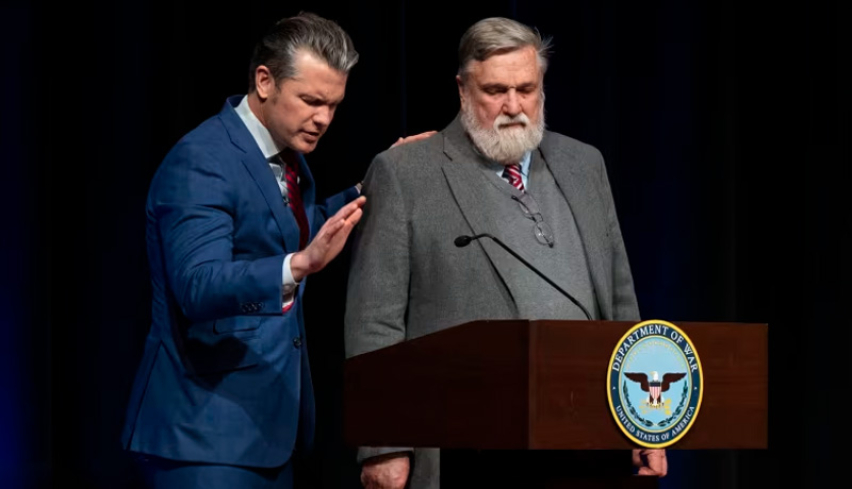
The promoters of dominion theology and the Seven Mountains mandate suggest that Christians are called to take charge of each sector of society: religion, family, government, education, media, arts and entertainment, business.
There are many things wrong with the Seven Mountains idea, but one of the most obvious is the underlying assumption that the spheres of society would function better if Christians were operating them.
A well-trained non-Christian will almost always perform better than a believer who claims some prophetic calling but lacks proper preparation.
Being good leaders in society requires honesty, integrity, and diligence, but it also requires skills that are obtained through education and training. Whether you want to be a public official, a teacher, a corporate manager, or a broadcaster, you’ll do your job better if you are properly trained. In all those fields, a well-trained non-Christian will almost always perform better than a believer who claims some prophetic calling but lacks proper preparation.
The idea of Christians influencing every area of society dates back to Abraham Kuyper, the famous Dutch prime minister who said, “There is not a square inch in the whole domain of our human existence over which Christ, who is Sovereign over all, does not cry: ‘Mine!’”
Furthermore, Christians are often uniquely positioned to contribute good ideas, not just integrity and a servant-like spirit, to politics. Charles Colson, who was sentenced to prison for his criminal activity in President Nixon’s administration, became a Christian while incarcerated and later founded Prison Fellowship. Colson promoted restitution as a positive principle in the criminal justice system, saying he got the idea from Exodus 22.
But neither Kuyper nor Colson envisioned Christians taking dominion in society. Kuyper instead called for principled pluralism, or giving equal treatment to all communities of faith. To this day, the Netherlands funds public and private schools on an equal basis, as opposed to many other countries that fund secular public schools and disadvantage all other worldviews.
Too many Christians today call for domination without competence.
Kuyper called Christians to public service with excellence. Too many Christians today call for domination without competence. The results aren’t usually good, as in Moscow, Idaho, where candidates connected to controversial pastor Doug Wilson consistently lose in elections.
As Christians, we have uniquely valuable spiritual and practical wisdom to offer. But we should not tarnish it by pretending to be experts in areas where we are not.
Responses from Christian political commentator David Koyzis
One of my favorite, widely recognized Christian experts on politics is David Koyzis, whose work I featured on my Substack one year ago. I shared a draft of today’s post with Koyzis and he offered the following helpful comments. (You can also hear Koyzis in a recent interview with Brian Stiller, Global Ambassador for the World Evangelical Alliance.)
I don’t think the faith of our political leaders is altogether irrelevant to doing justice in their respective offices. This is the grain of truth in Christian nationalism and similar movements. However, this is dependent on such Christians cultivating and retaining an awareness of how the several political ideologies work to distort their perceptions of reality.
Adding Christian to nationalism, or to any other ideology, in no way guarantees that it will produce just governance. Sad to say, even otherwise orthodox believers are susceptible to the allure of the ideological visions (or illusions) on offer in the public realm.
Christians who too easily speak of taking dominion have a weak understanding of the structure of politics.
Those Christians who too easily speak of taking dominion have a weak understanding of the structure of politics, which I believe is well articulated by the late British political scientist Sir Bernard Crick in his classic book, In Defence of Politics. Crick defines politics as the peaceful conciliation of diversity in a given unit of rule. In other words, people are different.
They have different material and other interests, and, due to their limited knowledge and to their own faulty perspectives, they disagree with each other over a wide variety of items. This is as true of Christians as of unbelievers.
Politics does not try to eliminate or suppress that diversity but instead constitutes a modest and non-utopian means of ensuring that we can live together amidst and despite our multiple disagreements. This is why we have parliamentary bodies with delegates representing the different perspectives in our polities.
Politics cannot usher in the kingdom of God.
I believe that our faith does indeed have implications for doing justice, but, even as we need to be aware of the distorting influences of the ideologies, we should not pretend that we can rid the world of them in the present age. We have to live with them while maintaining a bold and steady witness to the gospel. Politics cannot usher in the kingdom of God, something that Christian nationalists and the Social Gospellers of a century ago have been slow to comprehend.
Originally published on Bruce Barron's "Gently Provocative Thoughts" Substack. Republished with permission.
Bruce Barron has had a varied career that included investigating the charismatic movement, dominion theology, political campaigning and public policy in the USA. From 2015-2024 he volunteered for the World Evangelical Alliance as a communications aide and was executive editor of the WEA's theological journal from 2018-2024. Among other activities, he directs editorial services for the Society of Christian Scholars. Bruce writes a regular Substack blog, which can be subscribed to here: https://brucebarron.substack.com.