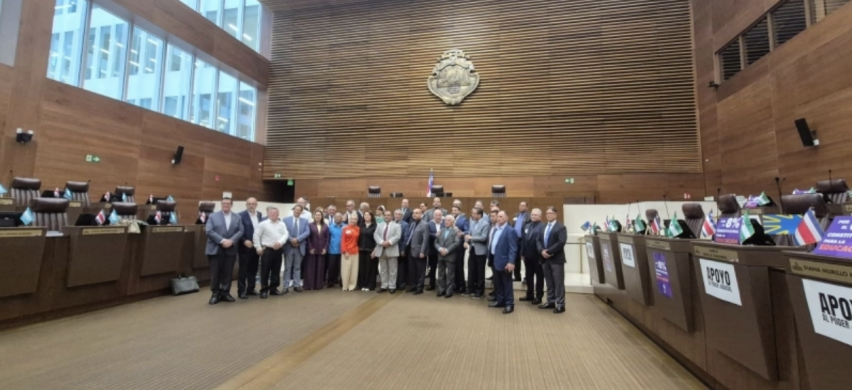
Presidents of evangelical alliances from across Ibero-America met with Christian lawmakers at Costa Rica's Legislative Assembly on Wednesday (Oct. 14) to discuss how evangelicals can shape public policy without bringing partisan politics into the pulpit.
The forum, titled "Called to Govern," took place in the assembly's Hall of Former Presidents during the 13th General Assembly of the Latin Evangelical Alliance (AEL), which concluded in San José on Friday. Leaders of the Costa Rican Evangelical Alliance Federation (FAEC) and the organization Foro Mi País also took part.
Speakers discussed the history of evangelical political participation in the region, cases before electoral and constitutional courts, legislative reforms in defense of life and the need to train Christian professionals for public service. A Costa Rican pastor described written commitments to Christian values signed by the country's president, and recounted being sanctioned by the electoral tribunal over his political work.
The day began with a video address by evangelist and international speaker Alberto Mottesi, who offered a sociological and theological analysis of the growth of the evangelical church in the region and its limited impact on the structures of the nations.
Citing the work of political scientist Samuel Huntington on the factors of cultural transformation in Latin America, Mottesi pointed to the growth of the evangelical movement. He described it through three current theological concepts that he said are setting the course of the continent: revival, reformation and renaissance.
"When I began in ministry, we had the idea that many converted people in a nation were going to transform that nation. And there are countries in Latin America where 50%, without exaggeration, declare themselves evangelical Christians, but we have not seen that transformation. In fact, I firmly believe that we have the most numerous church in history worldwide — not only in Latin America — but at the same time the one with the least social, political and economic influence in all of history," Mottesi said.
A comprehensive vision beyond a single issue
Mottesi said the lack of impact stems from the absence of deep structural changes in society. Although the defense of life has been the main focus of new Christian politicians on the continent, he said, legislation must cover all areas of public life.
"Lately, the new politicians of Christian faith who burst onto the life of their nations raised the pro-life banner; but pro-life is not enough. It is extremely important, but it does not go far enough. We need to carry God's thoughts, God's plans, into every sphere of life. When we look at the Holy Scriptures through these lenses, we discover that God speaks about every detail of life, including politics and government," he said.
He also set out his position on secularism and the role of the state with regard to faith.
"I agree with the separation of church and state or nation, but it is impossible to separate a nation from the source of life, the eternal Creator. We can and must separate the church as it is, an institution, from the government of a nation; but we cannot, must not, and do not have permission to separate a nation from God."
Historical context and political agreements of the evangelical sector in Costa Rica
FAEC President Pastor Ronald Vargas welcomed the international delegations and described the national church's coordinated efforts to have influence beyond church buildings.
"A church cannot be totally isolated from what happens in its communities. The Word says that we are salt and that we are light, and as such we cannot be holding our events within four walls; rather, we have to be part of everything that has to do with the country," Vargas said.
He then gave the floor to Pastor Reinaldo Salazar, director of the Foro Mi País project and pastor of Templo Bíblico.
Salazar gave a broad overview of the Protestant presence in Costa Rica from independence in 1821 to the present. He divided it into stages, from religious intolerance and persecution in the 19th century to the founding of the Costa Rican Evangelical Alliance in June 1950 and the emergence of Christian-inspired political parties from the 1980s onward.
"From 1980 until now, we have been forced to enter into politics not because we wanted to be politicians, but because of the whole historical background of persecution, of intolerance. They would not let us into hospitals to see our sheep who were sick; they would not let us into prisons — I am talking about pastors — to attend to particular cases; they would close churches for any reason. So the evangelical sector made the decision to enter politics, and the first evangelical parties emerged," Salazar said.
He noted that the country's first evangelical lawmaker was elected in 1998.
From legislative activism to commitments with the executive branch
Salazar said that in November 2001 he took part in the founding of the Ibero-American Forum for Evangelical Dialogue (FIDE), the predecessor of the AEL, in Caracas. There, he said, he identified a common gap in the region.
"At the lunches and breakfasts with the presidents, I came to discover a common element: that the evangelical sector wanted to make changes through politics. The problem is that we were brandishing an empty scabbard, because in no country was there any concrete project that had a vision of government for a nation," he said.
Salazar said that between 2006 and 2022, under governments of the National Liberation Party (PLN) and the Citizens' Action Party (PAC), the evangelical sector suffered setbacks on sex education policy, the implementation of the technical standard on abortion, and the approval of same-sex marriage following an advisory opinion from the Inter-American Court of Human Rights.
Unable to reverse these measures through Congress alone or through appeals to the Constitutional Chamber, he said, pastoral leaders decided to seek policy agreements with presidential candidates in the 2022 elections.
According to Salazar, after meetings with the presidential hopefuls in 2022, then-candidate Rodrigo Chaves Robles signed a commitment to halt the gender ideology agenda in the education system and to oppose abortion and euthanasia initiatives. Chaves certified in writing in March 2025 that the agreement had been fulfilled, Salazar said.
For the 2026 election cycle, Salazar showed the Latin American delegates the original document signed by President Laura Fernández Delgado, her two vice presidents and the ruling Pueblo Soberano party’s 57 candidates for deputy.
"This letter of commitment, which you have in your booklet, is a letter of Christian values that came from us. The president signed it, the two vice presidents signed it, and the party's 57 candidates for deputy signed it, in which they committed that their entire government during these four years would be on the foundation of these Christian values," Salazar said.
He added that in August the party, which holds 31 seats in the assembly, formally incorporated those principles into its statutes.
Electoral restrictions and inter-American jurisprudence
Salazar also described the legal consequences he faced after he was reported to the Supreme Electoral Tribunal (TSE) for distributing the booklet on those agreements among pastors.
Article 28 of Costa Rica's Constitution prohibits political propaganda that invokes religious motives. But Salazar said the TSE did not sanction him under that provision. Instead, it argued that his leadership among pastors "enhances his capacity to influence and persuade electoral behavior, which constitutes undue interference in free electoral self-determination."
The Constitutional Chamber, known as the Sala Cuarta, rejected four amparo appeals — petitions for the protection of constitutional rights — on the grounds that the matter fell under the TSE's exclusive jurisdiction. His lawyers proposed taking the case to the Inter-American Court of Human Rights, but Salazar decided to stop the litigation there.
"That's where we stopped everything. That's where I stayed. Why? Because if the Court, which is woke, which is progressive, rules saying, 'Yes, the conviction of that pastor stands,' it's not affecting me: it is going to affect all the pastors on the continent. And so we said, 'No, we are not going to do that,'" Salazar said.
Leadership, character and service from parliamentary seats
Ruling-party lawmaker Gonzalo Ramírez then gave the keynote address, titled "Who decides the future when good leaders do not participate?" Ramírez is a lawyer, a former president of the Legislative Assembly and the author of the book Llamados a gobernar (Called to Govern).
Pointing to an empty chair in the hall, Ramírez reminded the alliance presidents that Costa Rica's parliament is unicameral and has only 57 seats.
"I ask: if Gonzalo had not participated in 2014, and the Christian sector had not participated by supporting Gonzalo, would the seat Gonzalo would have occupied have stayed empty? No! Someone was always going to fill it. Because whether or not you participate does not interest them; what interests them is that their people get in. And if there are no people reaching those places with a right heart, who is going to get there? People with perverse hearts," he said.
Preserving rights and training new generations
Ramírez warned that civil and religious liberties are lost gradually when Christian citizens stay out of decision-making spaces.
"Rights are gained little by little, but rights are also lost little by little," he said.
He said that during a course on civil and religious liberties at the University of Oxford, his own election as president of the Costa Rican Congress was presented as a case study of a public official challenged solely for coming from the evangelical Christian sector.
Ramírez presented a four-pillar framework for public engagement: character as the foundation, influence as the bridge, service as the method and transformation as the goal. He defined transformation as "lasting positive change."
"Leadership does not begin with the privileges of a position, but with the willingness to take on responsibilities that others prefer to avoid," said Ramírez, who urged pastors to prepare the next generation for public service.
"If God called you to be a pastor, blessed be God. But there are others around you whom God may well have called to be in positions of influence. What are you doing to prepare them, equip them, train them and send them? What are we doing so that they go and represent us and take these seats that are not going to stay empty?" he asked.
Constitutional reforms and defense of life in the plenary
Three other Costa Rican lawmakers from the legislative bloc aligned with Christian principles described the bills they are promoting in the Legislative Assembly.
Deputy Kattia Mora described entering public service without a previous political career. She said congregations should encourage their members' academic preparation so they can hold positions of national importance.
"We have already presented proposals for constitutional reform on the issues that matter to the sector: life, family, protection of life. In fact, we presented the reform to Article 21: 'Human life is inviolable.' The one we have now puts a period there; we put a comma, adding: 'from conception to natural death,'" Mora said.
"Politics is not of the devil; politics is an area where we can exert influence with responsibility, with wisdom and with the fear that comes from heaven," she added.
Cindy Murillo, a deputy for Guanacaste province and chair of the International Affairs Committee, spoke about her call to legislative service.
"Four years ago I walked in through those doors, and the first thing I did was look up to heaven and say to him: 'Lord, if it is for me, in four years, if you so will, help me to become a deputy of the Republic to serve you, the Scriptures and the people of Costa Rica.' And God spoke to me, and today I am a deputy of the Republic. That is why I fear God; I serve him, my family and this country," she said.
Deputy Gerald Bogantes, vice president of the National Front for Life (Frente Nacional por la Vida) and a former member of the youth commissions of the AEL and the FAEC, spoke about bills to protect life in the Penal Code and the group's role as a check within Congress.
"Something that really strikes me is that the other deputies who perhaps are not from the evangelical sector notice in us — perhaps a mini-caucus, a mini-group — and they know that here, in these four years, not a single anti-life, anti-family or anti-religious-freedom bill is going to pass, because our convictions give us that clarity," Bogantes said.
The position of the Latin Evangelical Alliance and the World Evangelical Alliance
Closing the presentations, AEL President Pastor Juan Cruz acknowledged the progress described by the Costa Rican delegation. He set out the position the region's evangelical alliances hold on political training and on keeping partisan politics out of churches.
"We always talk with the presidents about reading the times well, understanding the times. And yes, one thing we agree on is forming people, training them. What we are always careful about is not bringing partisan politics into our churches, because that is where we believe we could run a dangerous risk, as happens in some countries and we later regret it, because when the elections are over, the one who suffers is the people," Cruz said.
He said church members and pastors have different callings, and that representative bodies have a guiding role.
"Within the churches there are spectacular professionals who have the calling to serve the nation. Well, the pastor has a different calling: to preach the word, to form people... We, from the evangelical alliances, are going to take care of the alliances; we are going to motivate the people to go and vote according to their principles and values; but you are not going to find any alliance issuing a statement saying 'vote for such-and-such candidate or vote for the other one.' At least we don't get into that; that is very clear for us. But we are going to tell people: vote for people who defend life, the family, principles, values, religious freedom — and that is the path of the evangelical alliances."
World Evangelical Alliance (WEA) Secretary General Botrus Mansour, a native of Nazareth, Israel, then spoke to the lawmakers and the national alliance presidents.
"I believe that being a Christian political believer is something very important. And if God is in it, and if you truly represent God, you can make a great difference not only in your country but for the whole continent. We have been called to be salt and light in our families and, of course, also in our churches, in small communities; but if God has also called you to make a difference in the country as a whole, that will be a great blessing for the whole country," Mansour said.
He said caring for the family and legislative work in Congress are both part of the same service to the kingdom of Christ.
Original reporting by Diario Cristiano, Christian Daily International's Spanish edition.