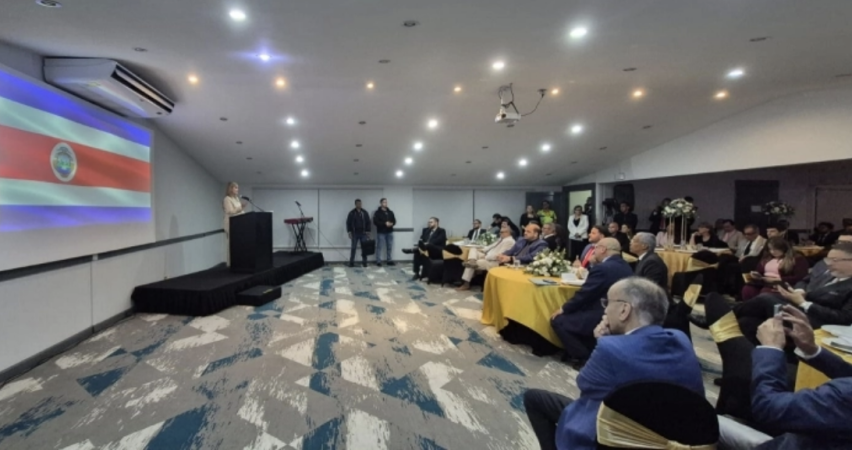
Costa Rican President Laura Fernández Delgado told evangelical leaders from across Latin America on Monday that she placed her country "at the feet of Jesus Christ" when she took office and that God brought her to the presidency to fight organized crime.
Fernández, who is Catholic, gave the opening address at the 13th General Assembly of the Latin Evangelical Alliance (AEL) in San José. Delegates from 22 Ibero-American countries attended. The AEL's member alliances represent more than 160 million believers, according to its president, Juan Cruz Cellamare.
In a lengthy and personal speech, Fernández spoke about her faith, her reliance on prayer and her pro-life convictions. She also pledged that Costa Rica would maintain "absolute freedom of worship" while her government pursues "a strong values agenda — and not just any values: Christian values."
Also present were the AEL board of directors, led by Cruz; leaders of the Costa Rican Evangelical Alliance Federation (FAEC), including its president, Pastor Ronald Vargas Badilla; World Evangelical Alliance (WEA) Secretary General Botrus Mansour; and Jorge Gómez Varela, AEL vice president and a WEA international board member.
'It is Jesus Christ who has me here'
Gómez Varela introduced Fernández, saying she has not been ashamed of the Gospel in more than two decades of public life. She began by responding to that introduction.
"Don Jorge: How could I feel ashamed to speak about the Gospel, or how could I feel ashamed to say that I am a person of Christian principles and values, when it is Jesus Christ who has me here?" she said. "That would be absolutely unthinkable for me as President of the Republic, since it is so clear to me that the one who decides where I am, where I will be and everything I have lived through is the Lord alone; and not just any Lord: the King of kings and the Lord of lords, Jesus Christ, our heavenly Father."
Fernández said she dedicated her government to God from the start.
"From the moment I took office as President of the Republic, I placed Costa Rica at the feet of Jesus Christ. There has not been a single day as President of Costa Rica when I have not felt the presence of God in my life and in the office I hold," she said.
She also recalled her recent participation in a Bible Day commemoration at the Legislative Assembly, where she described Scripture as a reference point for those who govern.
"To recognize in the Holy Scriptures a book of governance, to recognize in the Holy Scriptures road maps that have led kings and rulers to success and to failure throughout human history, is not to speak about religion: It is to speak about a truth that is within reach of anyone who wants to read and understand it," she said.
Fernández said she turns to prayer when facing difficult decisions of state.
"When I have a particularly difficult challenge ... I always say: 'My God, here I go. Hold my hand tight, dear God, because here I go and I am going to take this step,' which is difficult, which is complex, but I always manage to find that small moment of intimacy to place myself in His hands."
The fight against narcoterrorism
Fernández said she prays to be useful to the country. "I always say to Him: 'My God, I am an empty vessel and I want you to fill me. Fill me, tell me where to go, how I can serve you, what more I can do, how I can please you even more.'"
She described the main battle of her administration in both practical and spiritual terms.
"God brought me here to fight to banish narcoterrorism from Costa Rica, to banish organized crime. So that Costa Rica does not become a paradise for organized crime," she said.
"And that is no ordinary fight. And that is not a fight against people of flesh and blood like us. That is a much heavier battle that we have to wage united. But I am waging it with a heart that beats very strongly, because I am certain that it is a war we can win with God's help and the work of all our teams."
She asked those present for prayer, saying it matters more to her than gifts or honors.
"When they give me flowers or give me a very beautiful Bible — I have some gorgeous Bibles — or give me some award, I always tell them the same thing: 'Thank you very much, but give me prayer. Give me prayer.' That is the most important thing you can give me."
Pro-life commitment and national sovereignty
Fernández recalled her years of activism in civic pro-life groups and her opposition to what she called "gender ideology."
"We were from the pro-life groups, from the groups that were fighting against gender ideology, those of us who have always dreamed of a constitutional reform that recognizes that human life begins at natural conception and ends at natural death ...
"At first, when I put this before Him, I said to Him: 'Oh, Lord, this is a lovely opportunity I am going to have to straighten out a whole lot of things in Costa Rica.' A whole lot of things that I had talked about with don Ronald, with don Jorge, with many of you for a long time: gender ideology, the issue of our children, who are so sacred, the issue of our children starting to be asked whether they are an 'elle,' a 'he' or a 'she' ...
"Things about which I would say: 'If I were president, I would fix all of that.' The United Nations, which at times wants to impose itself on the sovereignty of countries with progressive woke criteria and other things besides ... to set right the course that progressive and even leftist governments steered us onto for a time."
"Elle" is a gender-neutral pronoun used by some Spanish speakers.
Fernández said that resolving these issues in the first weeks of her government led her to reconsider her mission.
"A month after we resolved that ... — and it's not that there isn't still road to travel, because there always is — but you know, I have thought: 'My God, did you bring me here for a task I could complete in a month? I don't think so.' And it was a big challenge and it needs follow-up, certainly, but now you and I can breathe very easy about that, right?
"So ... after much reflection on that, I found a new purpose in my calling to presidential service, because this is a service, like the one you provide. This is a calling to public service, using politics as an instrument to achieve human dignity and the common good."
Catholic faith and religious freedom
Fernández said she sees no conflict between her Catholic faith and praying with evangelicals.
"I am not evangelical; I am Catholic. And for me, being Catholic has never meant that I cannot pray with an evangelical brother," she said.
Responding to people who question why she joins evangelical leaders in celebrations and prayer while attending Mass, she said: "I have always believed that any path that leads us to Jesus Christ, to working and to being people of values, of faith, good Christian people ... I believe you can go to Jesus Christ by road, you can go by boat, you can take a plane; perhaps someone takes a longer, steeper route, but as long as the path leads us to Him, to His truth, to what He expects of us, leads us into a spiritual communion of doing good and giving ourselves for our neighbor, of loving one another, of respecting one another, I believe the paths that lead us to Him should be what divides us least and what most seeks to unite us."
She also spoke about her commitment to vulnerable communities and her practice of working with them directly, outside the presidential office.
"I am a person who is never, ever ashamed of her faith, and who, in this position to which the Lord brought me, will do everything within my reach so that the people of Costa Rica ... have better conditions to live with love, as families."
Fernández acknowledged the work of churches in social projects, including Proyecto Abraham (Project Abraham), and restated her government's position on freedom of religion.
"Costa Rica's doors are wide open to support the Church's various missions. This is a country where we have absolute freedom of worship, absolute respect for freedom of worship, where there is no persecution on the basis of religious creed, and in addition, as long as I am President of the Republic, we will continue to drive a strong values agenda — and not just any values: Christian values."
'Whom do I want to please?'
Fernández shared advice Gómez Varela gave her privately during a lunch at Casa Presidencial. She said she now uses it as a rule for difficult decisions.
"Don Jorge told me something, and I have told it to a whole lot of people since that day: 'When you are unsure about a difficult decision you have to make, think about whom you want to please with the decision you are going to make. Whom do you want to please with your decisions?'"
She told the evangelical leaders how she applies it:
"Faced with any question about a difficult decision to make: Whom do I want to please? Jesus Christ and the people of Costa Rica. Whom do I serve? Whom do I serve in this position? Whom do I want to please? Whom do I want to serve? A business group? No. A TV channel? No. Economic groups in Costa Rica? No. Magistrates? No. Whom do I truly want to please as a public servant? And of course — I'd have to be a fool otherwise, when I have an eternal life to look after. Well, of course!"
Family origins and public career
Fernández, a specialist in public policy and democratic governance, reviewed her career. She said she worked on state reform projects from an early age, directed parliamentary advisory services at the Legislative Assembly and worked in municipal government. She described these stages as preparation guided by God.
She said she comes from a family with no ties to traditional politics.
"When the opportunity came to me to be a candidate for the presidency of the Republic — I am the daughter of a retired educator; no one in my family is involved in politics, much less electoral politics. My father is a pensioner; he was a farmer, a construction businessman, he had a tiny family business — what I want to tell you with this is that my family's wallet was not big enough to sponsor an election campaign for some curious daughter or one with that professional calling.
"But when the opportunity came to me to be the candidate for the presidency of the Republic, of course the first thing I did was to take it to prayer, because it is an enormous decision, a complex one to make, at a complicated moment."
Fernández noted that she is the second woman to serve as Costa Rica's president. She said her husband, Jeffrey, has joined the small group of 13 first gentlemen currently serving around the world.
Reaction from regional evangelical leaders
After the address, Cruz thanked Fernández for attending. He said the AEL brings together 24 national alliances and fellowships in 22 countries, representing more than 160 million believers and more than 400,000 local congregations.
Cruz said churches serve in neighborhoods, prisons, hospitals and schools, generally without state funding, and that pastors are willing to work with civil authorities for the good of society. He encouraged the president to persevere, citing Joshua 1:9.
Vargas Badilla, the host pastor, thanked Fernández for making room in her schedule. He asked the international delegations to hold a week of continuous prayer for the presidency and for peace in Costa Rica.