
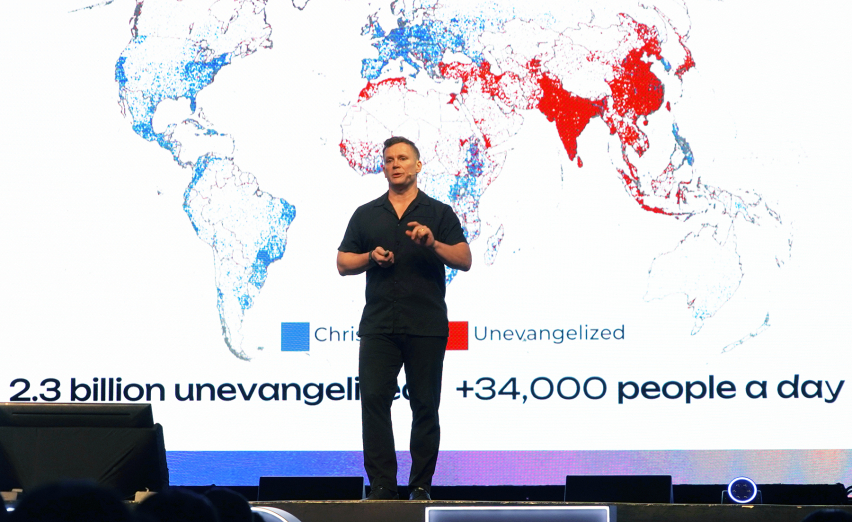
The Great Commission will not be finished at the rate the Church is currently working, Jason Mandryk told approximately 4,000 young Christians gathered for the Arise Asia 2026 Congress Tuesday morning (July 28) — and the numbers, he said, make that conclusion unavoidable.
Mandryk, a Canadian citizen living in South Korea who serves as editor of Operation World, the global prayer guide tracking the state of Christianity in every nation, opened the second day of the congress with a data-driven survey of the unfinished task. His address drew on statistics from the World Christian Database, Operation World, and the Joshua Project to argue that the Church needs to rethink the scale of its missionary effort — and then offered reasons, grounded in the same data, to believe that transformation is possible.
"Data is my love language," Mandryk said near the opening of his address, and he proceeded to spend the better part of an hour making good on the claim.
A gap that keeps widening
The first number Mandryk put before the congress was one that, he acknowledged, many in the room might already know. More than two billion people alive on earth today — 28 percent of the global population — have no meaningful access to the gospel. They have never heard the name of Jesus in a context where they could respond.
But the raw percentage understates the problem. Because the world's highest birth rates are concentrated in its least-evangelized regions, the number of unevangelized people is not shrinking. It is growing. Every day, Mandryk said, 34,000 more people are born into a world where they will not encounter the gospel.
"Trying a little bit harder isn't going to get rid of that deficit," he said. "We need to conceive of mission in an entirely new way, and we need to mobilize the whole Church to be part of the Great Commission."
Mandryk traced the trajectory across two millennia. In 50 AD, approximately 99.9 percent of humanity had not heard the gospel — the Church was barely a generation old. By 1960, that figure had dropped to 50 percent. By 2025, the most current data puts it at 28 percent. The progress is real. But the complication is that the raw number of unevangelized individuals has moved in the opposite direction: from 250 million at the time of the New Testament, to 1.5 billion in 1960, to more than 2 billion today.
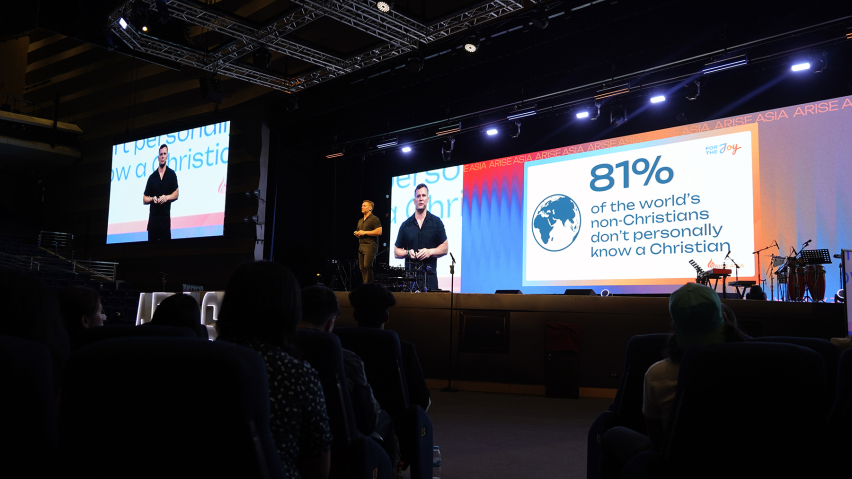
The social geography of that gap is also stark. Eighty-one percent of the world's non-Christians, Mandryk said, do not personally know a single follower of Jesus. No Christian friend, no Christian colleague, no Christian family member. "The vast majority of people who become followers of Jesus do so because of a personal relationship with another Jesus follower," he said. "And yet the majority of those who aren't Christian don't know a Christian."
Where the need is concentrated
Mandryk showed a map dividing the world's unevangelized billions by region. The Americas account for only 12 million. Europe has roughly 30 million. The Pacific, 1.4 million. Africa jumps to more than 300 million. Asia accounts for 1.8 billion — alone representing nearly the entire unevangelized population of the world.
The most populous country in the world has 600 million people who have not heard the gospel. The second most populous has 500 million. "Just those two countries by themselves represent over a billion people who are still waiting to hear about Jesus," Mandryk said.
He then pointed out that the large majority of delegates in the room came from within the region he was describing. "Arise Asia therefore is one of the most strategic conferences in the world today," he said, "because we're mobilizing a new generation to go where there is no gospel — and that is mostly inside that circle, " as he pointed to Asia on his slide.
Among the world's unreached people groups, defined as communities where the Church has not grown large enough to evangelize its own members without outside help, the same pattern holds. India alone has by far the largest number; China, Pakistan, Bangladesh, Indonesia, and Iran together account for hundreds more.
The testimony problem
Mandryk spent a portion of his address on a challenge that, he said, has less to do with geography and more to do with how Christians present themselves to the world.
He cited recent research from the Billy Graham Evangelistic Association surveying Americans who do not attend church, focusing on younger demographics. The study found that the majority of those respondents were put off from engaging with Christianity because of the faith's association with a particular political figure. Mandryk insisted his point was not about politics as such, but about perception.
"The bottom line is that if our politics and the way that we communicate that puts up a barrier between people and encountering Jesus, then we really need to reexamine our hearts," he said. "This is not an ethical or a moral or a policy issue. This is a gospel issue."
He drew a contrast with the early Church. Quoting the early Christian theologian Tertullian, who wrote a defense of Christianity while it was still being actively persecuted by Rome, Mandryk cited the observation that pagans were drawn to the faith by watching how Christians treated one another: "See how they love one another and how ready they are to die for one another," he quoted Tertullian as saying.
He also recounted a story from roughly a century and a half later, during the reign of Julian the Apostate. When plague spread through cities and pagans fled, Christians ran toward the sick to care for those who had been abandoned. Christians had already become known for rescuing infants left to die of exposure by parents who did not want them, raising those children in their communities. Julian, Mandryk said, found this behavior so confounding — and so politically damaging to paganism — that he complained to his own priests about it.
"The Church grew in these centuries because of its fearless testimony to Christ, because of its love for one another, and because of its willingness to run into places of risk in order to demonstrate with their very lives the love of Jesus," Mandryk said.
Where the money goes
Mandryk cited another data point that he described as sobering. Of all giving by Christians — tithes, offerings, church contributions — only a small fraction of one percent reaches missionaries working among unevangelized peoples. By comparison, he noted, Americans spend more money annually on Halloween costumes for pets than the entire Christian world gives to frontier mission.
He connected this to a pattern he traced back more than two centuries. When a young William Carey raised the question — in his Baptist church in England in the late 1700s — of what Christians owed to those who had never heard the gospel, an elder of the church told him to sit down. "When God pleases to convert the heathen, he will do it without your aid or mine," the elder said.
"I thank God that William Carey did not sit down," Mandryk said. The movement Carey helped spark has since contributed to hundreds of millions of people hearing about Jesus, beginning with Carey's own decades in India.
Today, Mandryk said, roughly 15,000 long-term missionaries serve cross-culturally among unreached people groups. By his calculations, if every new missionary to such groups were responsible for reaching 50,000 people during their tenure, the Church would still need 75,000 additional workers — five times the current number — to cover the remaining unreached peoples. "The order of magnitude of need," he said, "is just staggering."
Reasons for confidence
Mandryk shifted, in the second half of his address, to evidence that the gap can be closed.
He pointed first to the quality of information now available. When Carey wrote his landmark 1792 pamphlet — one of the earliest surveys of global religious populations — he was working with a handwritten table of nations using place names that are barely recognizable today. Contemporary mission researchers now have access to detailed data on every country's religious demographics, church presence, and language groups, compiled by organizations including the World Christian Database, Operation World, and the Joshua Project.
Digital access is accelerating change in ways that Carey could not have imagined. Seventy-four percent of the world's population is now connected to the internet, Mandryk said. People in heavily restricted contexts — where asking a Christian neighbor about Jesus could result in violence or expulsion from one's family — can now explore the gospel privately, through social media, through apologetics channels, and through online Scripture tools available in hundreds of languages.
Among Muslims especially, Mandryk said he believes the combination of prayer and digital access is producing a historic shift. He cited a statement by a prominent Muslim leader who used the phrase "avalanche of apostasy" to describe the number of younger Muslims leaving Islam after researching it online. Several well-known apologists — including figures active on YouTube and social media — have reached Muslim audiences in ways that traditional outreach could not.
He also pointed to the spread of church planting movements and disciple-making movements: rapid multiplication networks operating outside conventional denominational structures, where new believers are immediately incorporated as evangelists. These movements, Mandryk said, are growing most quickly in historically unevangelized regions — the Muslim world, the Hindu world, and communities shaped by animist belief.
Diaspora communities add another layer. With more than 300 million people living outside their birth countries — a number that Mandryk noted includes himself (born in Canada, many years in England, now in South Korea) — the opportunity exists for believers from the Global South to carry the gospel back to their own unreached communities, through in-person witness, through return migration, and through digital media that reaches diaspora members worldwide.
"When we love one another in Jesus' name among the nations," Mandryk said, describing international mission teams made up of believers from Australia, Korea, Brazil, and Germany serving together in some parts of Asia, "there may be no more powerful way to convey the gospel."
The burden belongs to the Lord of the harvest
Mandryk closed with a word about where the weight of the Great Commission ultimately rests, emphasizing that it is not with the people in the room.
"We don't need to be distressed by the fact that 34,000 new unevangelized are being added every day," he said. "We don't need to be anxious about the reality of the thousands of unreached people groups still around the world today. Why? Because he is the Lord of the harvest and he will do it. And we just have the privilege of saying our ‘yes’ to God in order to be part of his story."
He listed the many forms that participation might take: going physically to a place where no church exists, engaging unreached communities through digital platforms, praying, giving, or equipping those who go. "The burden doesn't fall on us," he said. "Only the joy."
Arise Asia 2026 continues through the week in Manila.
Follow Christian Daily International's full reporting on Arise Asia 2026.








