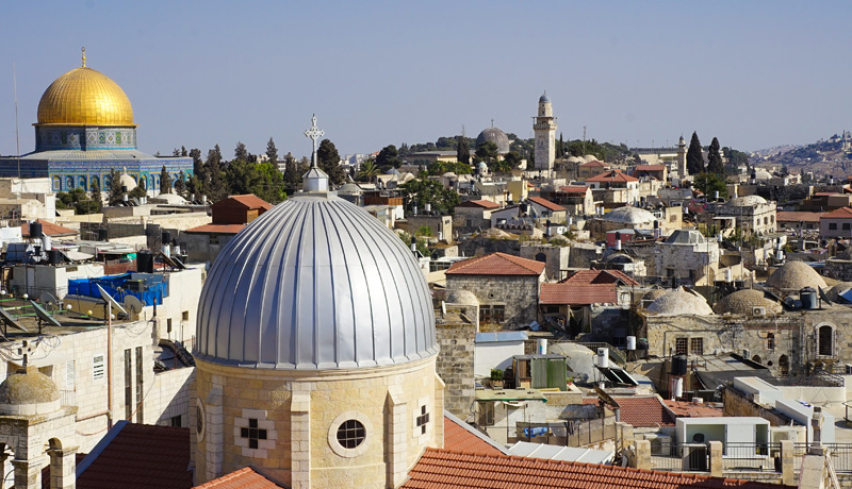
For many Christians, the Holy Land is first encountered through the Bible. Yet it is not merely a collection of sacred sites or ancient stories. It is a living homeland shared by peoples carrying different histories, identities, wounds, and hopes.
The words we use can reveal reality—or hide it. This brief vocabulary offers Christian readers a starting point for listening carefully and speaking truthfully about the land of my forebears and its people.
The Holy Land
“The Holy Land” is a religious rather than an official political name.
“The Holy Land” is a religious rather than an official political name. Christians generally use it for the land connected with the biblical story and the life, death, and resurrection of Jesus—including Israel, Jerusalem, the West Bank, and Gaza.
But the Holy Land is more than holy sites and ancient stones. It is also home to living communities. Christians cannot love the places associated with Jesus while overlooking the people who live in and around those places today.
Palestine
“Palestine” has historical, geographical, national, and political meanings. Today, it commonly refers to the Palestinian homeland, particularly the West Bank, including East Jerusalem, and Gaza.
For Palestinians, Palestine... represents home, identity, memory, family, culture, and belonging.
For Palestinians, Palestine is not merely a political slogan. It represents home, identity, memory, family, culture, and belonging. Recognizing Palestine and Palestinian identity does not require denying Jewish history or Israeli identity.
Israel
In the Bible, “Israel” may refer to Jacob, his descendants, the people of Israel, or the ancient kingdoms. In contemporary political language, Israel means the modern State of Israel, established in 1948.
Biblical Israel and the modern State of Israel should not be treated as automatically identical.
Biblical Israel and the modern State of Israel should not be treated as automatically identical. Respecting Jewish identity and opposing antisemitism do not require Christians to endorse every policy of an Israeli government. Like every state, Israel should be evaluated according to justice, truth, and the equal dignity of all people.
Palestinian
A Palestinian is a person belonging to the Palestinian people. Palestinians include Muslims and Christians, refugees and non-refugees, and people living in the West Bank, Gaza, East Jerusalem, Israel, Jordan, and throughout the diaspora.
Palestinian identity is not defined only by conflict with Israel.
Palestinian identity is not defined only by conflict with Israel. It includes a rich culture, Arabic language, family traditions, food, music, faith, hospitality, and a deep connection to the land.
The West Bank
The West Bank is the Palestinian territory west of the Jordan River. It includes Bethlehem, Ramallah, Hebron, Jericho, Jenin, and Nablus. East Jerusalem has a distinct and contested political status.
Many Israelis call the area “Judea and Samaria,” using its biblical names. While these names have historical significance, their modern use must not make the millions of Palestinians living there invisible.
Gaza
Gaza is an ancient city and the name commonly used for the Gaza Strip, a small Palestinian coastal territory.
Gaza's... small Christian community is an important part of the Palestinian church and the worldwide body of Christ.
Gaza must not be reduced to Hamas, war, or statistics. It is a human community with families, churches, schools, universities, businesses, memories, and hopes. Its small Christian community is an important part of the Palestinian church and the worldwide body of Christ.
Occupation
In this context, “occupation” refers primarily to Israel’s military control over Palestinian territories captured in 1967, especially the West Bank and East Jerusalem. Gaza’s legal status is discussed differently, but its borders, movement, and access have also been subject to extensive Israeli control and blockade.
For Palestinians, occupation is not an abstract political term.
For Palestinians, occupation is not an abstract political term. It is experienced through checkpoints, military orders, permits, settlement expansion, land restrictions, home demolitions, and limitations on movement. Christians may debate political solutions, but they should not ignore this daily reality.
Palestinians with Israeli citizenship
Palestinians with Israeli citizenship are Palestinians who live within the State of Israel and hold Israeli citizenship. Many are descendants of Palestinians who remained in their homeland during and after the events of 1948.
“Palestinian citizens of Israel”... acknowledges both their citizenship and their Palestinian national identity.
They are often officially described as “Arab citizens of Israel” or “Israeli Arabs.” Some accept these descriptions, while others prefer “Palestinian citizens of Israel” because it acknowledges both their citizenship and their Palestinian national identity. They include Muslims, Christians, Druze, and others, although each community may understand its identity differently.
Arabs
“Arab” is a broad cultural and linguistic identity shared by peoples across the Middle East and North Africa. Palestinians are Arabs, but not all Arabs are Palestinians.
(Many) Arabic-speaking Christians... belong to ancient Christian communities rooted in the land for centuries.
Calling Palestinians simply “Arabs” can be misleading if it erases their particular history and relationship to Palestine. In the same way, Arabic-speaking Christians should not be viewed as recent outsiders. Many belong to ancient Christian communities rooted in the land for centuries.
The Church of the Holy Land
The Church of the Holy Land is not one denomination or institution. It is the diverse Christian community living and worshiping in the land of Jesus. It includes Orthodox, Catholic, Oriental Orthodox, Anglican, Lutheran, Evangelical, and other churches.
These Christians are not merely caretakers of holy sites. They are living witnesses to Christ within their own society. Most are Palestinian Arabs, while others come from Hebrew-speaking, migrant, expatriate, and international communities.
The global Church should not speak about the Holy Land without listening to its local churches.
The global Church should not speak about the Holy Land without listening to its local churches. They understand the land not only through archaeology, tourism, or prophecy, but through worship, service, suffering, and faithful presence.
Sumud
"Sumud" is an Arabic word meaning steadfastness, perseverance, or remaining firmly rooted. In the Palestinian context, it describes the determination to remain on the land, protect community life, preserve identity, and continue hoping despite hardship.
For Palestinian Christians, sumud is more than political resistance. It can be a spiritual practice: remaining faithful to Christ, serving one’s neighbors, educating children, sustaining churches, planting olive trees, creating work, and refusing both hatred and despair.
Sumud... means continuing to live, worship, serve, and hope while seeking a just peace.
Sumud does not mean passive acceptance of injustice. It means continuing to live, worship, serve, and hope while seeking a just peace.
A more faithful vocabulary
These definitions will not resolve every theological or political disagreement. They can, however, help Christians begin with greater understanding.
The language we use should be truthful without being hateful, courageous without becoming dehumanizing, and guided by the justice and compassion of Jesus. To love the Holy Land faithfully, Christians must learn to love, and listen to, the people who call it home.
Rev. Dr. Jack Sara is the President of Bethlehem Bible College. Born and raised in the Old City of Jerusalem, Jack studied at Bethlehem Bible College after committing his life to Christ and his teachings. Jack is an ordained minister with Evangelical Alliance Church in the Holy Land where he still maintains an overseeing role with the leadership of the churches. He is the General Secretary for the Middle East & North Africa Evangelical Alliance and works extensively in the areas of peace & reconciliation.