
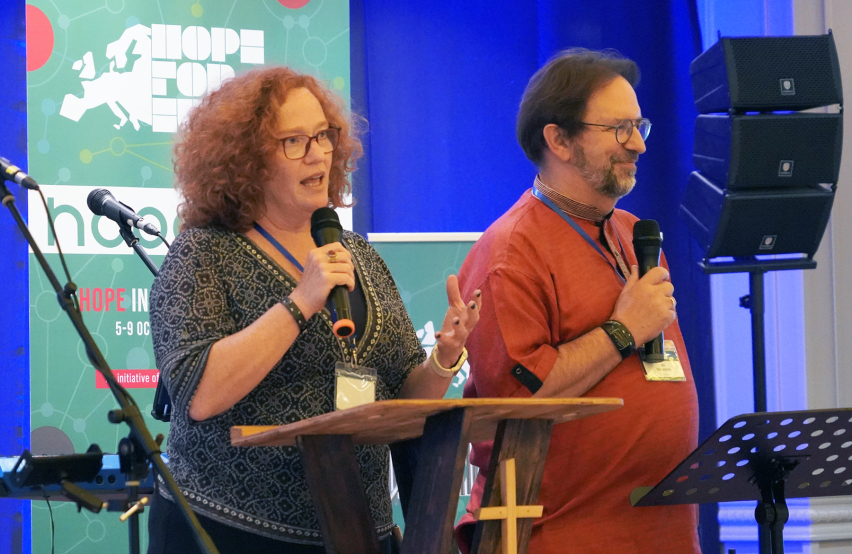
Evangelical leaders from across Europe opened a five-day gathering in Albania on Monday evening. Their Albanian hosts described the country's path from enforced state atheism to a growing evangelical church as a sign of hope for the continent.
Hope for Europe 2026 is organized by the European Evangelical Alliance and runs through Friday, Oct. 9, under the theme "Hope in Uncertain Times" and bringing together about 250 Christian leaders from across Europe. It is the movement's fifth major gathering since 2002 with the last one held in Sarajevo in 2022.
For the host country's evangelicals, the location carried particular meaning.
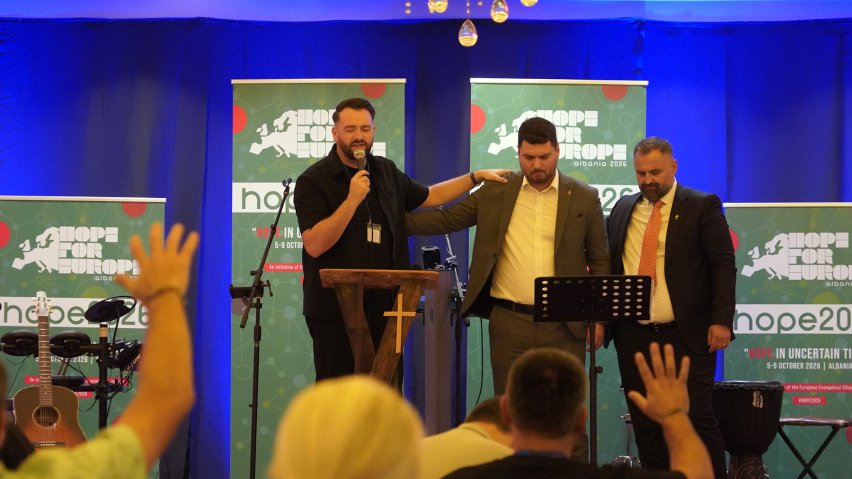
"Hope for Europe is not a slogan for us. It is a testimony," said Alesio Sema, general secretary of the Albanian Evangelical Alliance, known by its Albanian initials, VUSH. "If God can bring hope to a land that was once called the first atheist state in the world, he can bring hope to every nation in this room."
'For us here in Albania, it is our home'
Sema began his welcome with Romans 15:19. In that verse, the Apostle Paul writes that he had fully proclaimed the gospel from Jerusalem as far as Illyricum.
"For many it is just a name in a footnote, but for us here in Albania, it is our home," Sema said.
The Roman province covered lands where the ancestors of today's Albanians lived, he said. He added that the Via Egnatia, a Roman road used by soldiers, began at the nearby port of Durrës and ran east toward Macedonia. The gospel traveled on roads like it, Sema said.
"The gospel did not stay in Jerusalem. It crossed the seas, the mountains and borders, and it reached the Balkans," he said.
Sema then turned to Albania's recent past. He described decades in which faith was banned, churches were shut and Bibles were hidden. Under that regime, the state declared itself atheist, and many believed the Christian story in the country was finished.
"But it had not," he said. "The seed planted in Illyricum was never lost."
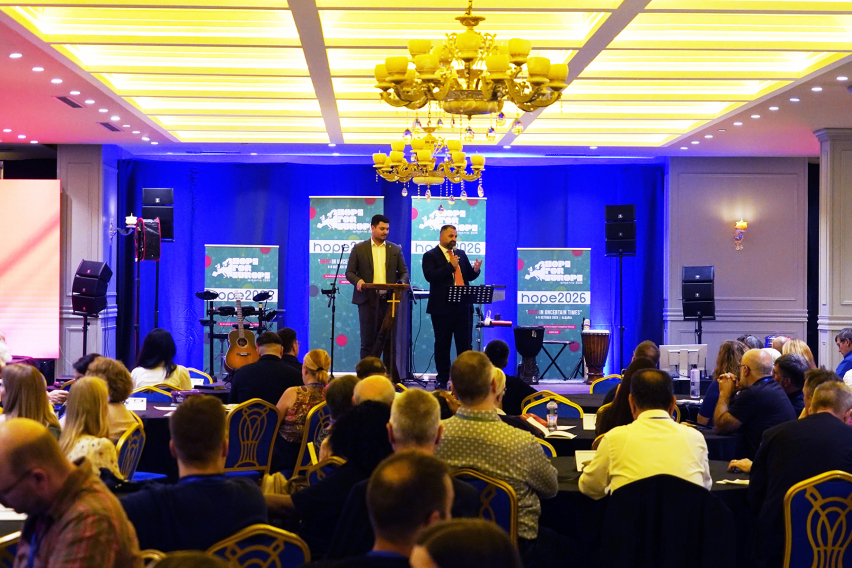
Thirty-five years after the country opened, Albania has active churches, young leaders and a new generation looking for hope, Sema said. He told participants that holding the gathering in Albania at this moment carries particular weight for the country's evangelicals.
He asked participants to listen and learn from one another during the week. He also urged them to let the Holy Spirit renew their vision for "your own Illyricum, the place that God has sent you." Paul, he said, was never content with work already done and wanted to preach where Christ was not yet known.
From 20 believers to 13,000
Jan Wessels, co-general secretary of the European Evangelical Alliance, built on Sema's remarks. He noted that the same chapter of Romans records Paul's plan to travel to Spain.
"Paul was actually looking at the whole of Europe already, long before Europe was even on the map," Wessels said.
Wessels said he had read that only about 20 evangelical believers remained in Albania in 1991. Citing Sema, he said the country now has about 300 churches and church plants and roughly 13,000 believers. According to Wessels, the Albanian state officially recognized VUSH in 2011. He added that many Albanian Christians who emigrated now serve in churches elsewhere in Europe.
"From fewer than 20 people to 13,000 in one generation," Wessels said. "This is a testimony of the faithfulness of our God."
Identity, hospitality and emigration
Erion Prendi of VUSH described Albania as a nation long engaged in a struggle over its identity. He pointed to about 500 years of Ottoman rule and some 50 years of communism. Missionaries from Europe and the United States later helped Albanians understand that "identity is not in the flag, but it is Jesus Christ," he said.
Prendi also spoke of the country's reputation for hospitality. He cited Albanians who took Jewish people into their families during World War II and gave them food, shelter and clothing.
He said the country still faces serious problems. A growing number of young people are leaving because of a weak economy and a lack of hope, he said.
"We don't just want to say to Albanians, 'Don't leave,'" Prendi said. "We want to give them reason to believe that we can build something together."
Prendi appealed directly to church leaders from other countries about Albanians who have settled abroad. "Please take care of them and please pray for them and invite them to come to your churches, because they belong to us," he said. He also said VUSH recently launched a business forum for evangelicals and invited leaders to discuss partnerships.
A theme drawn from Job and Hebrews
Connie Main Duarte, who shares the general secretary role with Wessels, explained the choice of theme by pointing to the biblical account of Job. In that story, four messengers bring news that Job's family, wealth and security have been lost. Job responds by falling to the ground in worship before his own health is also taken.
"What Job faced in his life, we are watching and living on a European and global scale," Main Duarte said.
She cited the war in Ukraine, now in its fifth year, along with droughts, floods, earthquakes and fires. She also listed school violence, youth suicide, mental health struggles across age groups, loneliness among older people and fear of artificial intelligence among the young.
"It's all left us on shaky ground," she said. She added that political, moral and values conflicts had brought back divisions Europe experienced not long ago. "A surging polarization has seeped into all of society, and the church has not been left untouched."
Job saw his life through faith, Main Duarte said, but that faith was still waiting for its completion. Christians today, she said, see the world through the resurrection of Christ and a story of redemption and reconciliation, while still living in a "not yet."
"In other words, we live with hope in uncertain times," she said.
The gathering's theme passage is Hebrews 6:19-20, which describes hope as a firm and secure anchor for the soul. It also describes Jesus as the forerunner who has entered the inner sanctuary on believers' behalf.
Main Duarte said this hope endures because it rests on Christ alone. "Hope is not just a word, and it's not just a concept," she said. "Hope is a person and his name is Jesus."
A movement born after communism
Wessels traced Hope for Europe to the years after the collapse of communism. At that time, evangelistic teams entered Central and Eastern Europe full of zeal but often worked side by side without knowing one another.
A group of leaders that included Jeff Fountain of YWAM Europe began to ask a different question, Wessels said. "Instead of asking what each of us can do, they asked what God is doing in Europe and how we can do it better together," he said.
The movement grew into what Wessels called a network of networks. Leaders of ministries serving children, students and artists, and leaders in prayer and mission, met at annual European round tables, built trust and developed a shared theology of hope. Wessels said that theology answered what he called the "gloom and doom view of Europe" then common among evangelicals.
The first large gathering, held in Budapest, Hungary, in 2002, drew about 1,000 people from 20 networks, according to Wessels. Later gatherings followed in 2011, 2018 and 2022. Wessels described the 2022 host city, Sarajevo, as one that knows "what division costs and what reconciliation means." The European Evangelical Alliance later became the movement's home.
Wessels said each gathering had carried the same conviction: there is hope for Europe. "It isn't a nostalgic hope or a political one," he said. "It is hope rooted in the God who raised Jesus from the dead."
'Our unity is a testimony'
Wessels called the event a family gathering rather than a conference. He said its goals are inspiration, new partnerships across network lines and, above all, the glory of God. "Not the EEA, not our networks, not our names are important," he said.
He tied the gathering's purpose to Jesus' prayer in John 17 that his followers would be one so the world may believe.
"When believers from the east and from the west pray together, when the Baptists and the Reformed break bread together, Jesus himself is put on display before a watching Europe," Wessels said.
Communion at the beginning
The opening session ended with the Lord's Supper. Main Duarte said organizers chose to share it at the start of the week, rather than at the close as is common, to express unity and obedience to Christ's command.
Andreas Wenzel, chair of the European Evangelical Alliance board, led the service. He described Communion as a meal of fellowship, belonging, forgiveness and God's grace.
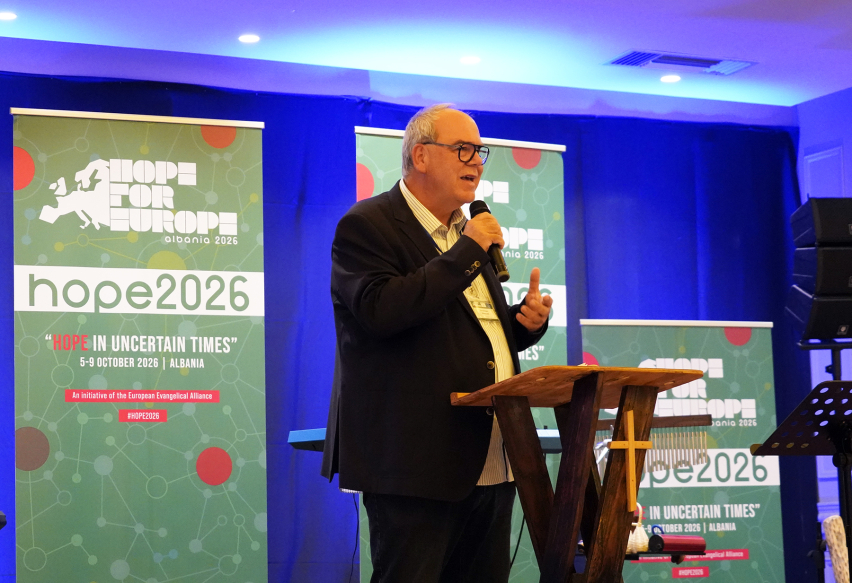
"So it has always been a meal of hope," Wenzel said. He pointed to Jesus' words that he would not eat it again until the coming of the kingdom.
In his prayer, Wenzel said that remembering what Christ has done also turns believers toward the future. "As we celebrate and are reminded of what you have done for us, we also look forward to what is going to come," he prayed.
Hope for Europe 2026 continues through Friday.








