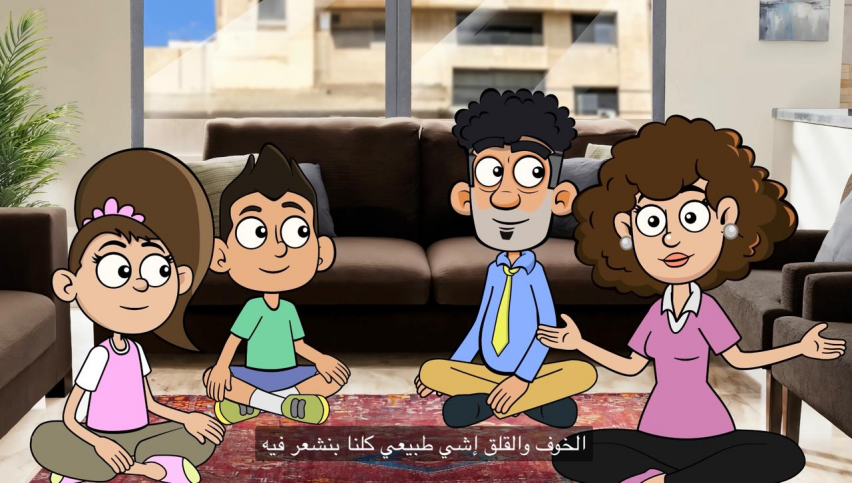
As sirens warning of possible missile strikes echo across parts of the Middle East, a Jordanian animation company has released a short video aimed at helping families cope with the emotional strain of the ongoing conflict involving Iran.
Digitales Media, based in Amman, developed the five-minute animated episode to offer practical ways—especially for children—to deal with tension and anxiety linked to war conditions. The initiative comes as the conflict’s impact extends beyond physical destruction and travel disruptions, affecting daily life and mental well-being across the region.
The episode opens with the now-familiar sound of the siren blasting through an apartment neighborhood in Amman while the streets are deserted. The production is part of a long-running YouTube series, Our Family Life, that has captured the imagination of families around the region.
Cynthia Madanat-Sharaiha, creative director and co-owner of Digitales Media, explains that her team was looking for ways to help families during the war. “We wanted to find a practical way for people in general, and children in particular, to deal with tensions emanating from the war,” she told Christian Daily International.
Shadi Sharaiha, the program’s executive producer, told CDI that this particular episode of “Our Family Life” was a deliberate attempt to translate evidence-based coping techniques into something families can actually use at home—in moments of tension and after the sirens fade.
“The entire Middle East region has been overwhelmed with flying missiles and 24-hour war news that has engulfed everyone. Our creative team worked around the clock to find practical solutions that can help families deal with trauma, not only during war but at any other time,” he said.
In the YouTube video, after hearing the siren, Abu Sanad’s family meets and reflects on their concerns. The mother presents breathing exercises and encourages her family to follow them. The company says they were careful to present evidence-based treatments in a visually attractive manner, with additional downloadable exercises provided at the end.
Issam Smeir, a Chicago-based trauma counselor and advisor to the content of the Digitales products, told CDI that the “Our Family Life” series is not merely entertaining but a creative show that helps parents teach their children how to engage with life’s challenges.
He said that “the dealing-with-stress episode” aims to help families regulate their nervous systems when war anxiety spills into daily life. “The wisdom comes from the mother, whose on-screen breathing exercises are not gimmicks but a gateway to resilience that can be learned without prior therapy and without leaving the living room,” he explained.
Smeir said that stress is a natural response to an unnatural situation. According to the mental health specialist, the breathing exercise helps “reset the nervous system back to normal.”
Digitales Media adopted a real-time approach, pairing a short film with downloadable exercises and a digital toolkit offering science-based methods to manage stress and trauma. The approach combines accessibility with methods commonly used in clinical trauma care, including breathing exercises and routines designed to create a sense of safety.
Yet in many Arab countries, where access to mental health services can be uneven, stigmatized, or disrupted by displacement—these tools risk remaining abstract unless they are rendered tangible and culturally resonant.
Digitales, the producer of the award-winning feature film “Saleem,” is a leading media organization that creates content addressing emotional issues. It tells the story of a curious and adventurous nine-year-old who moves to a new town with his family after losing his father.
The company’s co-directors, Shadi and Cynthia Sharaiha, received the King Abdullah II Award of Excellence for the film and the production team was also visited by Crown Prince Hussein bin Abdullah and Princess Rajwa during production.
Digitales also produces a creative digital mental health and psychosocial support tool, “Amal for Children,” that combines animation and storytelling with evidence-based therapy modalities to help reduce the intensity and frequency of PTSD, depression, and anxiety symptoms in children navigating trauma. Their video content has been used by refugee groups in Egypt and has been translated for use in other regions of the world.Church leaders have said the production enables them to better support children in difficult situations as they cope with stress and trauma.
When content is crafted in local dialects and framed within familiar family dynamics, it becomes less intimidating and more credible, producers say. The Jordanian film’s setting in Amman, its emphasis on family participation and its clear, actionable guidance exemplify how healing tools can be culturally anchored and practically useful.
With the conflict reaching countries unaccustomed to such threats, the sound of sirens and the need to seek shelter have contributed to rising stress levels among families.
The video presents a practical sequence from awareness to action, equipping families with tools they can use in daily life, whether at home, in school or during emergencies.