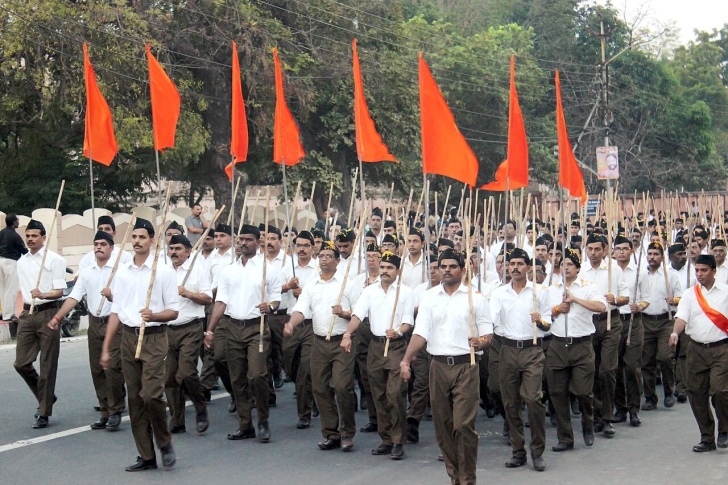
A U.S. advisory body for the first time has called for targeted sanctions against a major Hindu nationalist group, accusing it of systematic violations of religious freedom.
In recommending India be designated a “Country of Particular Concern” (CPC) for the seventh consecutive year, the U.S. Commission on International Religious Freedom (USCIRF) called on the U.S. government to act against the Hindu nationalist Rashtriya Swayamsevak Sangh (RSS) by freezing its assets and barring its personnel from entering the United States.
As it did last year, USCIRF also called for sanctions against India’s external intelligence agency, the Research and Analysis Wing (RAW).
India’s Ministry of External Affairs rejected the findings as “propaganda,” calling the report “motivated and biased” and “a distorted and selective picture of India.”
The commission’s findings on conditions in 2025 describe a country where minority communities face escalating legal pressure, vigilante violence and state-sponsored detention. In the previous six years, however, the U.S. State Department, has declined to act on the CPC recommendation.
USCIRF, an independent, bipartisan agency created by the International Religious Freedom Act of 1998, monitors global conditions for freedom of religion or belief and delivers formal policy recommendations to the U.S. president, secretary of state, and Congress.
Under the act, a CPC designation applies to countries the U.S. government determines are “engaging in or tolerating systematic, ongoing, and egregious violations” of religious freedom. Countries currently or previously listed under the designation include China, North Korea, Iran, Pakistan and Saudi Arabia, among 18 countries recommended for CPC designation in the 2026 report.
India has appeared in USCIRF’s CPC recommendations since 2020. Despite seven consecutive CPC designations, successive U.S. administrations spanning both Democratic and Republican governments have declined to formally accept the designation for India.
USCIRF Chair Vicky Hartzler said the commission remained committed to documenting conditions on the ground.
“As USCIRF’s Annual Report shows, far too many people in key nations are denied religious freedom through unjust laws, discrimination, harassment, violence, and even crimes against humanity,” Hartzler said. “The U.S. government must continue to advance religious freedom abroad to make a difference for those facing religious persecution.”
Sanctions Recommended
The most striking element of the new report is the explicit naming of RAW (Research and Analysis Wing) and the RSS (Rashtriya Swayamsevak Sangh) as targets for sanctions that would freeze assets and ban affiliated individuals from entering the United States.
USCIRF had previously recommended sanctions against RAW in its 2025 annual report, in connection with an alleged 2023 assassination attempt in New York linked to former RAW official Vikash Yadav. The 2026 report extends those sanctions to cover the RSS, tying the recommendation to the organization’s “responsibility and tolerance of severe violations of religious freedom,” the report states.
The report also calls on the U.S. government to link future security assistance and bilateral trade policies with India to improvements in religious freedom, and to enforce Section 6 of the Arms Export Control Act to halt arms sales to India, citing “continued acts of intimidation and harassment against U.S. citizens and religious minorities.”
The commission calls on the U.S. government to press India to allow in-country assessments by USCIRF and the U.S. State Department. New Delhi has consistently refused to grant the commission access for such assessments.
The report urges U.S. lawmakers to reintroduce and pass the Transnational Repression Reporting Act of 2024, which would mandate annual reporting on acts of transnational repression by the Indian government targeting religious minorities in the United States.
Hindus for Human Rights, a U.S.-based advocacy group, called the RSS sanction recommendation “a major shift” in how U.S. policymakers are approaching religious nationalism and minority rights in India, saying it reflects growing international scrutiny of networks linked to majoritarian politics.
Other Findings
Religious freedom conditions in India “continued to deteriorate” throughout 2025, the report states, as authorities introduced and enforced new legislation targeting minority communities and their places of worship, including Christians.
Several Indian states introduced or strengthened anti-conversion laws during the year. Rajasthan’s new legislation drew particular attention, imposing life imprisonment as a possible penalty for conducting religious conversions. People wishing to change their religion voluntarily must notify the government two months in advance, while anyone performing a conversion must give one month’s notice. Failure to comply with either requirement carries a penalty of up to three years in prison.
Indian authorities also “facilitated widespread detention and illegal expulsion of citizens and religious refugees and tolerated vigilante attacks against religious minority communities,” the report states.
The commission accused Hindu nationalist groups of carrying out violence with impunity. Throughout 2025, “Hindu nationalist mobs across several states harassed, incited, and instigated violence against Muslims and Christians,” the report states.
The report holds the Bharatiya Janata Party-led government of Prime Minister Narendra Modi responsible for enforcing discriminatory nationalist policies within a legislative environment hostile to minorities. Laws specifically cited include the Citizenship Amendment Act, the National Register of Citizens, the Unlawful Activities Prevention Act, and various state-level cow slaughter laws.
The report references the April 22 Pahalgam terror attack in Jammu and Kashmir, in which gunmen targeted a group of predominantly Hindu tourists in the Muslim-majority territory, killing 26 people. The Indian government subsequently “seized the aftermath of the attack to justify deportations of religious minorities it considers ‘illegal’ migrants,” the report states.
The report criticized the Waqf (Amendment) Act, passed by the Indian parliament in 2025, which governs Muslim endowments and religious property, calling it another instance of legislation targeting minority communities.
USCIRF cited communal clashes in states including Maharashtra, Odisha, and Uttar Pradesh, and blamed the Vishwa Hindu Parishad, an RSS affiliate, for playing a role in fomenting violence.
India Hits Back
India’s Ministry of External Affairs on March 16 refuted the report two weeks after its release.
“We have taken note of the latest report of the U.S. Commission on International Religious Freedom,” spokesperson Randhir Jaiswal told a media briefing. “We categorically reject its motivated and biased characterisation of India.”
Jaiswal accused the commission of persistently presenting a “distorted and selective picture of India, relying on questionable sources and ideological narratives rather than objective facts,” adding that such “repeated misrepresentations only undermine the credibility of the Commission itself.”
Jaiswal redirected attention to attacks on India’s diaspora in the United States, saying what truly deserved the commission’s attention was the “vandalism and attacks on Hindu temples in the United States, selective targeting of India and growing intolerance and intimidation of members of the Indian diaspora in the United States.”
Vishwa Hindu Parishad spokesperson Vinod Bansal said the organization had “put the report where it belonged – the dustbin,” noting that while the commission had for years criticized India and Hindu organizations in general terms, the 2026 report marked the first time the RSS had been named explicitly.
“This report carries no reliability even with the people of America,” Bansal said.
Opposition Party Response
India’s main opposition party, the Indian National Congress, moved quickly to highlight the report, on March 16 posting a series of messages on X (formerly Twitter) urging accountability from the ruling government.
The Congress party wrote that the commission, described as “an official U.S. government body,” had warned that the RSS “poses a threat to people’s religious freedom.” Invoking Sardar Vallabhbhai Patel’s post-independence ban on the RSS following Mahatma Gandhi’s assassination in 1948, the party accused the organization of opposing the Indian Constitution and described it as “poison to the unity and brotherhood of this nation.”
The Congress party framed the USCIRF report as evidence of democratic backsliding under the BJP government and accused the ruling party of damaging India’s global reputation on human rights.
Wider Context
USCIRF operates independently of the executive branch, and its recommendations carry no binding force on U.S. foreign policy. The State Department makes its own annual designations under the International Religious Freedom Act, and it has not included India on the CPC list despite USCIRF’s sustained advocacy.
The relationship between Washington and New Delhi has deepened considerably across administrations, and India’s strategic role as a counterweight to China in the Indo-Pacific has consistently shaped U.S. diplomatic calculations. Analysts have pointed to these geopolitical considerations as a primary reason the State Department has declined to act on the commission’s repeated recommendations.
Still, the USCIRF report carries diplomatic weight. Its findings shape congressional conversations, influence the terms of international human rights discourse, and provide ammunition for both domestic opposition parties and foreign critics of the Indian government.
The 2026 report arrives at a moment of already-heightened bilateral sensitivity. Relations between Washington and New Delhi absorbed a significant jolt when U.S. prosecutors charged Indian national Nikhil Gupta and linked former RAW official Vikash Yadav to an alleged plot to assassinate Sikh separatist leader Gurpatwant Singh Pannun on U.S. soil. India has disputed the characterization of official involvement. That episode informed the 2025 USCIRF report’s sanctions recommendation against RAW and appears to have directly influenced the escalated 2026 call.
India’s record on treatment of religious minorities has drawn scrutiny beyond USCIRF as well. The U.S. State Department’s own International Religious Freedom Report has cited concerns about communal violence and discriminatory legislation in India, as have reports from Human Rights Watch and Amnesty International, though the State Department stops short of the CPC designation USCIRF has sought.
Whether the Trump administration, which since taking office in January 2025 has cultivated a close relationship with Modi, will move differently from its predecessors on the designation question remains to be seen. So far, the pattern holds: the commission recommends, the State Department declines to act, and India rejects the findings as interference in its internal affairs.