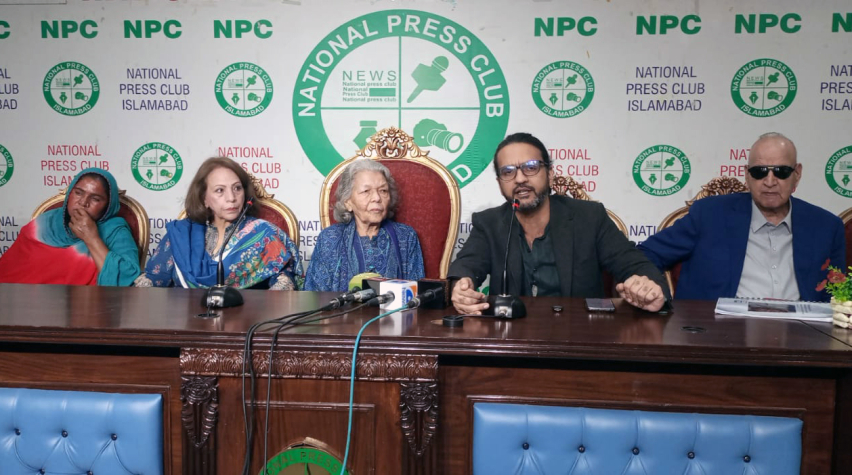
The Human Rights Commission of Pakistan (HRCP) and a coalition of civil society organizations on Sunday (March 29) called on authorities to immediately suspend ongoing and planned eviction operations targeting low-income settlements in the federal capital, warning that the drive risks violating legal protections and triggering a humanitarian crisis among vulnerable communities.
The demand was made in a joint statement issued after a press conference at the National Press Club in Islamabad, where representatives of the All-Party Alliance for Katchi Abadis, the National Commission for Justice and Peace (NCJP), the Awami Workers Party (AWP) and Aurat March Islamabad voiced alarm over what they described as a growing pattern of forced evictions across informal settlements.
The groups specifically condemned the “imminent threat of demolition” facing residents of Allama Iqbal Colony, a 25-year-old, predominantly Christian, working-class neighborhood slated for clearance in the coming days.
“We unequivocally reject the ongoing pattern of evictions carried out by the Capital Development Authority (CDA) without due process, adequate notice or lawful rehabilitation,” the statement said, adding that such actions disproportionately affect the marginalized Christian community who have lived and worked in these areas for decades.
The criticism comes amid an intensifying anti-encroachment campaign by the CDA, which maintains that several settlements, including Muslim Colony in Bari Imam, Rimsha Colony in Sector H-9 and parts of Sector G-7, constitute illegal encroachments on state land.
According to CDA regulations, dozens of private housing schemes were required to transfer designated amenity land to the civic authority for public use. However, officials acknowledge that the agency has struggled to recover such land over the years, while some of it has already been absorbed into private developments.
A CDA spokesperson previously told Christian Daily International that recent operations targeted structures built on public spaces, including a park in G-7 and commercial units such as junkyards and shops in Rimsha Colony. The spokesperson said these actions were necessary to reclaim state land and enforce urban planning regulations.
Christian residents and community leaders, however, contest these claims, arguing that some settlements, including Rimsha Colony, were originally established or later regularized by state authorities, raising questions about the legality and consistency of current enforcement measures.
Rimsha Colony’s history is closely tied to one of Pakistan’s most widely reported blasphemy cases involving a Christian minor. In 2012, a teenage girl, Rimsha Masih, who had a mental disability, was accused of burning pages of the Quran in Islamabad’s F-12 sector. The allegations were later found to be fabricated, but the case sparked widespread fear among Christians living in nearby settlements.
At the height of the crisis, dozens of Christian families fled their homes in the Mehrabadi area near G-12, fearing mob violence. While many eventually returned, the episode left a lasting sense of insecurity among minority communities in the capital — a sentiment that residents say has resurfaced amid the current eviction drive.
Eviction operations have triggered anxiety among an estimated 25,000 Christian residents in affected settlements, many of whom say they received only verbal notices and remain uncertain about their future. Community representatives have questioned the transparency of the process and urged authorities to adhere to court-mandated procedures.
At the center of the dispute is a 2015 ruling by the Supreme Court of Pakistan, which directed authorities to protect residents of katchi abadis (informal settlements) from forced evictions without proper resettlement and to develop comprehensive housing policies.
Rights groups argue that ongoing operations violate both the spirit and letter of that judgment.
“The continued disregard for the 2015 Supreme Court stay order and the absence of a coherent, rights-based policy reflect a troubling erosion of legal protections for marginalized citizens,” they said.
Pakistan’s major cities, including Islamabad, have long grappled with the expansion of informal settlements, driven by rural-to-urban migration, chronic housing shortages and rising land prices. Katchi abadis often provide affordable housing to low-income workers who lack access to formal real estate markets.
While authorities periodically launch clearance drives citing environmental concerns, urban planning requirements and land recovery, critics say such operations frequently fail to provide viable alternatives for displaced families, exacerbating poverty and social exclusion.
“The demolition of katchi abadis represents a systemic assault on the housing, dignity and livelihoods of working-class communities,” the statement said, adding that women and children are particularly vulnerable to the impacts of displacement, including loss of access to education, healthcare and employment.
Activists also warned that the climate of fear surrounding evictions discourages residents from organizing or asserting their legal rights, further weakening already marginalized communities.
The coalition urged authorities to immediately halt all eviction operations, including those planned in Allama Iqbal Colony and Rimsha Colony, and to ensure full compliance with judicial directives.
It also called on the government to develop a “transparent, inclusive and rights-compliant” national framework for informal settlements, guaranteeing security of tenure, prior consultation with affected communities, and fair resettlement within a reasonable distance, along with adequate compensation where displacement is unavoidable.
“We further demand meaningful engagement with representatives of katchi abadi communities, as well as accountability for arbitrary and unlawful actions undertaken in the name of urban development,” the coalition added.
In a separate statement, the All-Party Parliamentary Group for Pakistani Minorities (APPG) in the United Kingdom echoed these concerns, warning that forced evictions carried out without legal safeguards or alternative housing could breach Pakistan’s constitutional guarantees and international obligations.
“The Christian families living in Islamabad’s informal settlements are among the country’s most vulnerable communities. Pakistan’s Constitution guarantees equality and protection for minorities. Any development initiative must uphold these commitments,” said Jim Shannon, chair of the APPG.
“Authorities should halt demolitions, consult residents, and ensure that no family is left without shelter or support,” he added.
APPG co-chair David Alton highlighted the broader human rights implications, noting that Pakistan is bound by international agreements protecting minority rights and prohibiting discriminatory practices.
“Forced evictions without due process or alternative accommodation would raise serious concerns,” he said.
The APPG noted that Pakistan is a signatory to key international treaties, including the International Covenant on Civil and Political Rights (ICCPR) and the International Covenant on Economic, Social and Cultural Rights (ICESCR), which recognize protections against forced eviction and affirm the right to adequate housing.
It warned that actions undermining these commitments risk further marginalizing vulnerable communities and could adversely affect Pakistan’s international standing.
“The APPG reiterates that any evictions conducted without lawful safeguards or resettlement measures would raise serious legal and humanitarian concerns, particularly where impacts fall disproportionately on religious minorities,” the statement said.