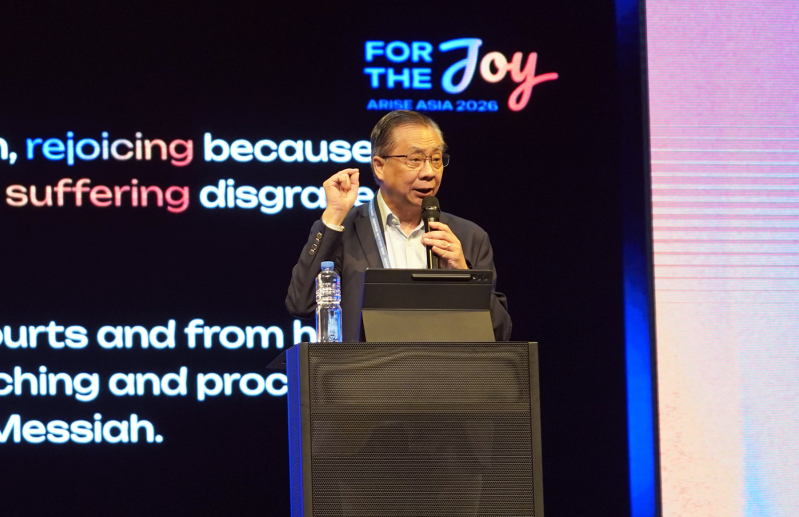
Patrick Fung, Chair of the Global Board of Directors of Arise Asia and Director Emeritus of OMF International, opened the third morning of the Arise Asia 2026 Congress in Manila on Wednesday with an address that pressed delegates to reckon with a truth he said modern Christianity tends to avoid: that joy and suffering do not stand in opposition but always accompany each other in the life of a faithful follower of Christ.
Speaking to approximately 4,000 young Christians from 50 countries gathered around the conference theme "For the Joy," drawn from Hebrews 12:2, Fung explored the day's theme of "Joy of Surrender, Holiness and Sacrifice" through the early chapters of Acts, warning that the greatest threats to the church have never come from outside.
A forgotten theology
Fung opened by acknowledging that the conference had spoken extensively about joy over the previous two days. He wanted to add what he called an inseparable companion.
"For followers of Jesus, joy and suffering always coexist," he said. "Jesus did not want his disciples to follow him without realizing that there is a cost involved in doing so."
He pointed to the breadth of Scripture's testimony on joy — more than 80 references in the Old Testament, 31 in the Psalms alone — before turning to a passage he said should stop readers cold: Acts 5:41, where the apostles left the Sanhedrin "rejoicing because they had been counted worthy of suffering disgrace for the Name." They had just been flogged. The juxtaposition, Fung said, is not incidental. It is the point.
Many Christians instinctively treat suffering and joy as opposites, he said — one displacing the other. Scripture, he argued, does not. He drew delegates to James 1:2-4, where the apostle writes that trials of various kinds should be considered pure joy, because the testing of faith produces steadfastness. The logic is not that suffering ceases to hurt, but that something else is also true simultaneously.
Fung quoted a Sri Lankan theologian who described the theology of suffering as "a forgotten treasure," one largely displaced in contemporary Christianity by what he called an overemphasis on the therapy for suffering rather than its meaning. The problem, Fung suggested, is not that Christians seek comfort — it is that they have been taught to expect that comfort and faith move in the same direction. "The happiest people in the world are not those without suffering," he said, "but those who are not afraid of it."
He was careful not to minimize fear itself. Fear, he said, is real, and it can paralyze. The early church in Acts 4 was not fearless — the threats against them were real. Faith does not make fear disappear. What it does is hold joy and fear in the same hand.
Pressure from outside
Turning to Acts 4, Fung examined how the early church responded to external persecution, specifically the moment Peter stood before Jewish leaders and declared that salvation is found in no one else than Jesus Christ and no other name under heaven saves. Peter, he noted, was described by those same leaders as unschooled and unqualified. That, Fung said, was precisely the point.
"God often uses the unschooled, the uneducated, the unexpected to bring breakthroughs in gospel ministry," he told the congress. "God is not calling the able. God is calling the available."
When the early church faced its own crisis of persecution, Fung noted, it did not pray for the threats to be removed. The congregation in Acts 4 raised their voices together — the Greek word is homothumadon, appearing 11 of its 12 New Testament occurrences in Acts, he pointed out — and addressed God as sovereign over creation, revelation, and history. They asked not for relief but for boldness. "Nothing surprises God," Fung said.
He referenced the 21 Egyptian Coptic Christians killed by ISIS on a Libyan beach in February 2015, their lips moving in prayer in the moments before their deaths. The image, he said, brought revival to the Egyptian church and arrested the attention of many who did not share their faith. He also recalled the China Inland Mission's decision during the Boxer Rebellion of 1900, following the killing of 58 missionaries and 21 of their children, to refuse any government compensation — a response that moved a provincial governor to write a public letter commending their example to his people.
"Persecution has never killed the church," Fung said. "But a compromised gospel will." An assertion he would return to later in his address.
The weight of surrender
Fung then described his own experience of counting the cost. When he and his wife, Jenny, left careers in medicine to serve as missionaries in Pakistan, his father struggled deeply to understand the choice. For years he could not reconcile what he saw as a waste of his son's training and prospects.
Over time, what he could not explain away was the joy he observed in them. He eventually testified to noticing something he couldn't account for, and 20 years after they left for the mission field, Fung’s father became a Christian.
Fung also shared a conversation with a woman whose husband was imprisoned for preaching the gospel. When asked how to pray for him, she did not ask for his release or for the suffering to end. "Fear is real," she told Fung. "Fear can be contagious. But joy is even more contagious. Pray that he will be filled with joy, and that joy will spread across the prison."
The danger within
In the second half of his address, Fung turned from external pressure to what he called the more fatal threat: internal corruption. The structure of Acts, he argued, is deliberate. Chapter 4 shows Satan attacking the church through persecution from outside. Chapter 5 shows Satan changing tactics.
"When persecution doesn't work," Fung said, "he tries another method — to destroy the church through corruption, through falsehood, through deception from within."
That is the context, he said, for understanding the account of Ananias and Sapphira, the couple who sold property, secretly kept part of the proceeds, and presented the rest to the apostles as though it were the full amount. Fung paused on the precise charge Peter brings in the passage. The Greek word translated as "kept back," he explained, carries the sense of embezzlement — of taking what was not one's to take. Peter does not merely say they withheld money. He says they stole it.
The theological weight of that distinction matters. The money, Fung noted, was theirs. They were under no obligation to give any of it. The sin was not the amount. It was the pretense.
"It was a show," he said. "People thought they had given everything. They had not. The gravity of their sin is hypocrisy."
And hypocrisy, he argued, is not a private failure. It is a threat to the whole body. Great fear fell on the church following the deaths of Ananias and Sapphira not because of the punishment itself but because the community understood what was at stake. A church that performs its devotion rather than living it becomes something other than the church. "Persecution can lock you up in prison," Fung said. "But hypocrisy destroys you — and it will destroy the church. It is more fatal than persecution."
He drew a direct line from that passage to the present moment. "Perhaps you have made promises to God in the past," he told the delegates. "You may appear to people as godly, spiritual, and sacrificial. And yet deep down, you know in your heart you have not fulfilled your vow before God."
"Have we surrendered to God with a pure motive?" he asked. "Not a show. Not a performance."
The antidote he named was not more effort or resolve, but a posture toward God: holy fear. Where Ananias and Sapphira feared the opinion of the church more than the eyes of God, Fung called delegates to reverse that order. "We need to be true before God. We need to be authentic before God."
No reserve, no regret, no retreat
Fung closed with a call to full surrender: no reserve, no regret, no retreat. He quoted Dixon Hoste, one of the Cambridge Seven, who served in China from age 25 to age 85, on the danger of spending spiritual energy fighting colleagues rather than the powers of darkness. "Choose your battle," Fung said. "Often we fight the wrong one."
He asked the delegates to examine the authenticity of their own commitments before God, and he prayed that what Arise Asia becomes — not in Manila this week but across Asia in the years ahead — would look like the early church of Acts: united, prayerful, proclaiming, and spirit-filled, going to places where the gospel has not yet been heard.
At the close, he returned once again to the theme he had pressed throughout the morning. "Joy and suffering will always coexist. But may the joy of the Lord be our strength — and that is God's promise to us."
Follow Christian Daily International's full reporting on Arise Asia 2026.