
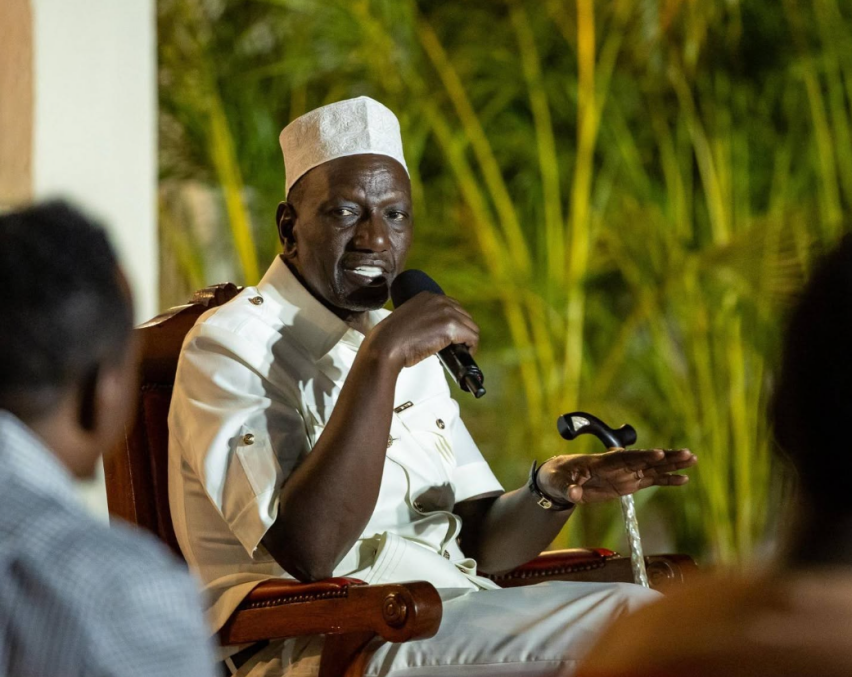
President William Ruto instructed Education Cabinet Secretary Julius Ogamba to begin formal consultations on integrating madrasa, duksi and pastoral instruction programs into Kenya's Basic Education framework.
The directive, reported by local media, does not alter existing curriculum subjects. Christian Religious Education (CRE), Islamic Religious Education (IRE) and Hindu Religious Education (HRE) remain optional, examinable subjects under the Kenya National Examinations Council (KNEC). The directive is a mandate to begin consultation, not a law.
Speaking during the country’s independence day celebration in Wajir County on June 1, President Ruto said the move targets thousands of children in northern Kenya and other underserved predominantly muslim communities who remain outside the formal education system.
"Some children in northern Kenya and other marginalized regions remain outside the formal education system because certain alternative learning pathways have not been adequately recognized or accommodated within our education framework," Ruto said.
"Today I direct the Cabinet Secretary for Education to engage all relevant stakeholders and take the necessary measures under the Basic Education Act, to consult widely and recommend appropriate measures for the formal integration of the same. Every child deserves a door into learning. It is our duty to open every door," he added.
A Duksi is a foundational Quranic school for young children, particularly in Somali-dominated communities, where learners are taught to recite the Quran, often in Arabic, before entering formal schooling.
A madrasa is a more structured Islamic educational institution that provides religious instruction alongside some academic content. Both have operated entirely outside Kenya's formal education framework, meaning graduates have had no recognized pathway into the national examinations system. The Program for Pastoral Instruction similarly serves nomadic children in communities that follow livestock migrations and cannot attend fixed-location schools.
Muslim clerics and scholars in Mombasa welcomed the Government’s intention to integrate Duksi and Madrasa which will allow students under these two pathways from pre-primary to grade 12 to be recognized by the educational system.
“We call upon the ministry of education to ensure the full implementation of this directive. Its successful implementation will guarantee that all children irrespective of their background or location have equal, quality and recognised education,” said Sheikh Izzudin Alwy, an Islamic scholar.
Church response
Major church associations such as the National Council of Churches of Kenya (NCCK) and the Kenya Conference of Catholic Bishops (KCCB) are yet to respond to the pronouncement by the President. However, Evangelical Association of Kenya Chairman, Bishop Calisto Odede responding to a question during a radio show said the content of Madrasas is religious and not formal education similar to Sunday School.
"It is important that matters like these be subjected to public participation so that the people understand the direction they are being led...the concern is whether this move grants special privileges to one religion," said the Bishop of Christ is the Answer Ministries.
Bishop Odede reminded the listeners that President Ruto once opposed the inclusion of Kadhi courts in the constitution. "Many are asking; 'what has changed now?'" posed Bishop Odede.
Another leader in the evangelical movement, who asked to comment anonymously said the directive was “ill advised” and that it “will open a Pandora’s box.”
Members of the public and some clergy however raised questions about how the policy will be implemented with many comparing Madrassa and Duksi classes to Sunday School or Catechism classes. “We already have CRE (Christian Religious Education) and IRE (Islamic Religious Education) integrated in the formal education (system),” noted Muchoki Kennedy, in a post on social media, reflecting the debate that spilled over online.
Religious education teachers had already signaled concern before this directive. In November 2025, educators sent a formal letter to the KICD warning that Kenya's ongoing shift to a Competency-Based Education (CBE) framework was squeezing CRE, IRE and HRE out of student subject choices, particularly on the STEM pathway, as reported by Eastleigh Voice.
"Such a scenario would compromise schools' long-standing mission to offer both intellectual and moral guidance, undermining the holistic development of learners," the teachers wrote.
What the Constitution says
Kenya's 2010 Constitution addresses both sides of this debate. Article 8 establishes that Kenya has no state religion and requires the government to remain neutral in matters of belief. Article 32 guarantees every person the right to freedom of conscience, religion, thought, belief and opinion, and prohibits discrimination on grounds of belief.
The question of whether integrating faith-based learning institutions into a state-funded education framework creates tension with those provisions has not been tested in court in relation to this directive.
Notably, the government's own framing positions the madrasa integration as an access and transition measure rather than an ideological or theological one: the intent, as stated by Ruto, is to provide a bridge for children already in these institutions into the national examinations system, not to introduce Islamic instruction as a compulsory subject.
However, the constitutional questions around the state's relationship with religion in education remain unresolved in Kenya. A 2019 Supreme Court ruling in a case brought by the Methodist Church of Kenya, which challenged a directive allowing Muslim girls to wear the hijab at its sponsored school, St. Paul's Kiwanjani Day Mixed Secondary School in Isiolo, set aside a lower court ruling on a procedural technicality rather than addressing the underlying constitutional questions.
The court ordered the Ministry of Education to produce guidelines reconciling school dress codes with constitutional rights to freedom of religion. Those guidelines were never issued, as reported by Ghanamma.
That unresolved gap resurfaced as recently as February 2026, when a Grade 10 student, Samira Ramadhan, was sent home from St. Mary's Lwak Girls High School in Siaya County for wearing a hijab, triggering a High Court petition, a parliamentary committee intervention and a Ministry of Education order for her immediate reinstatement, according to Citizen Digital and The Star.
The pattern is consistent: government directives on religious accommodation in education keep colliding with the autonomy of church-sponsored schools, and the constitutional framework for resolving those collisions remains incomplete.
A pattern across Africa
Kenya is not the first majority-Christian African country to face this question. In Uganda, where Christians make up approximately 85 percent of the population, a two-and-a-half-year project concluded in 2023 by the International Center for Religion and Diplomacy (ICRD) and other organisations produced a detailed roadmap for integrating madrasa learning into formal national standards, per ICRD project documentation. The published roadmap proposed a unified dual curriculum allowing students to combine religious studies with mathematics, science and digital literacy within a single, state-recognised pathway.
In Nigeria, where madrasa education predates British colonial rule in the predominantly Muslim north, federal integration attempts have been politically contested and uneven, varying significantly by state. In Senegal, government efforts to integrate Quranic schools known as daaras into the formal system have been described as "difficult and not always conclusive," according to a 2018 peer-reviewed comparative study published in the International Journal of Educational Development.
Across the region, where Muslim minority communities coexist within majority-Christian states, governments are under increasing pressure to formally recognize Islamic learning institutions that have long operated outside official frameworks.
Kenya’s education ministry has been tasked with engaging all relevant stakeholders, including churches and educational institutions, and present recommendations under the Basic Education Act. The government says it will consult widely. No timeline has been announced.
Church-sponsored schools, run by evangelical, Anglican, Catholic and Presbyterian bodies, account for a substantial share of Kenya's school infrastructure. The government has named them among the stakeholders it intends to consult. Whether they will engage that process or challenge it, and what legal ground they stand on when they do, will shape the outcome of one of the most consequential education policy debates the country has seen in years.








