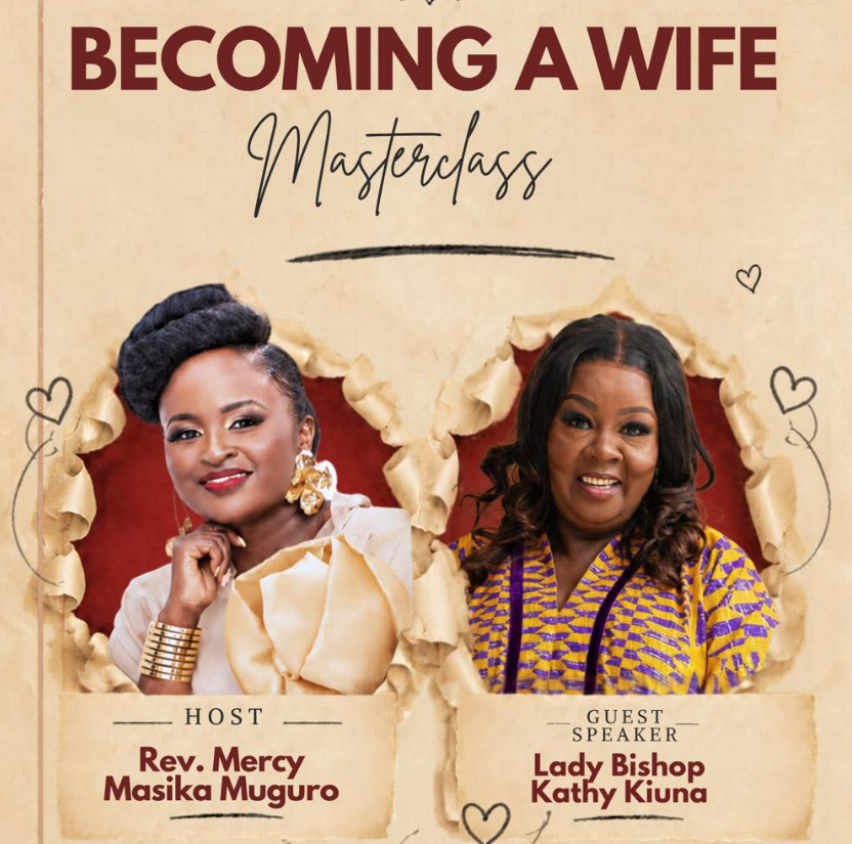
A marriage masterclass announced by Kenyan gospel singer Mercy Masika has sparked debate over the responsibilities of women and men in marriage, with critics questioning its focus on preparing women to become wives while supporters defend her decision to offer faith-based relationship guidance.
The Becoming a Wife Masterclass, organised by Women of Light Ministry, is scheduled for Nov. 21 to Dec. 12. The seven-session programme is presented as a guide to biblical marriage and is intended for women seeking to build healthy marriages grounded in Christian teaching.
In an interview with Christian Daily International, Masika explained that she started the masterclasses after observing that many women were unhappy in their marriages and often lacked guidance in building healthy relationships.
Masika also addressed what she described as a misunderstanding of humility, saying some women associate it with weakness, silence or accepting mistreatment.
“Christ modelled something different: humility as strength under control, truth spoken in love, and service without self-erasure,” she said. The masterclasses, she added, aims to help women recover biblical confidence, develop practical relationship skills and build marriages and homes that reflect God’s wisdom.
She stressed that contrary to the criticism that the programme has elicited, it does not make women responsible for violence or abuse by their partners.
“This does not mean that a woman is responsible for a man’s violence or abuse. It means she is equipped to build well, to love wisely, and to live out her God-given strength with dignity and purpose,” Masika said.
A publicity poster shared by Masika attracted mixed reactions from leading media personalities, gospel artistes and members of the public.
Why some are against the masterclass
Journalist and women’s rights activist, Janet Mbugua questioned why women were being taught how to become wives while less attention was being given to men’s responsibilities as husbands. Other public figures defended Masika, arguing that women should be free to pursue marriage guidance if they consider it valuable.
Mbugua challenged the timing of the programme in a post shared on Instagram on Oct. 25. “So many of the people we’ve buried asked for help first. Before any masterclass, shouldn’t we learn how to listen?” she wrote.
“If the pulpit can find its voice for a masterclass, it can find it for justice too,” she added.
Mbugua also questioned why there was no equivalent programme preparing men to become good husbands.
“Where is the masterclass for how to be a good husband? Why is the burden always on the woman?” she asked.
She argued that a woman could make every effort to sustain a relationship but could not save a marriage on her own if her partner was unwilling to work on it.
Other critics also questioned the programme’s focus on women. Rachel Gitau said she wanted opportunities for both wives and husbands to learn how to become better partners, while actress Catherine Kamau noted that marriage was one of several aspirations women pursue, alongside education, property ownership and financial and mental well-being.
Kamau added: “We are not against marriage; it really is a beautiful thing!” Gitau’s comments and Kamau’s statement were shared in response to the announcement.
In support of the ‘Biblical wife’
Television journalist Mashirima Kapombe defended Masika, questioning why women advocating for empowerment would criticise another woman for an initiative they did not support.
Television journalist Mashirima Kapombe defended Masika, urging those uninterested in the programme to move on, adding: “You’re not the target audience, and that’s okay. Scroll past. Not everything is for everyone.”
Journalist Lynn Ngugi also defended Masika, questioning whether critics should expect her to prioritise other issues affecting women. “What if according to Mercy, a masterclass on being a biblical wife is all that is important to her right now?” Ngugi asked.
Ngugi said women who wanted to learn from Masika’s experience should be allowed to do so, adding: “Mercy’s masterclass shouldn’t stop you from doing what you like.”
Business coach Hannah Githuki also defended women’s freedom to choose marriage education. While acknowledging concerns about men’s responsibilities and gender-based violence, she said: “But we can question an idea without mocking the women who choose differently from us.” Her Oct. 26 remarks were shared in an Instagram video.
Masika acknowledged that more needs to be done to protect women from violence, recounting an experience of a friend who was a victim of gender-based violence in Kenya. After the woman relocated to the United Kingdom, neighbours heard what was happening and called the police. Authorities intervened, and the abuse stopped. The couple eventually separated.
Masika said the experience demonstrated the importance of communities and authorities treating domestic abuse as a crime, rather than a private family matter. She called on African governments, police, neighbours and communities to take action to protect women.
Her comments come amid continuing concerns about violence against women in Kenya. The 2022 Kenya Demographic and Health Survey found that 34% of women aged 15 to 49 had experienced physical violence since the age of 15. It also found that 41% of women in that age group who had ever had a husband or intimate partner had experienced economic, psychological or emotional, physical or sexual violence from their current or most recent partner.
A government technical working group report on gender-based violence and femicide recorded 1,639 killings of women between 2022 and 2024. The report noted that the cases were captured under general homicide statistics, without a specific femicide indicator.
Masika has also supported advocacy on gender-based violence. In December 2023, the UN refugee agency named her among Kenyan public figures supporting its BongaForLife campaign, which sought to mobilise support for displaced women and girls affected by gender-based violence.