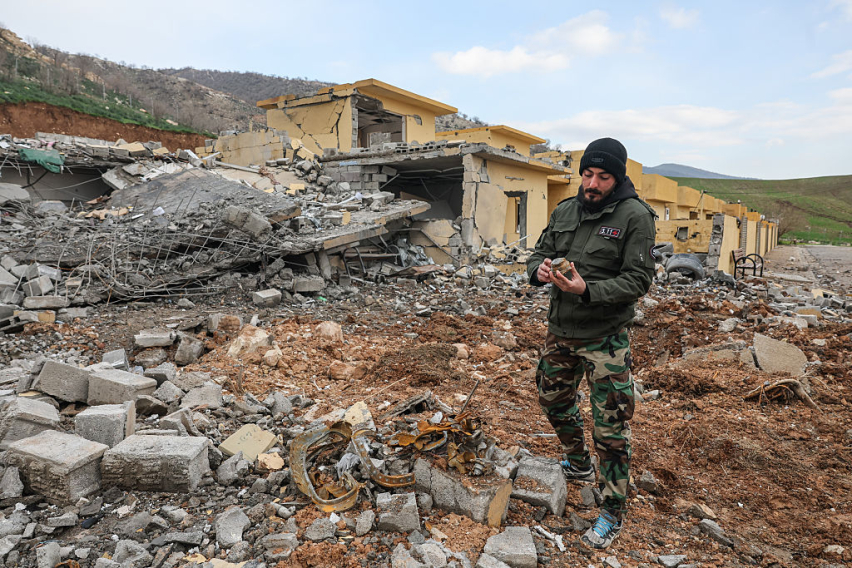
Northern Iraq, specifically the city of Erbil, has experienced constant military operations amid the current escalation in the region. A member of the leadership of an Ibero-American missionary movement serving in Iraq spoke with Diario Cristiano, the Spanish edition of Christian Daily International, about the situation on the ground. His name is being withheld for security reasons.
“We’ve had around 100 attacks in the city where we are right now in the north, in Erbil,” he said.
The offensives have hit civilian infrastructure in areas inhabited by minority communities. “An apartment complex in Ankawa, the Christian district, was struck by a drone and sustained significant damage.” In addition to residential areas, incidents have also been reported near the international airport. “In just the last 48 hours, more than 50 attacks have been intercepted.”
Given the level of risk in the area, diplomatic missions have issued alerts to their citizens. The Spanish Embassy advised them to evacuate the area immediately. However, the missionary chose to remain with the local community. He said the decision was based on a simple question: “What weight would our service carry when we say, ‘God protects, God keeps you, God is our refuge,’ if in the end we are the first to leave?”
The security situation is compounded by a crisis in basic services caused by the suspension of gas exports from the Khormor field. “There has been a critical reduction of up to 3,000 megawatts in electricity generation.” As a result, electricity supply is extremely limited. “We only have two or three hours of power a day, sometimes up to five.”
The war and memories of recent conflicts with the Islamic State influence religious communities in the Kurdish autonomous region, including Assyrians, Chaldeans and Turkmen.
“Fear is growing — people are increasingly afraid to gather or meet.” There is concern that the attacks may no longer be limited to U.S. military targets but could also affect civilian groups and consulates.
The missionary also addressed how the evangelical church is perceived in a Muslim-majority region, noting the need for caution regarding geopolitics.
“We see evangelical churches displaying the Israeli flag … sometimes Christianity gives the impression that it means loving — and perhaps supporting — what the Israeli government is doing, and that’s something we need to be careful about.”
Regarding the impact of the situation in Iran, the leader mentioned expectations about the Iranian underground church in the event of possible regime change. “The hope is that if the regime falls, there will be a wave … from this church that is growing rapidly.”
However, he said operating in secrecy brings its own challenges. “The Church, at least in northern Iraq, wants to be more visible, more institutional, and to hold a recognized place in society, because when everything is done in secrecy … they are often subject to immediate persecution.”
Comparing this reality with the perspective of believers in other parts of the world, the interviewee challenged some modern theological practices.
“The church in the West — whether in Hispanic America or Latin America — needs to embody the gospel and truly live it in a way that pushes them out of their comfort zone.”
The current operational needs of Christian ministry groups in northern Iraq include funding for local initiatives and hiring local staff, he says, since “I don’t see people coming here in the short term.”
The missionary said prayer requests to the international community focus on the safety of families and local minorities, handling the situation with “wisdom and discernment” in order to be “gentle as a dove and shrewd as a serpent,” and paying attention to neighboring countries affected by the escalation, such as Jordan and Lebanon.
Originally published by Diario Cristiano, Christian Daily International's Spanish edition.