Fifty years after a Lutheran pastor set himself ablaze in a public square to protest communist oppression of the church, German Christians remember a man whose act reverberated through East Germany and beyond.
Oskar Brüsewitz, a village pastor in the German Democratic Republic, died Aug. 22, 1976, four days after he doused himself with gasoline and ignited his clerical robes in front of the Michaeliskirche in Zeitz, in what is now the German state of Saxony-Anhalt. A protest sign mounted to the roof of his car read: "The Church in the GDR accuses communism — because of oppression in schools against children and youth."
Brüsewitz was born May 30, 1929, in what is now Lithuania — then part of German East Prussia. He was evacuated westward at age 15 as Soviet forces advanced in 1944, served briefly in the Wehrmacht, and was captured. He eventually settled in East Germany in the mid-1950s, where he converted to Christianity through the witness of a host family. He was ordained as a pastor in 1970 and assigned to the 200-person village of Rippicha near Zeitz.
From his first Sunday in Rippicha, he took a confrontational approach to the atheistic state. Against the party's harvest festival slogan — "Without God and sunshine we bring in the harvest" (German: "Ohne Gott und Sonnenschein bringen wir die Ernte ein") — he posted his own counter-sign: "Without rain, without God, the whole world goes bankrupt." (German: "Ohne Regen, ohne Gott, geht die ganze Welt bankrott.") At Advent, he mounted a large neon cross on the church tower to answer the neon slogans of the party.
Young people were especially drawn to him. His congregational activities regularly drew more attendance than state-mandated party youth meetings. When his congregation built an "Evangelical Children's Playground," the secret police threatened to destroy it. Authorities warned parents of young churchgoers that their children would be denied apprenticeships and university places if they continued attending.
His methods brought him into tension with church leadership as well as the state. Just two days before his self-immolation, he received a letter from church officials suggesting he seek another pastorate, according to jesus.de. On the morning of Aug. 18, he left a farewell letter with a neighbor, addressed to the local pastoral conference. "A mighty war rages between light and darkness," he wrote. "Truth and lies stand side by side."
Several hundred witnesses were present when Brüsewitz set himself on fire before the Michaeliskirche. Bystanders threw him to the ground and extinguished the flames with blankets, but he had sustained severe burns and died four days later in hospital. He was 47.
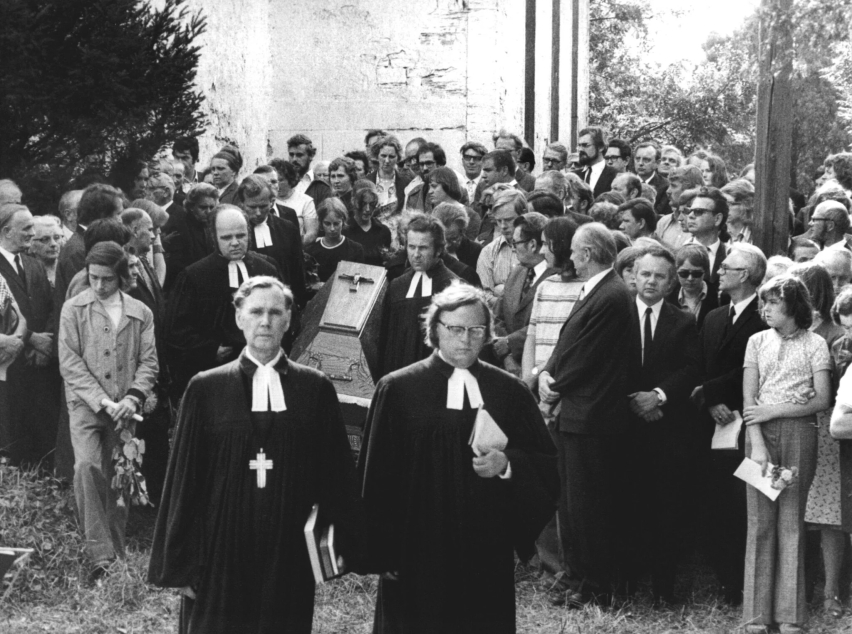
The East German government moved quickly to suppress the story and prevent Brüsewitz from becoming a martyr. Despite police checkpoints and efforts to turn away mourners, hundreds streamed to Rippicha for his funeral on Aug. 26. Approximately 80 pastors in clerical robes stood among hundreds of attendees at the village cemetery. A West German television crew filmed the service and broadcast it into homes across Germany — carrying with it an implicit indictment of the Communist regime.
Provost Friedrich-Wilhelm Bäumer, speaking at the graveside, refused to distance the church from the dead pastor. "We do not distance ourselves from Brother Brüsewitz," he said.
The Communist Party newspaper "Neues Deutschland" responded with a smear campaign, portraying Brüsewitz as mentally ill and invoking unnamed clergy who allegedly called him "unusual, indeed abnormal." The attack had an unintended consequence: it drew a formal protest letter from 35 East German dissidents — including singer Bettina Wegner — addressed to the party's Central Committee. Three signatories were imprisoned. Three months later, poet Wolf Biermann was stripped of his citizenship and expelled to West Germany.
Church historians and witnesses have since debated how to characterize Brüsewitz's act. His widow and biographers have resisted easy labels — neither straightforward martyrdom nor suicide, they argue, because the action was meticulously planned and driven by deliberate conviction, yet no adversary took his life. Some have compared him to Old Testament prophets whose symbolic acts were designed to be unforgettable even at great personal cost.
Christine Neuß, director of the archives of the Evangelical Church in Central Germany, told jesus.de that roughly 1,000 pages of documents in the church archive show he was "a freedom-seeking, indeed, I would even say, a freedom-hungry person."
Manfred Stolpe, a former senior church official who later served as a state premier in reunified Germany, offered a direct assessment of Brüsewitz's place in history: "Oskar Brüsewitz was a harbinger of system change."