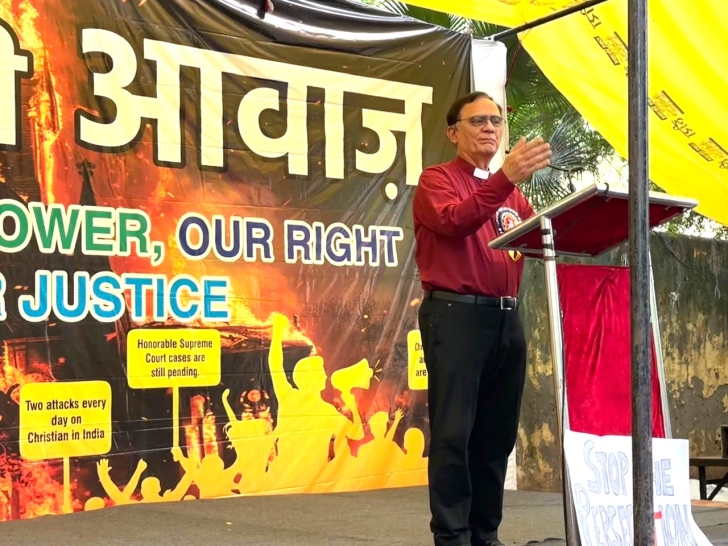
India’s move from 11th to 12th place on an annual ranking of countries where it is most difficult to be a Christian may appear to signal marginal improvement, but church leaders and rights advocates say it masks historic highs of persecution in the country.
In Open Doors’ World Watch List (WWL) 2026, which ranks the 50 countries where Christians face the most severe persecution, India slipped one place, but its overall persecution score remained unchanged at 84. Open Doors notes that rankings are relative and often change because conditions worsen elsewhere rather than because they improve in a given country.
“India’s marginal drop in the World Watch List ranking must not be construed as an improvement in the condition of Christians, which in fact has sharply aggravated,” said Dr. John Dayal, a veteran human rights activist and one of India’s most prominent voices on religious freedom. “It is just that another country has become more unsafe for Christians.”
Covering the period from Oct. 1, 2024, to Sept. 30, 2025, Open Doors’ data reveal troubling indicators even as India’s ranking dropped. The country’s violence score climbed to 16.1 out of a maximum 16.7, the highest in India’s history since the organization began tracking in 1993.
India now leads the world in Christian detentions, with 1,622 believers arrested, imprisoned or detained without trial during the reporting period. The country also scores 15.1 out of 16.7 in “National Life” persecution, the highest of all five measured pressure categories.
Christian monitoring organizations in India report similar escalation.
“From our own monitoring through the Evangelical Fellowship of India’s Religious Liberty Commission [EFI-RLC], we have recorded at least 920 incidents targeting Christians in 2025, the highest number we have documented in any single year,” said the Rev. Vijayesh Lal, general secretary of the EFI.
The United Christian Forum (UCF), another major monitoring body that operates a nationwide helpline for Christians in distress, documented 834 incidents in 2024. UCF National Coordinator A.C. Michael said the organization has not yet released its consolidated annual report for 2025 and plans to do so in March while Parliament is in session.
The WWL reported that sexual violence and harassment against Christian women increased 69 percent, from 13 documented cases during the previous reporting period to 22. The organization documented 16 Christians killed for faith-related reasons during the reporting period, down from 20 the previous year.
‘Rankings Are Relative; Persecution Is Lived’
Dayal said the ranking fails to capture how persecution has evolved within India.
“Rankings are relative; persecution is lived,” he said. “What the data for 2024-25 shows is not relief, but reconfiguration: fewer headline-grabbing episodes in one conflict zone, alongside a nationwide normalization of harassment, criminalization through anti-conversion laws, disruption of worship, social boycotts, and prolonged legal intimidation of pastors and congregations.”
When pressure becomes “localized, bureaucratized and routinized,” it may register less dramatically in global indices but cuts deeper into daily life, he added.
“The reality on the ground is that Indian Christians continue to face a hostile ecosystem that is widening, not receding,” Dayal told Christian Daily International.
Even Christian festivals have increasingly become flashpoints.
“Santa’s effigy was lynched in many towns,” he said. “Cribs were destroyed in macabre Herodian scenes.”
Lal of the EFI said that many of the incidents documented by EFI-RLC do not involve immediate physical violence but nonetheless have a deep impact on local Christian communities.
“Persecution today often operates below the threshold of mass violence,” he said. “But it is persistent, localized and deeply corrosive to religious freedom. Against this backdrop, a marginal shift in India’s World Watch List ranking does not reflect improvement on the ground.”
Michael of the UCF said preliminary findings from UCF’s monitoring show an alarming escalation.
“Violence against Christians has become more dangerous than before, as organized attacks have increased and hate speech has risen sharply,” he said. “False allegations of forced religious conversions are increasingly being used as a pretext to attack Christians, despite the absence of evidence.”
From Mob Violence to Legal Weaponization
Christian leaders say expanding misuse of state “anti-conversion laws” against forcible or fraudulent conversion has become one of the most significant drivers of persecution.
Rajasthan became the 12th state to enact anti-conversion laws in 2025, joining a growing list of states with such legislation. These laws often include provisions that reverse the burden of proof or require prior notification to authorities before religious conversion.
In January 2025, Jose and Sheeja Pappachan became the first Christians wrongly convicted under Uttar Pradesh’s anti-conversion law. The couple received five-year prison sentences and fines for working among Dalit communities. Uttar Pradesh had strengthened its 2020 law in 2024 to include life imprisonment as a possible sentence.
Michael highlighted a troubling pattern emerging from court proceedings. Police officials have repeatedly acknowledged in court that they found no proof of forced conversions in cases that led to arrests or detentions.
“Courts are acquitting the accused one after another,” he said, even as new complaints continue to be filed.
Legal advocates say that even when cases collapse in court, the process itself becomes a form of punishment. Those accused often spend months navigating police stations and courts, incurring legal costs and facing social stigma in their communities. Pastors and church members report that accusations under these laws frequently follow complaints by non-state actors, sometimes accompanied by mob pressure on police to act.
According to Open Doors, these laws “legislate the Hindu nationalist narrative that Hindus only convert due to pressure or incentives from Christians, so effectively criminalizing actions that lead to, or might lead to, Hindus converting.”
Why Ranking Shifted
The decrease in some violence indicators, including churches attacked or closed (82 during the current reporting period compared with 459 the previous year), primarily reflects fewer forced displacements in Manipur state, where violence remains severe but shifted in character. Open Doors notes that “while there remain outbreaks of brutal violence, fewer Christians were forced to flee their homes this year, and this was the main reason for the reduction in the violence score.”
Syria’s dramatic escalation, which saw the country jump 12 places to enter the top 10 for the first time in nearly a decade, contributed to India’s ranking drop despite India’s unchanged score. Put simply: Syria got dramatically worse, pushing India down a spot despite no improvement in India itself.
Christian leaders stress that India’s size and diversity complicate any single national assessment. Conditions vary sharply between states, and shifts in violence or pressure in one region can affect national-level indicators even as other regions experience worsening conditions.
Economic Power and Political Will
Prime Minister Narendra Modi, first elected in 2014 and re-elected in 2019 and 2024, has presided over a period when, according to Open Doors, “the annual reported number of violent attacks against Christians has increased significantly.”
Modi’s 2024 margin of re-election was narrower, requiring him to build a coalition with parties including some that strongly support religious freedom. Open Doors states, however, that this “hasn’t held back a growing tide of persecution against Christians, enabled at both the federal and state levels.”
India’s sustained economic growth has made the government “more confident in resisting international pressure on minority rights and in promoting religious nationalism,” according to Open Doors. India is now the world’s fourth-largest economy, the aid organization states, citing Deloitte.
Beyond legal pressures, Christian leaders point to rising social hostility and hate speech as key contributors to persecution. Monitoring groups report an increase in inflammatory rhetoric targeting religious minorities, including Christians, spread through public meetings, social media and local campaigns. According to UCF, the growth in hate speech has coincided with more organized attacks on churches and prayer gatherings.
The EFR-RLC reported a 6.5 percent increase in targeted attacks against Christians in 2024 compared with 2023, Christianity Today reported in March.
Call for Careful Reading
Despite differences in emphasis, Christian leaders interviewed agree on one point: the lived reality of Christians in India in 2025 does not support a narrative of improvement.
“What concerns us is not just the number of incidents, but the normalization of pressure and hatred,” Lal said. “When disruption of worship, false accusations and legal harassment become routine, they reshape how Christians live and practice their faith.”
Michael said the timing of UCF’s forthcoming annual report is intended to draw attention to these patterns at the national level.
“These are not isolated events,” he said. “They represent a sustained trend that lawmakers and society must take seriously.”
Dayal warned that a lower ranking could reduce international attention at a time when domestic pressures remain high.
“When persecution becomes embedded in administrative and social systems, it may appear less dramatic, but it is no less destructive,” he said.
International observers should read the WWL alongside credible local monitoring and listen carefully to voices from within the country, Christian leaders say. India is now among 15 countries classified as having “extreme” persecution levels, up from 13 countries in the previous year’s list.
“Persecution is lived daily by ordinary believers,” Dayal said. “No ranking can fully capture that reality.”
More than 388 million Christians face high levels of persecution and discrimination globally, an increase of 8 million from the previous year. North Korea maintained its position as No. 1 on the list for the 24th consecutive year, followed by Somalia, Yemen, Sudan, Eritrea, Syria, Nigeria, Pakistan, Libya and Iran in the top 10. Afghanistan ranked No. 11, followed by India at No. 12.
As India continues to be listed among the most difficult places in the world for Christians, church leaders say sustained attention, accurate reporting and legal accountability remain critical to protecting religious freedom and the rights of all citizens.