Thanks to misuse of a law against “outraging religious feelings,” a Christian pastor in Punjab state, India still cannot return home. His church is shut.
He survives on daily physical labor, and some months there is not enough money to feed his family or pay his children’s school fees. A second pastor who was arrested alongside him lives the same way, moving from place to place, doing what he can find and living constantly in fear.
What happened to them in police custody in 2023 nearly killed one of them.
Both were wrongly charged under Section 295A of the Indian Penal Code, which criminalizes “deliberate and malicious acts intended to outrage religious feelings,” with a maximum sentence of three years, no mandatory minimum and the right to seek bail. Punjab has had a state sacrilege law since 2008, but its criminal provisions were limited and police routinely used the IPC instead.
A 2026 amendment to that law changes everything, transforming a limited regulatory framework into a powerful criminal instrument with life imprisonment, mandatory minimums, non-bailable offenses and complete immunity for enforcement officers.
“What happened to these two men happened under a law that prescribed three years maximum,” a pastor who knows both men told Morning Star News on condition of anonymity. “Under this new amendment, with life imprisonment possible and police fully protected from accountability, I do not want to think about what could happen to the next person who is accused.”
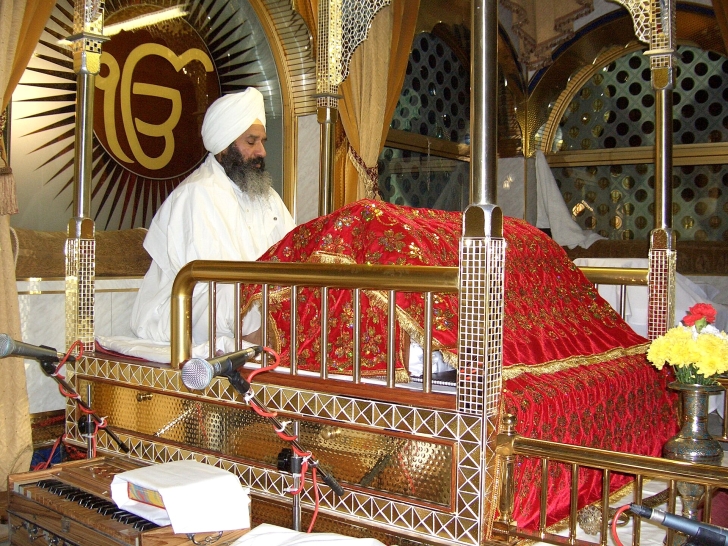
On April 13, the Punjab state assembly passed the Jaagat Jot Sri Guru Granth Sahib Satkar (Amendment) Act, criminalizing sacrilege, meaning desecration of the Guru Granth Sahib, the holy scripture of the Sikhs, revered by them as a living guru. Gov. Gulab Chand Kataria, a constitutional appointee of the central government led by the Bharatiya Janata Party (BJP), granted assent within days. The law came into force on April 20.
The new amendment prescribes a minimum of seven years imprisonment, extendable to 20 years, with fines between 2 lakh and 10 lakh rupees, approximately $2,150 to $10,750. For sacrilege carried out as part of a criminal conspiracy to disturb communal harmony, the ceiling is life imprisonment with fines up to 25 lakh rupees, approximately $26,900.
All offenses are cognizable, meaning police can arrest without a warrant, and non-bailable, meaning the accused cannot seek release as a matter of right. They are also non-compoundable, meaning the matter cannot be settled out of court. Section 6 shields state government officers from any suit or legal action for anything done under the law.
One of the two Christians punished under the law, a pastor, spoke on condition of anonymity because his case remains before the courts. Both were arrested in 2023 after torn pages of a Gutka Sahib, a Sikh prayer book, were found scattered on a road near their village. Police cited CCTV footage as the basis for their identification. Both were sent to police custody.
What followed, sources say, left one of them so physically and psychologically shattered that he came close to death while in custody. He spent weeks in a hospital before being transferred to jail, too weak to walk.
In jail, facing a complete crisis of faith, he stopped praying. Both men were broken. But in the prison where they were held, they found ways to meet. Together they began to remember who they were in Christ.
They read the Bible together, prayed together and refused to let go of hope. For the pastor, it was a very real spiritual experience, he said.
They were eventually granted bail, which their community saw as nothing less than a miracle. Their churches have not reopened. Every time a new sacrilege incident is reported in the region, sources said, police contact them and threaten to accuse them. The legal proceedings continue.
“They are barely surviving,” the pastor who knows them said. “Their families are suffering and paying the cost, but they are alive and they are still in the faith. That is what matters.”
Their ordeal, which predates the 2026 amendment, illustrates what Punjab’s Christian communities fear the new legislation could make faster, more certain and far harder to survive.
The amendment’s origins lie in the Bargari sacrilege of 2015, when more than 110 pages of the Guru Granth Sahib were found strewn outside a gurdwara, a Sikh place of worship, in Faridkot District, triggering protests in which two men were killed in police firing.
Of 597 sacrilege cases registered in Punjab between 2015 and early 2026, only 44 ended in conviction, a rate of barely 7 percent, according to Punjab Police data. A government study found the failures were due to investigative gaps and systemic delays, not the absence of legal provisions.
The Aam Aadmi Party, or AAP, government of Punjab Chief Minister Bhagwant Mann passed the new Act, calling it “a historic correction of past regimes’ failures.” What the government did not reveal is that the AAP itself had failed to deliver on earlier sacrilege-related promises after coming to power in 2022.
The party’s record on religious politics tells a more complicated story. In January 2022, AAP then-national convener Arvind Kejriwal called for an anti-conversion law while campaigning in Punjab. By March 2026, his own chief minister, Mann, was publicly warning that the “religious card” would never work in Punjab.
Gov. Kataria, a BJP appointee, told the Hindustan Times in a May 14 interview that religious conversion was “a cause of big worry” and called on the state government to “think seriously about bringing a law against religious conversions which exploit economic or social vulnerabilities.”
Explaining why he approved the bill so rapidly, Kataria said, “I went by the spirit and intent behind the law. I counselled the state government that a similar law needs to be framed to safeguard the sentiments of other religions to raise public satisfaction.”
Punjab does not yet have an anti-conversion law. But the governor’s words have done little to reassure Christian communities that one is not coming.
Long before the 2026 Act was passed, the atmosphere in Punjab’s villages had already turned hostile toward Christians. Amritpal Singh, a self-styled Sikh preacher who heads Waris Punjab De (Heirs of Punjab), and who supports the Khalistan movement, a Sikh separatist campaign seeking to carve an independent Sikh homeland out of India’s Punjab state, made religious conversion one of his central campaigns in 2022 and 2023.
In October 2022, the Christian community in Jalandhar organized a major protest demanding an FIR against Singh for allegedly making derogatory remarks about Christ. Punjab Police launched a crackdown against him in March 2023, eventually detaining him under the National Security Act, India’s preventive detention law. He was nonetheless elected to Parliament in 2024 while still in detention and remains a significant political presence.
Albert Dua, former member of the Punjab State Minorities Commission and president of the Christian United Federation in Punjab, said Singh’s movement had lasting consequences.
“After Amritpal Singh’s movement around conversion, an atmosphere was created in interior villages and inaccessible neighborhoods,” Dua told Morning Star News. “People began targeting local Christians, banning pastor visits in some villages, ostracizing families for being Christian. This law will only deepen that fear.”
Dua also challenged the law’s selective scope.
“This law ignores every other religion completely,” he said. “If such legislation had to be made, it should have covered all holy scriptures equally. As it stands, it is discrimination written into legislation.”
Pastor Robert Masih Khosla of Peace Makers Foundation Church in Chandigarh concurred.
“This is a partial law – the same punishment should apply to anyone who disrespects the Holy Bible or any other scripture,” Pastor Khosla told Morning Star News.
Khosla added a ground-level warning.
“When the law was not this stringent, it was already being used against pastors and Christian community leaders,” he said. “Now that it is far more severe, it will be used as a dhaal, a shield or pretext, by those who want to stop Christians from moving freely and speaking in villages. We have seen it happen. We will see it happen more.”
John Dayal, spokesperson of the All India Catholic Union and a veteran human rights activist, said communities most at risk are Dalit and Mazhabi Sikhs. At the lower end of Punjab’s entrenched caste hierarchy, for over two decades they have quietly found their way to evangelical Christianity.
“When a family converts from Sikhism to Christianity, the household copy of the Guru Granth Sahib must be returned to a gurdwara or disposed of with an appropriate ceremony,” Dayal told Morning Star News. “Under this new law, that deeply private moment becomes legally treacherous. A WhatsApp message about the scripture’s relocation, a spoken word misconstrued by a hostile neighbor, all fall within the law’s provisions.”
The non-bailable character of all offenses means a malicious complaint filed without evidence translates into police custody before any court examines its merits. This pattern is already established across the 12 Indian states that have enacted anti-conversion laws, where non-bailable provisions have repeatedly enabled arrest before investigation.
Arjun Sheoran, an attorney at the Punjab and Haryana High Court, noted in the publication LiveLaw that unlike Section 295A of the IPC, which requires prior government sanction before prosecution can begin, the new act contains no such filter between accusation and arrest.
Dua pointed to neighboring Rajasthan, a BJP-governed state that passed its own anti-conversion law in September, as a warning of what lies ahead. Since that law came into force, attacks on Christians have surged, with pastors arrested on false charges and prayer meetings raided by Hindu extremist groups.
“What is happening in Rajasthan is a khatre ki ghanti, a warning bell, for us,” Dua told Morning Star News. “Ultimately they will bring this law to Punjab also. As a community we have to stand united. We are Masihi (Christians), followers of Christ. We have to reclaim that identity, not say I am Catholic or I am Pentecostal or I am CNI [Church of North India]. We are one.”
The law has encountered resistance even within Sikhism. On May 8, the Akal Takht, the highest temporal seat of Sikh authority, gave the government a 15-day ultimatum to remove objectionable clauses, particularly provisions placing Sikh religious officials within a criminal legal framework and a requirement to publish online the locations of all scripture copies in private custody.
Mann refused. “There will be no withdrawal of the Sacrilege Act 2026 at any cost,” he said, launching a statewide Shukrana Yatra, or Thanksgiving procession, to celebrate the law’s passage.
The Akal Takht’s deadline expired on Tuesday (May 26) with no government response.
The law also faces challenges in the Punjab and Haryana High Court. The Anglican Church of India, known as CIPBC, associated with GAFCON, the Global Anglican Future Conference and distinct from the Anglican Communion and from the mainstream Church of North India and Church of South India, has filed a petition through its metropolitan bishop, Rockes Bernabas Sandhu of Amritsar. The petition argues the law creates a religion-specific penal regime violating the constitutional guarantee of equality before law and seeks both quashing and a stay on implementation.
India ranked 12th on Open Doors’ 2026 World Watch List of the countries where it is most difficult to be a Christian, up from 31st in 2013 before Prime Minister Narendra Modi came to power. Hostilities against Christians reached 747 incidents in 2025, according to the Religious Liberty Commission of the Evangelical Fellowship of India, more than five times the 147 cases documented in 2014.
For the two pastors living uprooted lives, statistics are an abstraction. They were charged under a law that prescribed a maximum of three years in prison, were never convicted, and returned to a world that no longer has a place for them.
The amendment that has now come into effect prescribes life imprisonment, grants enforcement officers complete immunity and leaves no gate between an accusation and an arrest.
They still have faith in Christ, something that is increasingly difficult in Punjab state.