This is the first in a series of four. You can read the other three here: Air, Earth, and Fire.
As you frolic in the water during your summer vacations (or for those in the southern hemisphere fortunate enough, while you are skiing the slopes) pause to reflect on the amazing phenomenon of H₂O.
Liquid water... is an extraordinary phenomenon.
To us, water seems to be everywhere. Yet, in the context of the cosmos, it is unspeakably rare. Though hydrogen and oxygen are common in the universe, liquid water (especially clean, drinkable water) is an extraordinary phenomenon. It is not just essential to life as we know it; it is inseparable from it. Where there is life, there is water. Where there is no water, life withers.
Water is a true wonder we easily take for granted. A clear, tasteless, shapeshifting, life-carrying, rock-eroding, fire-resisting miracle. It is Earth’s most precious element. Not gold, not oil. Water.
Water is a simple, basic molecule: two hydrogen atoms bonded to one oxygen atom. Yet this combination of atoms results in some of the strangest and most vital properties of any known substance. Water is the only natural substance found on Earth in all three physical states: solid (ice), liquid (water), and gas (vapor), and within a narrow temperature range. That makes it extremely versatile and dynamic.
Its molecular structure gives it polarity (positive and negative ends), making it a powerful solvent; cohesion and adhesion, allowing it to form droplets and climb plant stems; high specific heat, enabling it to absorb and store large amounts of heat; unusual expansion when frozen, making ice float rather than sink.
Without these unique properties, Earth’s climate would be unstable.
These quirks aren’t just fascinating science trivia. Without these unique properties, Earth’s climate would be unstable, cells couldn’t function, plants couldn’t draw water from soil, and oceans would freeze from the bottom up—killing aquatic life.
Preciously unique
Water is an unsung genius of molecular design, both astonishingly simple and miraculously suited for life. Though water molecules are detected in interstellar clouds, comets, and even as ice on Mars, liquid water in stable, drinkable form is rare, perhaps even unique. When we sip water from a glass, we are enjoying a rare cosmic delicacy!
We live in an oasis surrounded by a cosmic desert.
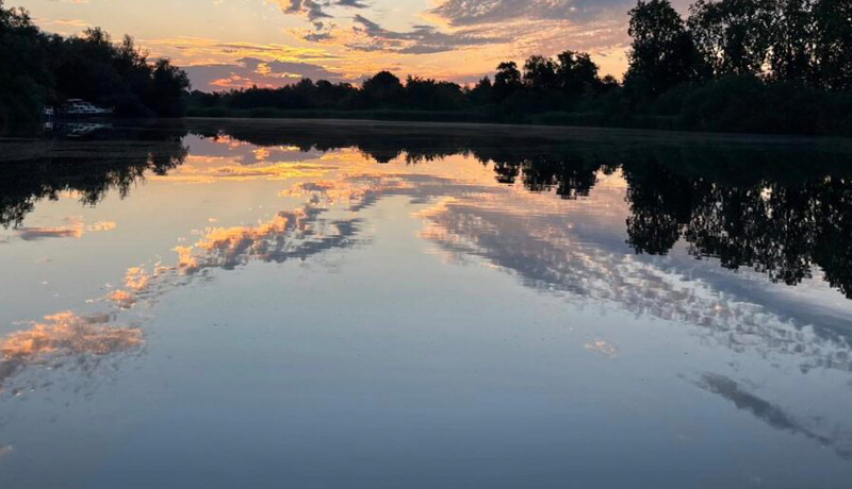
We live in an oasis surrounded by a cosmic desert. Scenes like that above (the waking sight from my boat this week) cannot be seen anywhere else in the cosmos. Think of the water itself, the trees and the clouds.
Earth lies in what astronomers call the "Goldilocks Zone" (that is, not too hot, not too cold) where water can remain liquid. Our planet has the right atmosphere to keep water from evaporating into space; the right pressure to keep it from boiling or freezing; a biosphere that recycles it constantly through evaporation, condensation and precipitation.
Water... is more than refreshment. It is re-creation.
Water seeps into every aspect of human life and culture. We use it in ways both basic and profound. The average human body is about 60% water (our blood alone is 90% water). Every cell requires it. We can survive weeks without food, but only days without water. When you sip water, you are restoring the core processes of life. It is more than refreshment. It is re-creation.
All agriculture depends on water. Rainfall, irrigation, and dew feed the soil. Crops rise and fall with the availability of water. Livestock, too, rely on fresh water, not just for drinking, but for the plants they eat. Industrial processes, power generation, and manufacturing also consume massive amounts of water—to cool machinery, mix chemicals, or clean materials.
Without water, the entire global economy would collapse.
The data centers that train and run AI models generate enormous amounts of heat, requiring huge amounts of water to cool these facilities; plus the additional water used to generate the electricity AI consumes. Without water, the entire global economy would collapse.
An archetype of grace
Water purifies. We start our day with a shower or a bath, brushing our teeth, washing our face, and using the lavatory. We wash our dishes and clothes with water; we clean our homes, streets, and cities with it. We clean our wounds with water.
Water... carries the story of humanity.
Rivers, seas, and oceans have been the highways of human civilization. Ancient trade, exploration, and migration followed water routes. Today, over 80% of international trade still happens over water. Shipping, fishing, and recreation depend on the continued stability of marine ecosystems. Water connects continents and cultures, and carries the story of humanity.
Poets, painters, and composers have long drawn inspiration from water’s beauty and movement; from the shimmering stillness of a lake to the roaring grandeur of a waterfall. Water reflects the sky. It dances with light. It sings in waves.
Water is the archetype of grace: given freely, flowing naturally, humble and patient, soft and yet stronger than rock.
Water is the archetype of grace: given freely, flowing naturally, humble and patient, soft and yet stronger than rock. It never forces itself, yet wears down mountains. It seeks the lowest place, yet brings life to all.
Water is tied to healing, humility, forgiveness, and restoration. Across cultures, it is seen as a force that renews both body and soul.
To reflect on water is to remember what it means to be alive, and to be human. It is to awaken awe. To realize that we are cradled in an extraordinary, delicate, and rare cosmic gift.
It is to stir wonder and gratitude… and worship of God our Creator.
Originally published by Weekly Word. Republished with permission.
Jeff Fountain and his wife Romkje are the initiators of the Schuman Centre for European Studies. They moved to Amsterdam in December 2017 after living in the Dutch countryside for over 40 years engaged with the YWAM Heidebeek training centre. Romkje was founder of YWAM The Netherlands and chaired the national board until 2013. Jeff was YWAM Europe director for 20 years, until 2009. Jeff chaired the annual Hope for Europe Round Table until 2015, while Romkje chaired the Women in Leadership network until recently. Jeff is author of Living as People of Hope, Deeply Rooted and other titles, and also writes weekly word, a weekly column on issues relating to Europe.
Weekly Word is an initiative of The Schuman Centre for European Studies. Jeff Fountain is a New Zealander holding a Dutch passport, is currently the director of the Schuman Centre for European Studies (www.schumancentre.eu), and lives in Amsterdam, the Netherlands. Jeff graduated with a history degree from the University of Auckland (1972) and worked as a journalist on the New Zealand Herald (1972-3), and as travelling secretary for Tertiary Student Christian Fellowship (TSCF) (1973). He has lived in the Netherlands since 1975, and has travelled and spoken in almost every European country. For twenty years following the fall of communism, he was the European director for the international and interdenominational mission organisation, Youth With A Mission. He was chairman of the international, trans-denominational movement, Hope for Europe, for which he organised two pan-European congresses in Budapest in 2002 and 2011. In 2010, he established the Schuman Centre for European Studies (www.schumancentre.eu) to promote biblical perspectives on Europe’s past, present and future, to encourage effective engagement in issues facing Europe today.