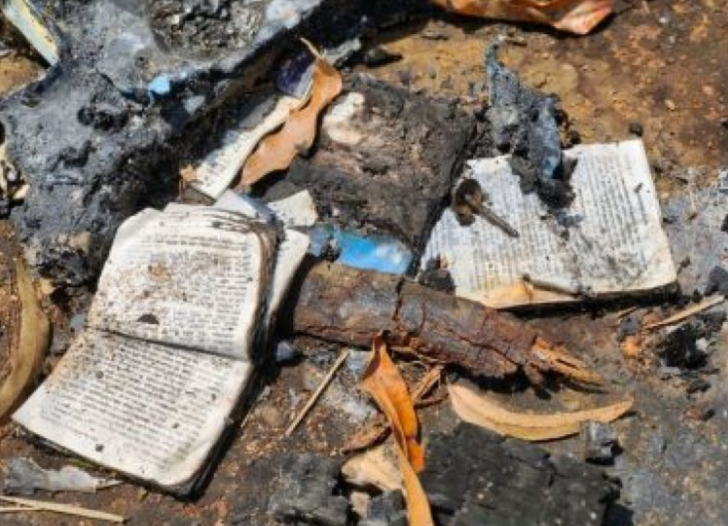
Three years after ethnic violence erupted in India’s northeastern state of Manipur, more than 300 church buildings have been destroyed and at least 217 people killed by official count, with broader estimates exceeding 260.
Fresh clashes broke out across the state in April, drawing in all three major clashing communities, and no senior official has been prosecuted in three years.
As the state commemorated the 2023 violence on May 3, two children killed in a rocket-propelled shell attack on April 7 were laid to rest on May 2, after their bodies lay unclaimed for 25 days while their family negotiated justice from the government. India’s Supreme Court has ordered a new forensic examination of audio recordings allegedly linking a former chief minister to the violence, and Kuki-Zo armed groups told the central government on Friday (May 1) that a return to the pre-conflict status quo is no longer acceptable.
Manipur is a state of roughly 3 million people in India’s far northeast, sharing a long border with Myanmar. It is divided between a fertile central valley and surrounding hills covering about 90 percent of the land.
The valley is home to the Meitei community, predominantly Hindu. Although Meiteis occupy only about 10 percent of the state’s physical territory, they hold 40 of Manipur’s 60 state assembly seats, giving them permanent legislative dominance. They control the civil services, the business economy, and the state’s political institutions.
The hill districts, home to Kuki-Zo, Zomi and Naga tribal peoples, almost all of whom are Christian, cover the vast majority of the land but hold only 20 assembly seats and remain severely underdeveloped.
Kuki-Zo and Naga tribes held Scheduled Tribe status, a government classification that reserved a share of government jobs and educational opportunities for communities historically excluded from power. In March 2023, a state court issued an order appearing to recommend extending that same status to the Meitei majority. For Kuki-Zo and Naga communities, already marginalized economically and politically, this threatened to open their lands to the dominant valley community for the first time.
Tribal communities organized a protest march, formally called the Tribal Solidarity March, for Sunday (May 3). That march was met with violence. By nightfall, churches belonging to Kuki-Zo, Naga and even Meitei Christian communities were burning across the state.
What followed demolished any claim that this was simply a land dispute. The Churachandpur District Christians Goodwill Council documented the destruction of more than 150 church buildings in the first days alone, across 15 denominations.
The Evangelical Fellowship of India, representing more than 65,000 churches across India, mourned “the loss of innocent lives, destruction of homes, property and the burning of multiple churches,” calling on the government to restore peace and affirming that “every human being is made in the image of God and deserves to be treated with dignity and respect.”
By the second anniversary of the 2023 violence in May 2025, the National United Christian Forum, a coalition that includes the Catholic Bishops’ Conference of India, the National Council of Churches in India, and the Evangelical Fellowship of India (EFI), reported that over 300 churches had been destroyed in total.
The violence did not spare even Meitei Christians. Mobs burned churches belonging to Meitei Christians, people of their own ethnic community whose only difference was their faith. Rev. Vijayesh Lal, general secretary of the EFI, stated plainly: “The victimhood was largely Christian. Meitei churches were also burned.”
Meitei Christian families reported being visited by extremists demanding they sign documents renouncing their faith, pledge not to build new churches, and return to Hinduism.
Writing for Scroll.in, human rights lawyer Nandita Haksar identified the political engine behind the religious violence: “Tribal communities feel the Bharatiya Janata Party [BJP] that is in power in the state is playing a dangerous communal politics by backing the Meiteis as ‘Hindus,’ as against the tribal peoples who are predominantly Christian. Hindu nationalism has allowed the burning of churches and growing religious fundamentalism in the Valley.”
The BJP, India’s ruling party, is a Hindu nationalist party governing both Manipur and India under Prime Minister Narendra Modi.
The political response to the 2023 violence compounded the disaster. Manipur was governed when the conflict began by BJP Chief Minister N. Biren Singh. All 10 Kuki-Zo members of the state legislature, including some from Singh’s own party, formally accused his government of complicity in the violence.
Among the primary drivers of organized anti-Kuki violence documented by human rights organizations was the Arambai Tenggol, a Meitei armed militia whose members were photographed at the state assembly demanding legislators sign loyalty pledges.
A Kuki civil body, the Kuki Organisation for Human Rights Trust (KOHUR), filed a petition before India’s Supreme Court containing audio recordings allegedly of Singh claiming he personally instigated the violence. On April 30, the Supreme Court ordered a fresh forensic examination of the full recording, confirmed in court as two hours and 26 minutes long, directing the National Forensic Sciences University in Gujarat to complete a voice comparison with Singh’s admitted recordings within six weeks. A private forensic firm had earlier indicated a high probability of a voice match, while a government laboratory found signs of tampering and could not offer a definitive comparison.
Singh has not commented, calling the matter sub judice, or ongoing court case.
Prime Minister Modi said nothing publicly about Manipur for 77 days. He broke his silence only after a 26-second video went viral on July 19, 2023. The footage, recorded on May 4, showed dozens of men parading two Kuki-Zo women stripped naked through a village. The women were groped and sexually assaulted. At least one was subsequently gang-raped, according to a police complaint filed by the survivors.
The video had been suppressed for over two months by a state-wide internet blackout that lasted more than 200 days in total, from May to December 2023, one of the longest such shutdowns in any democratic country, cutting off nearly 3 million people and preventing news of the atrocities from reaching the world. The mobile internet blackout affected 96 percent of users.
India’s Supreme Court called it a “gross constitutional failure.” Opposition leader Mallikarjun Kharge said in Parliament: “Manipur is burning, women are raped, naked, paraded, and horrific violence is taking place. But the PM kept quiet for so long until today.”
Modi made his first visit to Manipur only in September, more than two years after the violence began, announcing 7,000 new homes for displaced families. In April, as fresh violence erupted, he was campaigning in West Bengal. He did not visit Manipur.
“Manipur is dying every day,” Simanta Singh, pastor of the Manipuri Baptist Church, Dimapur, Nagaland, a Meitei Christian, told Christian Daily International. “There is anarchy – whatever seems right to each one, so are they doing. Because central government did not decide to bring justice. If they [the government] think with the divide and rule policy, they will be able to rule Manipur, they will not be able to attain anything.”
The conflict continued through 2023 and 2024 with no prosecutions of senior officials or militia leaders. The Biren Singh government further deepened the crisis in February 2024 by refusing to renew the Suspension of Operations (SoO) pact, a ceasefire arrangement first signed in 2008 between the Indian government and an umbrella of 24 Kuki-Zo armed groups. The pact was only renewed during President’s Rule in 2025, days before Modi’s first visit.
In November 2024, the crisis reached a new low when six Meitei civilians, including three women and three children, were kidnapped and killed in Jiribam District, their bodies recovered from the Barak river, triggering nationwide outrage.
In India’s 2024 national elections, Manipur voters handed both of the state’s parliamentary seats to the opposition, rejecting the BJP entirely. Singh resigned on Feb. 9, 2025, facing a no-confidence vote after his own coalition partners withdrew support.
One Christian victim’s suffering has reverberated throughout the conflict. Vungzagin Valte was a BJP legislator representing the Zomi tribal people of Churachandpur. On May 3, 2023, the first day of the violence, he was attacked while returning from the state secretariat. He never recovered, dying on Feb. 20, 2026. No one has been prosecuted for his attack.
Three years on, Manipur has effectively fractured into three distinct territorial zones. The Meitei valley, the Kuki-Zo hills, and the Naga-dominated north and east now function as separate worlds. Security checkpoints and buffer zones, cordons manned by central forces, separate Meitei from Kuki-Zo. In Naga-dominated Ukhrul and Kamjong districts, additional buffer zones have been established to prevent clashes between Naga and Kuki groups, with highways blocked to valley commuters. Families who lived in mixed communities have been permanently displaced from their homes, farmlands, and livelihoods. The division is as hard today as it was in May 2023.
A new BJP government of Manipur took office on Feb. 4 under Chief Minister Yumnam Khemchand Singh, whose “Journey for Peace” initiative involved traveling by road through conflict zones and buffer zones that no sitting Chief Minister had crossed since May 2023.
The Rev. Van Lalnghakthang, principal of Sielmat Bible College in Churachandpur and president of the Churachandpur District Christians Goodwill Council, is from the Hmar people, one of the Kuki-Zo tribal communities. He assessed the situation carefully.
“While there has been a change in leadership, for many people on the ground, the overall situation still feels uncertain,” he told Christian Daily International. “There may be some visible efforts, but the deeper sense of stability and normalcy that people hoped for has yet to fully return.”
Pastor Singh echoed a similar sentiment. “Nothing has changed with the new face governing the state,” the pastor said. “He [chief minister] met the Meitei people and the Kuki-Zo people, but there is no outcome of those meetings.”
Kuki-Zo residents of Kangpokpi District, just 20 kilometers (12 miles) from Imphal and its airport, cannot safely cross into Meitei-controlled territory. For any medical emergency, they must undertake a six- to eight-hour road journey on potholed highways to reach Dimapur in the neighboring state of Nagaland. From Churachandpur, the journey to reach air transport takes approximately eight hours.
Meiteis retain access to Imphal airport. Kuki-Zo have none in their territory.
A community organizer in Kangpokpi told media in September: “Even if there is a medical emergency, none of us will dare to go to a hospital in Imphal, which is just 20 kilometers away. We will have to travel by road to Dimapur.” As a result, people have reportedly died on those roads.
Manipur’s violence did not pause under the new government. On April 7, a rocket-propelled shell killed 5-year-old Tomthin and 5-month-old Yaisana as they slept beside their mother, identified only as Binita, in Bishnupur District.
When Binita regained consciousness in the hospital, she kept asking for her children. The family could not tell her the truth.
“Sometimes she would shout, saying, ‘My younger child is calling me. Why aren’t you giving them to me?’” her father-in-law Oinam Babuton, 70, told Outlook magazine.
For 25 days, the family refused to claim the bodies, holding prolonged negotiations with the state government pressing for justice and security assurances. During that period, three protesters were shot dead by Central Reserve Police Force (CRPF) personnel, India’s federal paramilitary force, when security forces opened fire to disperse a crowd near a CRPF camp. Five persons have since been arrested in connection with the April 7 attack.
On Saturday (May 2), the eve of the third anniversary, the family finally received the children’s bodies from the Regional Institute of Medical Sciences mortuary in Imphal. The last rites were performed at Lamthaboong in Bishnupur District amid scenes of deep grief. At least 11 people have been killed across Bishnupur and Ukhrul districts since April 7 alone. The Prime Minister’s Office issued no statement on the killing of the two children.
On April 18, armed attackers ambushed a convoy on National Highway 202 in Ukhrul District, killing two Naga civilians including a retired Indian Army soldier. The killings drew the Naga community, which had maintained uneasy neutrality for nearly three years, into direct confrontation with Kuki-Zo communities. Gun battles between Naga and Kuki groups broke out in Senapati District by April 21.
Violence erupted elsewhere on April 24. At around 5:30 a.m., a heavily armed group descended on Mulam, a Kuki-Zo village in Ukhrul District, a part of Manipur predominantly inhabited by the Tangkhul Naga people. The village authority had sent appeals for help to nearby authorities in the preceding days. No help arrived.
The attackers burned 17 homes and killed two village volunteers defending the settlement: Letlal, 43, and Paominlun Haolai, 19, both of whom had traveled from the Kuki-Zo heartland districts of Kangpokpi and Churachandpur to protect a minority community in Naga-majority territory. Women and children were among those injured and displaced.
By April 25, police confirmed a third death. The Tangkhul Naga Long, the apex body of the Tangkhul people, said a 29-year-old volunteer named Horshokmi Jamang was killed nearby, which they attributed to Kuki armed groups. Both communities accused the other of striking first.
Since February, at least seven people have been shot dead and more than 30 houses torched in Ukhrul District. On April 30, security forces destroyed 23 illegal bunkers in the Litan police station area and seized 18 improvised explosive devices in a separate operation in Tengnoupal District.
On Thursday (April 30), the Kuki CSO Working Committee of Ukhrul, a civil society organization representing Kuki communities in the district, formally banned security forces from entering all Kuki villages until “credible, impartial, and effective action is ensured.” The committee alleged that security forces had identified the perpetrators of repeated attacks on Kuki villages but were “unable to act decisively due to political pressure.”
Kuki communities formally barring India’s security forces highlights a breakdown of institutional trust with few precedents in three years of conflict. Kuki Inpi Manipur, the apex body of the Kuki tribes, separately reported over 50 Arambai Tenggol members allegedly operating alongside Tangkhul armed elements in Ukhrul District. These allegations have not been independently verified.
Amid the violence, the Kuki Christian Leaders’ Forum (KCLF) issued a statement on April 27 expressing grief that communities “that have worshipped the same God, read the same Scriptures, and professed the same gospel of peace” were now killing each other. The KCLF warned that churches and pulpits were being used “to encourage hostility, justify violence, or influence young people toward war,” and that “an ethnocentric interpretation of the Holy Scriptures does not only contradict the teaching of Jesus Christ but also causes ethnic tensions and conflict.”
On May 1, the Union Ministry of Home Affairs and the Manipur state government resumed tripartite talks in New Delhi with Kuki-Zo armed groups under the SoO pact, the first such meeting since the new government took office in February. Kuki-Zo groups told officials that their communities “continue to live under constant fear of attacks” in Ukhrul district and that numerous villages had been burned over the past month.
They reiterated their demand for a Union Territory with a legislature for the hill areas. In India, a Union Territory is governed directly by the central government in New Delhi rather than by an elected state government, meaning what Kuki-Zo communities are demanding is effective separation from Meitei-governed Manipur and placement under direct central administration. After three years of conflict, their political demand is no longer ambiguous.
Nu Rebecca Saheibung, spokesperson of KOHUR was unequivocal.
“We do not trust the Manipur state machineries anymore based on all the events since 3rd of May 2023,” Saheibung told Christian Daily International. “The central government must deal with all our grievances separately. We have no expectation from the state government but high expectations from the Central government. Rehabilitate us in our Kuki dominated areas and compensate us fairly.”
Her latest demand signals how far the community has moved: “Separate administration for each community to ensure the security and peaceful coexistence of all communities should be the underlying factor to solve the imbroglio of Manipur.”
Pastor Singh expressed distress over the demand of a separate administration.
“Meitei Christians are for peace, but we cannot do anything because we are in minority,” Pastor Singh said. “On the other hand Kuki-Zos are Christians who are in majority, and in a position of doing something, but they are not doing anything. Instead of trying to make a bridge between the two communities, they are demanding separation.”
The Kuki Women Organisation for Human Rights and Kuki Women Union wrote to Prime Minister Modi on April 29 demanding a CBI investigation into the Singh audio tapes, an NIA investigation of the Mulam attack, and structured political dialogue. “As mothers, wives, sisters and daughters,” they wrote, “we have borne the heaviest cost of the violence.”
As of March 30, 58,881 people remain in 174 relief camps. Some 7,894 homes were completely destroyed and a further 2,646 partially damaged. India’s central government has sanctioned Rs 947 crore, approximately $102 million, for relief and rehabilitation, with the state allocating a further Rs 734 crore, approximately $79 million, in its 2026-27 budget.
Around 3,000 prefabricated houses have been constructed. The church has become the primary institution keeping displaced families alive, with Kuki-Zo camp residents surviving largely on church support with minimal government aid reaching them on the ground.
The Rev. Van Lalnghakthang, addressed the limits of the security approach.
“The persistence of violence suggests that these measures alone are not sufficient,” he told Christian Daily International. “A sustainable solution will likely require a broader approach, one that includes dialogue, reconciliation and rebuilding trust alongside security efforts.”
Manngaihlun Tombing, a teacher and lay leader from the Evangelical Baptist Convention in Manipur, said the issue is not just about policy or administration.
“It is about people, their safety, and their dignity,” Tombing told Christian Daily International. “Lasting peace will depend not only on decisions made at the top, but on whether those decisions are truly felt in the everyday lives of those who have endured the crisis.”
Pastor Singh emphasizes that the central government has to take responsibility.
“As a Meitei Christian my expectation is that this violence should end,” Pastor Singh said. “We want to stay together. We need our Kuki-Zo brothers and sisters and their support.”
Three years after the first church buildings burned, no senior official has been successfully prosecuted.
“If the government wanted, they could call both sides and end this violence in 2023, within two-days,” the pastor said. “The Central Government has to use different strategies to bring peace, otherwise we see no end to this violence.”
(Modified May 6, 2026 to correct the name of Pastor Simanta Singh.)