
India’s Roman Catholic bishops have recently elected the country’s first Dalit cardinal to lead them. The symbolism is powerful. But can one man, in perhaps four years, dismantle the caste walls that still run through the Indian Church?
On Feb. 7, India’s Roman Catholic bishops did something that would have been unthinkable a generation ago. Meeting in the southern city of Bengaluru for their 37th general body meeting, they elected Cardinal Poola Anthony, the Metropolitan Archbishop of Hyderabad, as president of the Catholic Bishops’ Conference of India (CBCI). The vote, conducted by secret ballot, made Anthony the first Dalit to lead the conference, which represents nearly 20 million Catholics across the country.
The significance of that fact requires some context. The word “Dalit” comes from Sanskrit and translates roughly as “broken” or “crushed.” Dalits are people who fall outside the traditional Hindu caste system, a rigid social hierarchy that has organized Indian society for centuries. Under the old order, they were considered “untouchable,” forced into the most degrading forms of labor, denied access to temples, wells and schools, and subjected to routine violence.
India’s constitution formally abolished caste-based discrimination in 1948 and introduced affirmative action programs to help the historically excluded. But the reality on the ground has been slow to catch up with the law. Caste prejudice persists across Indian society, and, as Dalit Christians have long argued, it persists within the Church too.
Bishop Sarat Chandra Nayak of Berhampur, who chairs the CBCI Office of Scheduled Caste and Scheduled Tribes, was blunt about what the vote meant. “Bishops have sent a clear and prophetic message to those who still have the tail of casteism with them (both perpetrators and victims) that Dalits and Tribals can be leaders in the Church at all levels,” he told the Catholic news outlet Crux.
“There is no partiality in God,” he said.
From Poluru to Hyderabad
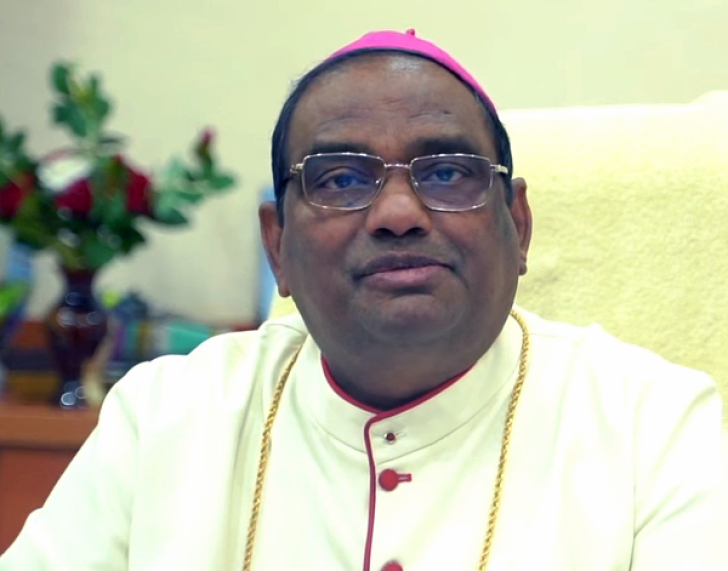
Anthony was born on Nov. 15, 1961, in Poluru, a small settlement in the Diocese of Kurnool in Andhra Pradesh, one of India’s southeastern states. He was ordained on Feb. 20, 1992, after training at Saint Peter’s Pontifical Seminary in Bengaluru. For the next decade, he served in parishes across small towns in Andhra Pradesh: Tekurpet, Badvel, Veerapalli. He spent years among ordinary congregations in rural India before studying at Loyola University in Chicago, where he earned a master’s degree in pastoral care while also serving at Saint Genevieve Church in the Archdiocese of Chicago.
He later ran the Christian Foundation for Children and Aging and held administrative roles in the Diocese of Cuddapah before being appointed Bishop of Kurnool in 2008. Pope Francis named him Metropolitan Archbishop of Hyderabad in 2020 and made him a cardinal in August 2022, the first Dalit ever to receive the red hat. He is also the first Telugu-speaking cardinal, representing a language spoken by about 100 million people in Andhra Pradesh and Telangana.
Caste and the Church: an uncomfortable conversation
It would be easy, especially from a distance, to treat Anthony’s election as a straightforward triumph. A man from the most marginalized community in one of the world’s most stratified societies rises to lead the Church. It is a good story. But the fuller picture is more complicated, and less comfortable.
Caste has long been a source of tension within the Indian Church. Dalit Christians across denominations, not only Catholics, have for decades raised concerns about being sidelined in church leadership, denied equal access to education in church-run institutions, and treated as second-class members in their own congregations.
The complaints are specific. They are about who gets appointed to positions of authority, whose children receive scholarships, and whose voices carry weight in church decision-making. Researchers have documented separate pews, segregated burial grounds and a persistent absence of Dalit clergy across churches in several Indian states.
The Dalit Christian Digest, responding to the election, captured the tension between celebration and caution: “For Dalit Catholics, his election carries the promise, still fragile, still unfolding, of a Church more willing to confront its own contradictions. For the wider Catholic community, it offers an opportunity to reimagine leadership not as inheritance, but as vocation.”
John Dayal, the veteran journalist and human rights activist who serves as spokesperson of the All India Catholic Union, offered a sharper assessment. Dayal has spent more than four decades investigating abuses against India’s Christian minorities and is a member of India’s National Integration Council (NIC), an advisory body set up in 1961 by Jawaharlal Nehru, the country’s first prime minister to foster harmony between religious communities. Tellingly, the NIC has never been convened by Narendra Modi, since he took charge as the Prime Minister in 2014.
“Cardinal Poola’s election as the first Dalit president of the Catholic Bishops Conference of India is historic and its ripples will be felt for decades to come,” Dayal told Christian Daily International. “But it by itself is not sufficient to set in motion reforms that are needed in the Catholic church, especially in the context of smaller families, reduced vocations from traditional states, and the complex relationship between the Latin church which is spread all over the country and the Oriental rites which emanate out of Kerala and are now allowed to expand deeper into areas where they had never gone before.”
Dayal questioned whether Anthony would have the time or leverage to push through real change. “He may possibly not be able in the time he has, perhaps four years, in which to convert his morale boosting elevation to motivate the almost two hundred bishops and their senior clergy to do what is needed,” Dayal said, “eradicate casteism, enforce gender justice, acknowledge laity as partners in the church and not just a prayer congregation.”
Dayal’s comments underscore the scale of the challenge. The CBCI presidency is a two-year term, renewable once and Anthony is working within institutional constraints that have resisted reform before.
Locked out by the state
The caste problem facing Dalit Christians is not only an internal church matter. It is also embedded in Indian law, and the consequences for millions of people are profound.
When India introduced affirmative action for Dalits after independence, it did so through a Presidential Order signed on Aug. 10, 1950. The order identified communities that had suffered the worst effects of caste-based oppression and granted them Scheduled Caste (SC) status, which opened access to reserved seats in government jobs, educational institutions and welfare programs.
But the order contained a clause that effectively punished Dalits for exercising their freedom of conscience: it stipulated that “no person who professes a religion different from the Hindu religion shall be deemed to be a member of a Scheduled Caste.” In other words, a Dalit who chose to become a Christian or a Muslim forfeited all constitutional protections.
Later amendments extended SC status to Sikh Dalits in 1956 and Buddhist Dalits in 1990, both considered offshoots of Hinduism under Indian law. Dalit Christians and Dalit Muslims remain excluded to this day.
The Indian Church has observed Aug. 10 as a “Black Day” for years, marking what it considers one of the most consequential acts of religious discrimination in the country’s post-independence history.
An estimated 8 to 10 million Dalit Christians live without access to benefits that their Hindu, Sikh and Buddhist counterparts receive. The National Commission for Religious and Linguistic Minorities recommended delinking caste status from religion back in 2007. No government has acted on it, despite multiple commissions, expert reports and recommendations all pointing in the same direction.
Indian courts, however, have begun to challenge the legal logic that underpins this exclusion. In a ruling handed down in February, the Allahabad High Court stated that caste, acquired at birth, does not change through religious conversion or marriage. Justice Anil Kumar-X, dismissing a criminal appeal, held that “though a person may change religion, his or her caste remains the same despite conversion to another religion.”
The ruling is consistent with established legal precedent, but it carries fresh weight at a time when the Scheduled Caste question for Dalit Christians remains unresolved in parliament and is pending before the Supreme Court.
Cardinal Anthony addressed the issue directly in an interview with The Indian Express published on Feb. 16. “This is a matter of justice and equality,” he said. “Dalits who embrace Christianity do not automatically cease to face social discrimination. The stigma of caste often continues in social life. The Church supports the demand that the Scheduled Caste status should not be restricted by religion. The issue is not about conversion but about historical injustice and equal rights under the Constitution.”
Faith and the constitutional vision
The theme the CBCI chose for the general body meeting at which Anthony was elected is itself notable: “Faith and the Nation: The Church’s Witness to India’s Constitutional Vision.”
The framing is deliberate. At a time when Hindu nationalist forces are advancing a vision of India as an essentially Hindu state, the CBCI is positioning the Church as a defender of the country’s secular constitutional order – the same order that guarantees freedom of religion, protects minority rights and, on paper at least, promises equality regardless of caste or creed.
Anthony has embraced this framing. Asked about anti-conversion laws in the Indian Express interview, he grounded his response in constitutional language. “The Church believes that faith must always be free and a personal choice,” he said. “Freedom of conscience is a fundamental right guaranteed by the Constitution of India. Evangelisation for us is primarily witnessed through service, love, and charity, not coercion.”
The Indian Church, in other words, is not simply asking for religious accommodation. It is making a broader argument about what kind of nation India should be. And that argument extends well beyond Catholic circles.
The Evangelical Fellowship of India, the National Council of Churches in India and other Christian bodies have been making the same case, sometimes jointly, as they challenge anti-conversion legislation in the courts and document rising violence against believers.
A hostile climate
Anthony takes charge at the CBCI during one of the most difficult periods for Indian Christians in recent memory. Several Indian states have enacted anti-conversion laws that Christian leaders say are used to harass pastors, intimidate congregations and criminalize ordinary expressions of faith.
Documented incidents of anti-Christian violence jumped from 139 cases in 2014 to 834 in 2024, according to the United Christian Forum, a monitoring body. The Evangelical Fellowship of India has reported that on average, four to five churches or pastors come under attack every day.
India’s Supreme Court is now reviewing anti-conversion laws across 12 states after the National Council of Churches in India filed a constitutional challenge, arguing the laws have been “systematically weaponized” against religious minorities. The CBCI itself has filed a separate legal challenge against the anti-conversion law passed in the state of Rajasthan in 2025, which allows authorities to demolish homes and seize property on the basis of conversion allegations.
Anthony’s first public remarks as CBCI president acknowledged the pressure. “In a time marked by division, violence, and growing social tensions,” he said, “the Church is called to be a sign of reconciliation, dialogue, and hope.”
In his Feb. 16 interview, he laid out what the Church wants from the government: “Protection of constitutional rights, especially freedom of religion. Swift and impartial investigation of incidents of violence. And public reassurance that minority communities are safe and valued.”
“We do not ask for special privileges,” he added. “We ask only that the Constitution be upheld equally for all citizens.”
A growing Church in a shrinking space
There is an irony at the heart of the Indian Church’s situation. Even as external pressures mount, the Church in India is growing. Anthony himself made this point in his Indian Express interview.
“In some European countries, churches are closing, and fewer people are practising their faith. But India is different,” he said. “Here, faith is still alive and strong. People value religion, family and community life. The church in India is young and active. It is close to the people, especially the poor and the marginalized.”
Anthony was also careful to define what growth means. “True growth means living the message of Christ through education, healthcare, social service and respect for every human being,” he said. It was a quiet but pointed rebuttal of the forced conversion accusations that Hindu nationalist groups routinely level at Indian Christians. The Church, in Anthony’s telling, grows not through coercion but through witness.
What comes next
Cardinal Anthony has laid out an ambitious internal agenda. “Within the Church, we must make sure that Dalits, tribals, women and other marginalized groups feel respected, included and valued,” he told The Indian Express. “This means giving them proper representation in leadership roles, ensuring equal access to education and opportunities in church institutions and addressing and removing any form of caste discrimination within our Christian communities.”
Those words will resonate beyond the Catholic community. Caste discrimination in India cuts across denominational lines, and churches of every tradition have faced their own reckonings with it.
What happens under Anthony’s leadership will be watched by Dalit Christians across the board as a measure of whether Indian churches are serious about practicing the equality they preach.
What he may not have is enough time. Dayal’s caution is worth holding alongside the celebrations. The structures that sustain caste within the Indian Church were not built in a day, and they will not be dismantled in four years. But for millions of Dalit Christians who have waited decades to see one of their own at the head of the table, this election is, at the very least, a down payment on a promise the Church has been making for a long time.
Whether the full debt gets paid remains to be seen.








