
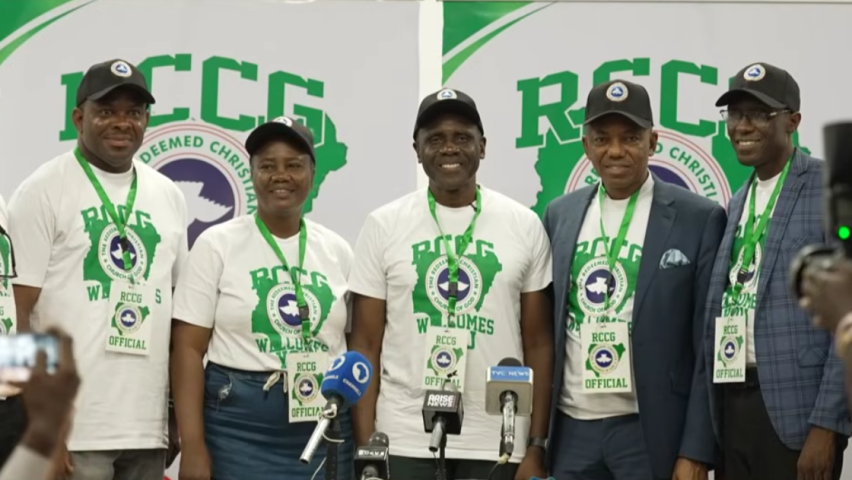
The Redeemed Christian Church of God (RCCG) has begun a humanitarian operation to bring at least 500 Nigerians back home from South Africa.
One hundred Nigerians arrived at the Murtala Muhammed International Airport in Lagos on Sept. 24 after travelling from Johannesburg. They were received by officials from the National Emergency Management Agency, the National Commission for Refugees, Migrants and Internally Displaced Persons and other government agencies.
The returnees underwent profiling at the airport before arrangements were made for their onward movement to their respective states.
The repatriation is being funded by the RCCG after an appeal from the Nigerian diplomatic mission in South Africa concerning Nigerians who wanted to return home.
Pastor Belemina Obunge, chairman of the RCCG Task Force for the Reception of Nigerian returnees from South Africa, said the intervention was approved by RCCG General Overseer Pastor Enoch Adeboye on humanitarian grounds.
Obunge said the Nigerians in South Africa had been documented by the Nigerian High Commission in Pretoria and the South African Home Affairs authorities. He also stressed that the exercise was not limited to members of the RCCG.
“Nigerians of different faiths are included,” he said, according to reports on the arrival of the first group. Obunge has also called on state governments to assist with the reintegration of their citizens after they return.
RCCG, headquartered in Ogun State, Nigeria is widely recognized as the largest Pentecostal denomination and movement in Africa by total membership estimated at 9 million baptized congregants spread across 50,000 assemblies in 147 countries.
The church is paying for the air transportation from Johannesburg to Lagos, while government agencies are responsible for receiving the returnees, completing the necessary processing and helping them reach their respective states.
The returnees are being brought home in batches because of the documentation and clearance procedures involved. At least 500 adult Nigerians are expected to benefit from the initiative, although the final number could be higher because of children and infants.
The intervention follows a wider Nigerian government effort to repatriate citizens from South Africa amid renewed concerns over xenophobic and Afrophobic attacks.
Nigeria began an evacuation programme in June after a new wave of attacks and tensions involving foreign nationals in parts of South Africa. By early September, the Federal Government said 1,640 Nigerians had already been brought home. Of these, 1,385 had been fully sponsored by the government, while 255 had returned with support from philanthropic donations.
Another 202 Nigerians were awaiting final screening by South African authorities at the time.
The RCCG announced on Sept. 4 that it had donated more than $260,000 to support the return of 500 Nigerians from South Africa. The Federal Ministry of Foreign Affairs said the money would be used to purchase 500 one-way air tickets for Nigerians seeking to return home.
Nigeria’s Ministry of Foreign Affairs welcomed the contribution, describing it as support for Nigerians facing difficult circumstances in South Africa. The government also said the donation demonstrated how faith-based organizations and public institutions could work together in responding to humanitarian situations.
The RCCG task force has said the church's responsibility covers the air journey between Johannesburg and Lagos. Government authorities will handle reception and onward transportation.
For Nigerians who remain stranded in South Africa and wish to return, the task force has encouraged them to contact Nigerian diplomatic missions in the country so they can be properly documented and considered for assistance.
The repatriation represents another phase of Nigeria’s ongoing effort to assist citizens who have chosen to leave South Africa amid the recent tensions. It also brings private humanitarian funding into an evacuation program that has so far relied on both government resources and contributions from organizations and individuals.








