
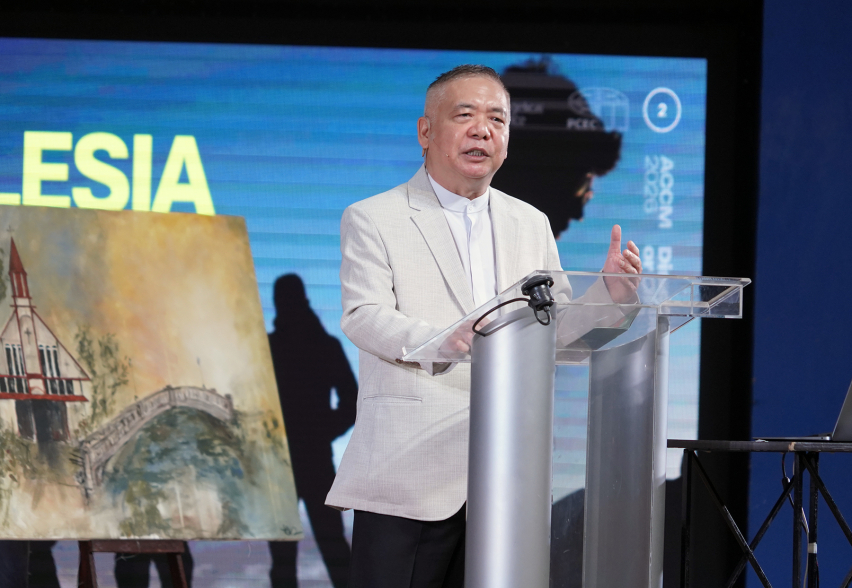
The General Secretary of the Asia Evangelical Alliance pressed evangelical leaders Tuesday to confront what he called three deep internal fractures keeping the church trapped in an event-driven model, and introduced a continent-wide tracking system to hold congregations accountable for the shift toward intentional disciple-making.
Dr. Bambang Budijanto opened the second day of the Asia Conference on Church and Mission (ACCM) 2026 at GCF South Metro in Alabang, Metro Manila, with a keynote that moved from diagnosis to action. He unveiled a set of cascading numerical targets, from the continental level down to the individual congregation, and launched a new digital registration and certification platform, which he called DCAR (Disciple-making Church Advancement Record), to track progress against those goals.
The conference, organized by the AEA in partnership with the Philippine Council of Evangelical Churches, has gathered 210 delegates from 25 nations under the banner "Disciple or Die 3.0." Building on two prior gatherings — in Mongolia in 2024 and South Korea in 2025 — organizers have framed Manila as the moment for measurable commitment, not just further discussion.
The three fractures
Budijanto told delegates that despite growing consensus on the importance of discipleship, three internal problems have kept most churches from making the transition.
The first, he said, is a long-standing confusion between urgency and emergency — and he argued it is the most consequential misreading of the Great Commission in the history of the modern Church.
Budijanto's starting point was not a critique of zeal, but a distinction within it. Every genuine revival, every season of spiritual awakening, he observed, carries with it an acute sense of urgency. People encounter Christ and feel, rightly, that there is no time to waste. The problem, he argued, is what churches have done with that urgency over the past two centuries: they have converted it into emergency thinking, and emergency thinking produces a fundamentally different — and far more limited — response.
He illustrated the difference with a medical analogy. When a patient arrives at an emergency room with multiple problems, doctors do not treat everything at once. They perform triage — identifying the single most pressing threat to survival and addressing that, setting everything else aside for later. The goal in an emergency is not restoration; it is stabilization. Keep the patient alive today, and deal with the rest when there is more time.
That logic, Budijanto argued, is exactly what has shaped the dominant model of mission across Asia and much of the world. Faced with billions of people outside the faith, the church looked at the scale of the task, felt the weight of eternity, and made a triage decision: get people to heaven first. Move them from lostness to salvation. Evangelism above all else. Discipleship can come later.
The consequence, he said, has been an approach that stops at the threshold rather than walking people through the door. Converts are made but not formed. Decisions are recorded but not nurtured into durable, reproducing faith. The church fills its pews with people who have prayed a prayer but were never apprenticed to a way of life.
True urgency, Budijanto told the room, does not cut corners — it insists on doing the whole thing now. The Great Commission, he said, is not a triage protocol. It is a comprehensive mandate: go, make disciples, baptize, teach obedience. None of those elements is optional. None is deferred to a second stage. The urgency of the commission should accelerate discipleship, not replace it with something shallower.
"Evangelism without discipleship has cost us a lot," he said.
He was careful not to dismiss evangelism itself — the problem is not sharing the gospel but treating that moment as the finish line. A church consumed by getting people in the door, he suggested, while investing almost nothing in what happens to them afterward, has mistaken the beginning of the journey for its end. After two centuries of emergency-mode mission, the visible result is churches across Asia filled with nominal Christians who have never discipled anyone and are not expected to.
The second fracture is what he called the domestication of discipleship. Based on his own survey, Budijanto said more than 90 percent of discipleship activity takes place inside church buildings and is directed at existing Christians. That, he argued, directly contradicts the scope of the Great Commission. "If discipleship was just for Christians in the church building, the Great Commission should say, 'go to all churches,'" he told the room. "My Bible says go to all people, go to all nations."
The third fracture is the displacement of disciple-making from the church to parachurch organizations. While expressing appreciation for such organizations, Budijanto was clear that the mandate belongs to the local church. "Great Commission is for the church," he said. "Bring it back to the church and strengthen the church."
He drew on the Greek structure of Matthew 28 to reinforce the point, noting that "make disciples" is the sole imperative in the passage — "go," "baptize," and "teach" are all participles subordinate to it. He estimated that fewer than 5 percent of Christians globally are actively discipling others, which means the vast majority are disobeying what he described as the last command Jesus issued before his ascension.
From movement to metrics
Budijanto then introduced a tiered definition of what a disciple-making church, and alliance, would actually look like in practice, offering concrete thresholds at every level of the evangelical ecosystem.
At the congregational level, he proposed that a local church qualifies as a disciple-making church when at least 20 percent of its members are personally discipling others. The figure, he explained, draws on the Pareto principle: 20 percent of a group typically drives 80 percent of its outcomes, meaning that if one in five members is actively discipling, the effect ripples through the rest of the congregation.
He was specific, however, that small group participation does not meet the bar. Citing research from the United States, he noted that 90 percent of small groups produced no disciples at all.
Moving up the structure: a denomination becomes a disciple-making denomination when 30 percent of its local churches meet that 20 percent threshold. A national evangelical alliance becomes a disciple-making alliance when 40 percent of its member denominations achieve that status. And by 2033, the AEA's continental goal is for 50 percent of its national alliance members to qualify as disciple-making alliances.
For the Philippines specifically, Budijanto pointed to the PCEC's 92 member denominations as a baseline for what achieving those thresholds would require. For Indonesia, the figure is 103 denominations.
He also reframed the purpose of the church in terms that pushed back against institutional measures of success. "I'm grateful if your national alliance has a big building," he said. "How many staff, how many members — but the question is how many of them are obeying Christ and discipling others? How many churches in your alliance are discipling others?"
A platform for accountability
To support the movement toward those targets, Budijanto introduced the DCAR platform, an AI-assisted digital registration system available in multiple languages. Pastors attending the conference were encouraged to scan a QR code on cards distributed at the tables, register their congregation, and — if their church already meets the 20 percent threshold — submit a declaration for certification.
Declarations require endorsement from a recognized authority: a national alliance leader or a denominational head who can verify the claim. Once endorsed and approved by AEA, a signed certificate, bearing the signatures of both Budijanto and Rev. Botrus Mansour, Secretary General of the World Evangelical Alliance, is issued to the church.
Budijanto said the first certificate, numbered 0001, would be awarded at the conference. He expressed hope that by the next edition of the gathering, certificate number 5,000 would be awarded, and by 2030 or 2033, the number would reach 100,000.
The platform is also designed to give national alliances a geographic view of where disciple-making churches are concentrated and where gaps remain, allowing organizations with discipleship resources to identify areas of greatest need.
A testimony of transition
Budijanto closed his keynote by describing the story of a Filipino church leader — the late Bishop Herley Montes — whose church had stalled at around 200 to 300 members across multiple church plants. When a mentor asked him how many disciples he had, Montes initially answered with his attendance figure. The mentor pressed him: not attenders — disciples.
"He could not answer," Budijanto said.
After being mentored in disciple-making principles and implementing the transition from an event-based to a disciple-making model, Montes's mother church grew to approximately 4,000 members, with around 500 daughter churches. The first six months of that transition, according to Budijanto's account, saw roughly half the congregation leave — members who wanted to attend services but were unwilling to disciple others. Montes, however, remained committed and ultimately saw abundant fruit as a result.
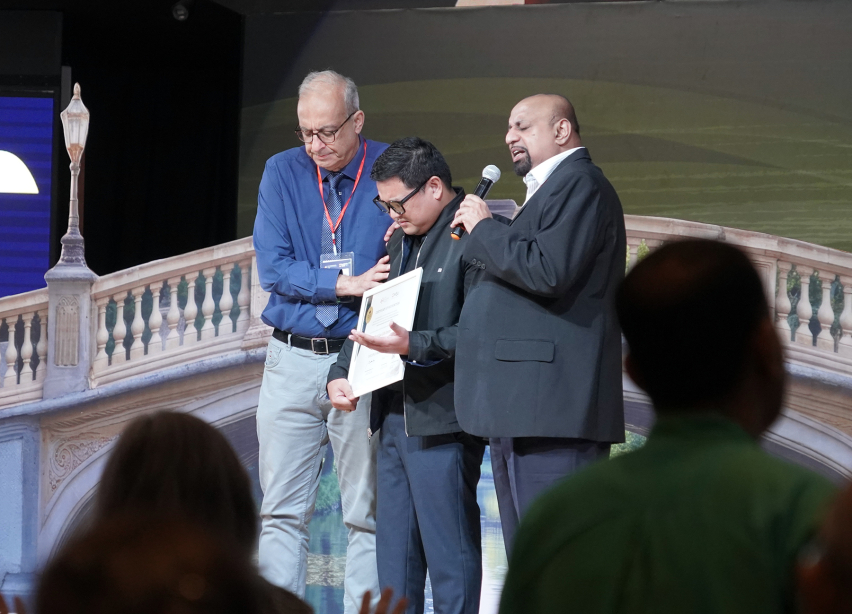
Montes died in early May 2026, weeks before the conference. His son, Bishop Joel Montes, attended the Manila gathering in his place and received the first DCAR certificate on behalf of the denomination — an organization of 520 local churches, most of which Budijanto described as disciple-making congregations.
The ACCM 2026 conference continues through Thursday, concluding on Friday with a joint session expected to bring together the visiting international delegates and an estimated 1,000 Filipino pastors for a day of intensive engagement on disciple-making practice.








