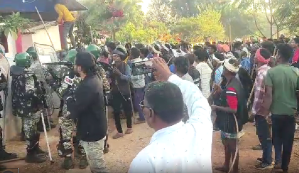
Tribal villagers in India have prevented Christians from burying the body of a woman who died on Feb. 24, saying it would defile their land and deities.
As the body of tribal Christian Sambai Mandavi still lay in a hospital mortuary, villagers demanded her family undergo forced reconversion to Hinduism as condition for burial, sources said. Days after India’s Supreme Court ordered a halt to forcible exhumations of tribal Christians’ bodies in Chhattisgarh state, the villagers have threatened to exhume the body if it is buried.
Mandavi was said to be 34 when she died on Feb. 24 due to respiratory and cardiac issues. Residents have prevented her husband, Kamlesh Mandavi, from burying her body in the village’s public cemetery or on his private land in Amodi village, Kanker District, Chhattisgarh state.
Local villagers have also threatened physical assault and property damage. They claim Christian burial rites would “defile” their land and deities, according to a press statement from the Progressive Christian Alliance (PCA) on Feb. 26. With the body remaining in the mortuary at Durgkondal Hospital, Kamlesh Mandavi has formally complained to the District Collector.
“This incident occurs just days after the Supreme Court issued an interim order halting exhumations,” the PCA statement said. “Yet, the persistence of such threats underscores a blatant disregard for judicial directives.”
The Rev. Simon Digbal Tandi, coordinator of PCA, called for immediate intervention by state authorities.
The Supreme Court on Feb. 18 had issued an interim order directing that “no further exhumation of buried bodies shall be permitted” while hearing a Public Interest Litigation filed by the Chhattisgarh Association for Justice and Equality (CAJE). Justices Vikram Nath, Sandeep Mehta and N.V. Anjaria also issued notice to the Chhattisgarh government, returnable in four weeks.
Systematic Intimidation
The Sambai Mandavi case isn’t isolated. A day after the Supreme Court order, the United Christian Forum (UCF) released data showing 23 burial-related incidents in 2025 alone, part of what they describe as systematic intimidation across tribal regions.
At a press conference in New Delhi on Feb. 19, UCF officials presented video footage of a Christian woman’s body being exhumed, wrapped in a white shroud and placed on the ground as villagers stood around it. The incidents reflect a recurring trend in Chhattisgarh, Odisha and Jharkhand states.
The UCF officials detailed specific cases. In Benur village in Bastar District, the remains of a tribal Christian man buried for more than 20 years were exhumed, cremated and scattered. In Kanker District, father of Rajman Salam, an elected village headman who is a follower of Christ, was buried on family land. Shortly after, a mob claiming the land belonged to a local deity attempted exhumation – invoking the PESA Act, which grants tribal communities autonomous governance – even though Salam’s father was not a Christian.
Families have described discovering empty graves or being forced to travel miles to pay respects to their loved ones, turning mourning into a prolonged ordeal, according to PCA documentation.
UCF National President Michael Williams described the court’s order as “a beacon of hope” but called on the state government to ensure complete implementation. John Dayal, UCF spokesperson, said the Supreme Court’s order was a necessary first step, but that interim relief was not justice.
“The Chhattisgarh government’s calculated silence speaks volumes,” Dayal told Morning Star News. “When the state refuses to defend constitutional burial rights, it effectively sanctions grave desecration.”
He pointed to an earlier order by a bench headed by Justice Nagarathna that could not be implemented under mob pressure.
“No one was charged with contempt of court or coercion,” he said. “This is not just about dignity in death; it’s about whether tribal Christians belong to their own villages.”
The Public Interest Litigation argued by senior attorney Colin Gonsalves alleged that tribal Christians were being forcibly prevented from burying their deceased in village burial grounds, though other communities were free to do so. Bodies already buried were exhumed and relocated to distant places without families’ knowledge.
The petition described how burial grounds traditionally accessible to all villagers were being informally restricted along religious lines. In several instances, families were allegedly pressured to abandon Christian burial practices as a precondition for burial within the village.
“Exhumation and forced reburial of bodies at distant places, sometimes over 50 kilometers away, constitutes cruel, inhuman and degrading treatment,” the petition stated, referring to constitutional guarantees of equality and the right to life with dignity.
Police Complicity
The petition raised serious concerns about police conduct. Officers frequently failed to protect families facing threats and instead encouraged compromise.
“The role of the Chhattisgarh police is very communal,” the petition stated. “The body was forcibly taken out of the villages to a so-called designated place by the police and administrations.”
Many pastors who conducted burial rites were arrested and sent to jail. The denial of burial rights was often accompanied by threats of violence, forced conversions and harassment.
Tribal Identity Under Threat
UCF coordinator A.C. Michael warned that campaigns in several states seeking to remove Christian Adivasis (indigenous tribal peoples) from Scheduled Tribe status, which provides indigenous communities with constitutional protections and reserved benefits, were directly linked to burial disputes.
“The Constitution of India does not tie tribal identity to religion,” Michael said.
Progressive Christian Alliance, a partner organization of CAJE that filed the petition, said local groups including Bastar District Rural Christian Service Committee (Bastar Jila Grameen Masihi Seva Samiti) and the Tribal Christian Service and Education Welfare Committee (Janjati Masihi Seva Evam Shaikshanik Kalyan Samiti) in Bastar have been documenting violations on the ground.
PCA noted that incidents targeting religious minorities in Chhattisgarh have risen sharply since 2005, with Christians who belong to Scheduled Tribes facing attacks despite constitutional protections under the Fifth Schedule, constitutional provisions protecting tribal land and governance rights.
Dayal said the burial disputes were connected to a larger pattern.
“Exhuming bodies is the logical endpoint of a campaign to delegitimize Christian tribal identity and assert ideological supremacy of local thugs inspired or trained by the Sangh,” he said, referring to Hindu nationalist umbrella group Rashtriya Swayamsevak Sangh and its affiliated groups. “Twenty-three documented incidents in 2025 alone, this is systematic, not spontaneous.”
Ghar Wapsi Connection
The Rev. Dr. Akhilesh Edgar, convener of Progressive Christian Alliance based in Chhattisgarh, said the denial of burial rights was directly linked to Ghar Wapsi (forced reconversion) campaigns.
“These elements form a coordinated Hindutva [Hindu nationalist] agenda, with burial denials as entry points for Ghar Wapsi and delisting as long-term disenfranchisement,” he told Morning Star News.
Edgar said groups like the Tribal Protection Forum (Janjati Suraksha Manch) were arguing that Christian converts forfeit “tribal identity” and should lose Scheduled Tribe benefits.
“This economic threat complements burial denials by linking religious choice to loss of protections under Schedule V of the Constitution,” he said. “Burial disputes are invoked to ‘prove’ detachment from traditions, justifying delisting.”
Burial denials often served as leverage for forced reconversion, Edgar said.
“Mobs condition burial permission on reconversion,” he said. “Numerous instances of Ghar Wapsi and violence have been noticed with burials weaponized to force compliance.”
Campaigns to delist Christian tribals have been explicit, he said.
“JSM rallies in Bastar demanded delisting, with leaders like Bhojraj Nag stating converts cannot take the benefits of Adivasis and refuse to follow the tradition,” he told Morning Star News. “No similar demands apply to Hindu-adopting tribals, exposing bias.”
The fear of losing Scheduled Tribes status was being weaponized: “This creates fear – distant Christian burials could challenge ST claims, pushing reconversion to retain status.”
Edgar traced the roots of Ghar Wapsi to RSS-affiliated efforts dating back to the 1950s with actions by RSS tribal welfare wing Vanvasi Kalyan Ashram to counter Christian missions and “reclaim” converts.
Alarming Data on Violence
In 2025, the UCF recorded more than 700 incidents of anti-Christian violence, disproportionately impacting Dalit Christians – members of formerly “untouchable” communities at the bottom of India’s caste hierarchy – women and tribal communities. Uttar Pradesh and Chhattisgarh accounted for nearly half of all violence against Christians, according to UCF.
Despite the scale of violence, accountability remained largely absent. Only 45 police First Information Reports (FIRs) have been filed against perpetrators out of nearly 580 recorded incidents in 2025, leaving 93 percent of cases remaining unpunished. Conversely, more than 230 FIRs had been filed against Christians, often under “anti-conversion” laws prohibiting forcible or fraudulent conversion.
The UCF named organizations such as Hindu nationalist groups Bajrang Dal, Vishva Hindu Parishad and Janjati Suraksha Manch as being repeatedly mentioned in complaints from affected areas.
Calls for Reform
Edgar said that while the Supreme Court order was a positive step, it fell short of delivering full justice as exhumations reflected broader patterns of discrimination.
He called for amendments to Chhattisgarh’s Freedom of Religion Act, which he said was being misused to harass tribal Christians.
“Human rights groups recommend repealing these laws or adding safeguards against abuse, as they disproportionately target Christian minorities while ignoring voluntary conversions,” he said.
Edgar also called for clarification that religious conversion does not forfeit Scheduled Tribe status.
“Over 23 burial incidents in 2025 alone underscore systemic violence by Hindutva groups like RSS and VHP, often with police inaction,” Edgar said, calling for prosecution of perpetrators under anti-discrimination laws.
Advocating for enhanced protections under the Scheduled Castes and Scheduled Tribes (Prevention of Atrocities) Act, 1989, and mandating common or designated burial grounds statewide with funding and oversight, he also called for support and rehabilitation for displaced families, including legal aid, economic aid and protection from social boycotts.
Implementation of reforms would require political will to counter rising Hindu nationalist influences, ensuring constitutional supremacy over majoritarian customs, Edgar said.
The UCF urged the governments of Chhattisgarh and Odisha to implement compensation and rehabilitation plans for displaced tribal Christians. It called for disciplinary action against police personnel who fail to protect religious minorities. The organization demanded that every village council (gram panchayat) maintain religion-neutral “common graveyards” accessible to all residents, and appointment of district-level officers to guarantee immediate police protection during funerals where tensions may arise.
Human Cost
Attorney Tehmina Arora underlined the human cost at the press conference. Recalling the Ramesh Baghel case, she said his family had buried their dead in the same village for decades, yet he was stopped from burying his father there.
“At the moment when a family is most vulnerable, they are told, ‘This is not your place,’” she said.
The Chhattisgarh government has not yet responded publicly to the Supreme Court notice or to the allegations. The matter was scheduled for hearing four weeks from Feb. 18.
The petition seeks a declaration that all persons, irrespective of religion, caste or Scheduled Caste/Scheduled Tribe/Other Backward Classes status, are free to bury their deceased in the villages where they live. It further seeks that all gram panchayats be directed to demarcate specific areas for burial of all communities, and that the state uphold secularism and fraternity by promoting, to the extent possible, common graveyards for all communities.
The hostile tone of the National Democratic Alliance government, led by the Hindu nationalist Bharatiya Janata Party, against non-Hindus has emboldened Hindu extremists in several parts of the country to attack Christians since Prime Minister Narendra Modi took power in May 2014, religious rights advocates say.
India ranked 12th on Christian support organization Open Doors’ 2026 World Watch List of the countries where it is most difficult to be a Christian, up from 31st in 2013 before Modi came to power.