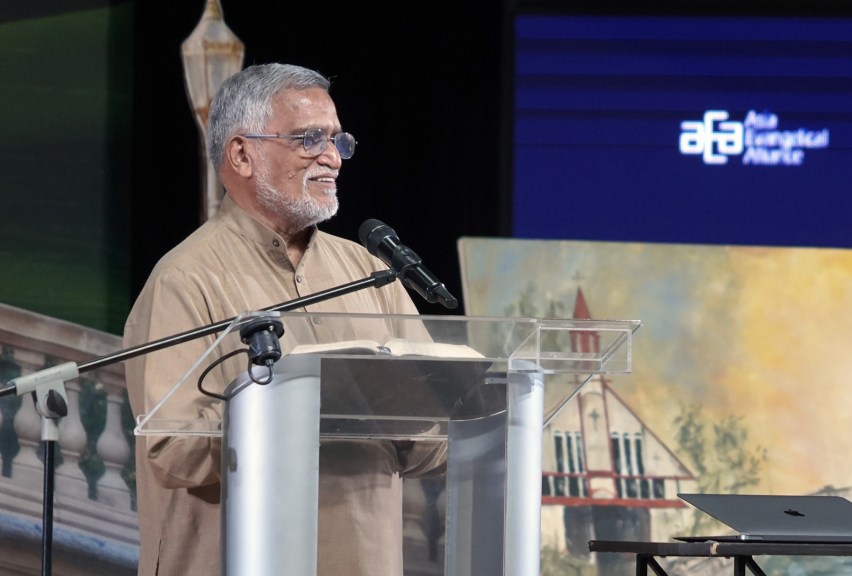
A veteran Indian Bible teacher challenged evangelical leaders gathered at a major Asian missions conference to confront what he called a pervasive failure of personal discipleship, pressing them to name at least five individuals they are actively discipling — and to ask themselves honestly whether they could.
Rev. CB Samuel, honorary theological adviser for Micah Global and EFICOR, delivered the closing keynote address on the second evening of the Asia Conference on Church and Mission (ACCM) on June 10, drawing on Paul's first letter to the Thessalonians to lay out what he described as the essential character of a disciple maker.
"Discipling is not a technique," Samuel told participants. "You pour your life into other people."
He opened with a personal reflection, describing a difficult season in his own life during which he had turned to the Psalms of lament — noting that more than a third of the 150 psalms fall into that category. He suggested that contemporary Christian music, particularly in Asia, often fails to reflect the pain of ordinary people. "Our songs should capture the pain of our people and the cry to God," he said. "Otherwise, we are totally disconnected."
The majority of his address focused on practical accountability in discipleship. Samuel recalled a staff conference model used by a Sri Lankan Christian leader, who required everyone on his leadership team to write the names of five people they were discipling on the back of their name badges and could be questioned about any one of them at any time. Leaders who lacked current knowledge of those individuals' lives were removed from organizational leadership, Samuel said. "If you can't even name one person you're discipling, what right do you have to talk?" he recounted the leader as saying.
He also described asking a prominent Christian leader to recommend someone from among his disciples for a ministry program. The leader reportedly told Samuel he had no one to recommend, saying his organizational responsibilities had left him no time to disciple anyone. Samuel credited him for his candor but used the exchange to press his point: "If you don't have time to disciple, you are in the wrong position."
Working through 1 Thessalonians 2, Samuel identified six characteristics he said define a genuine disciple maker. The first is courage. Paul had been beaten and mistreated, yet continued to proclaim the gospel, Samuel noted. "You cannot be a disciple maker without taking risks," he said, arguing that 21st-century Christians are often too committed to personal comfort to follow that example.
The second characteristic, he said, is integrity — freedom from flattery, self-promotion and hidden motives. Samuel was pointed in his critique of Christian leaders who use their platforms for personal enrichment. "If you don't have a reputation as a person of integrity, don't disciple," he warned. "The one you disciple will not be Christlike. He will be like you."
The third quality Paul models, Samuel said, is the tender care of a nursing mother. He highlighted Paul's willingness to use maternal language — "we were delighted to share with you not only the gospel of God but our lives as well" — as evidence that discipleship requires the discipler's life to be genuinely accessible. "You can't be a discipler if your home is not open to the people you're discipling," he said.
Fourth is hard work. Samuel recalled his own father, a health professional, expressing disappointment when Samuel entered Protestant ministry — not for theological reasons, but because Protestant pastors in his experience were slow to respond to needs, unlike Catholic priests. His conclusion was that "if you're a discipler, 24 hours, seven days a week is for the person you're discipling."
Character — holiness, righteousness and blamelessness — was the fifth quality, with Samuel drawing a distinction between the three terms: holiness as a person's relationship with God, righteousness as conduct within the community of faith, and blamelessness as one's reputation before the wider world. All three, he argued, are required.
The sixth characteristic is a father's heart — encouraging, comforting and urging those being discipled toward lives worthy of God. "That is the heart of a disciple maker," Samuel said.
He closed with an appeal, asking participants to pray silently and honestly over whether they could name five people currently in their care — and, if not, to commit before God to rebuilding that foundation. "I want to be known for discipling people," he said, framing it as the question by which Christian leaders will ultimately be judged. "God is not going to ask any of us how good a director of our organization we were. He's going to ask you how good a disciple maker you were."
ACCM drew evangelical leaders from across Asia and beyond to Manila, convening under the theme "Disciple or Die." Samuel's address was the final plenary session of the conference's second day.