

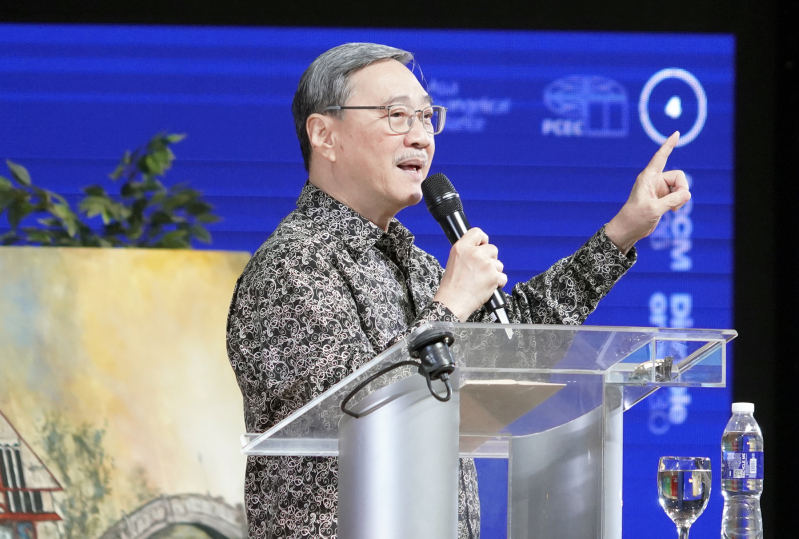
A Singapore-based pastor told evangelical leaders gathered in the Philippines that the church's core problem is not organizational but spiritual — tracing most failures in ministry back to a breakdown in discipleship and obedience, and calling on church leaders across Asia and beyond to become intentional disciple makers rather than program managers.
Rev. Edmund Chan, founder of the Global Alliance of International Disciple Making Churches and leadership mentor at Covenant Evangelical Free Church in Singapore, delivered the opening keynote on the third day of the Asia Conference on Church and Mission (ACCM), which brought together over 200 evangelical leaders from 25 countries in Manila. Chan has served as a guest lecturer in doctoral programs at five seminaries across four countries, and his address drew on that teaching experience to frame discipleship as the foundational issue facing the global church today.
He opened with a simple analogy: a shoe factory produces shoes, a paper factory produces paper, so what does the church produce? "The church is to produce disciples," Chan said. "The crisis of discipleship today is a crisis of product — not just are you producing disciples, but what kind are we producing?"
Chan framed his address around five diagnostic questions: why discipleship is so important, why it is so neglected, what it actually is, what makes it so difficult, and how it can best be accomplished. The questions, he said, provide a framework for understanding what genuine disciple-making looks like — and where most churches fall short.
A chain of consequences
"There are no church problems," Chan told attendees. "All we have are people problems. And what we have in people problems is actually a heart problem." He traced that chain further — from heart problems to obedience problems, from obedience to faith, and from faith to spiritual maturity. "If there's discipleship, there's great maturity. If there's great maturity, there's great faith. If there's faith, there's obedience. If there's obedience, there's a transformation of heart," he said. "That is why discipleship is so critical in the life of the church."
The same logical chain, Chan argued, explains why neglecting discipleship has such wide consequences. A church that fails to produce mature disciples does not simply have a programming gap — it has a people problem, which is at root a heart problem, which flows directly from the absence of genuine formation.
Misunderstanding as neglect
Chan argued that discipleship is commonly neglected not simply through inaction, but through misunderstanding. There are three ways to neglect something, he said: by not doing it, by starting and then stopping, or by doing it wrongly. The third, he suggested, is the most common failure in churches today.
Many churches, he said, treat discipleship as a program rather than a way of life, and confuse knowledge transfer with genuine formation. "Truth doesn't change lives," he said. "It is truth of life that changes lives." He drew a contrast between a Western philosophical understanding of truth as content — shaped, he said, by Enlightenment thinking — and an ancient Jewish conception of truth as connection: with God, with one another, and with the lost. When that relational dimension is stripped away, he said, truth becomes mere recitation rather than transformation.
Alignment and the call to follow
Asked to define discipleship in a single word, Chan offered "alignment" — a life oriented entirely around following Jesus. He described discipleship as five interlocking commitments: to know Jesus, to love him, to serve him, to proclaim him, and to become increasingly like him. Disciple-making, he said, is reproducing that same orientation in others.
He cited Luke 9:23, noting that Jesus' call to take up the cross is explicitly daily — a detail he said many churches have quietly dropped. "We have lost the dailiness in discipleship," Chan said. "In a lot of churches, the discipleship program is weekly, and we miss the call to live out our discipleship daily." He referenced an ancient Jewish blessing, also refered to by an earlier speaker, in which a disciple is wished to be so close to his master that the dust from the master's feet settles on him. That image of proximity, Chan said, captures what discipleship is meant to feel like — not distant admiration but intimate, daily pursuit.
Chan spoke with candor about his own spiritual history, describing himself as a third-generation Christian who backslid for four years before returning to faith. The experience shaped a conviction he said has served as a guiding compass since 1975. "If Jesus is not Lord of all, he is not Lord at all," he told the gathering. "I told myself — if I come back to Jesus, I must be all in. He must be all in all."
He also drew a direct line between discipleship and holiness, warning that the two cannot be separated. "We cannot walk with God by holding hands with the devil," he said. "There is a call to separation." The theology of repentance, forgiveness and a redeemed life lived in freedom, Chan said, must be central to any serious disciple-making effort.
The obedience problem
On the question of why discipleship is difficult, Chan pointed to obedience. He said the Great Commission is frequently misread: Jesus did not simply instruct his followers to baptize and teach, but specifically to "teach them to obey — teach them to submit to all things whatsoever I have commanded you." The word "observe," he said, is the hinge the church has missed.
When believers face a conflict between the word of God and personal experience — pain, pleasure, competing desires — three responses are available, Chan said. The first is backsliding. The second is repentance, returning to God's word. But he identified a third, which he described as widespread in the global church today: remaining in the pew while refusing the cost of obedience. "They don't backslide — they're still in church. They don't repent because it's too costly to obey. They pay lip service to God," he said. That posture, he warned, produces what he called "lukewarmness," and a lukewarm church cannot be an intentional disciple-making church.
Discipleship as a lived relationship
To illustrate his point, Chan played a short video in which a senior pastor described how Chan's investment in him — regular meetings over lunch during a sabbatical period — had provided practical and spiritual counsel through a demanding season of ministry. What the pastor said he valued most was not strategy or teaching, but simply feeling cared for and loved.
That detail, Chan said, captures the essence of disciple-making. "It's not about building a large movement or a megachurch," he told the gathering. "It's about helping the redemptive community of disciples of Jesus to journey together, to pilgrimage together, to share lives together."
The delivery system
Chan closed with a conversation from earlier in his ministry, in which a leader from Navigators observed that while most ministries rely on curriculum as their delivery system, Chan had made himself the delivery system. Chan said he owed that instinct entirely to his own mentors, who had shaped him not through materials but through the investment of their lives. "Their lives were the delivery system," he said, "and therefore I'm simply passing on that which I have learned."
He urged church leaders to do the same: to follow Jesus as disciples, make disciples, multiply disciples and mobilize them for the purposes of God — one soul, one disciple, one small group at a time. The goal is not a passion for discipleship as a ministry model, he said, but a passion for Jesus himself. "You and I," Chan told the room, "we are the delivery system."
The Asia Conference on Church and Mission brought together evangelical leaders from across Asia and beyond calling on participants to embrace intentional disciple-making as the defining task of the church in the present generation.


