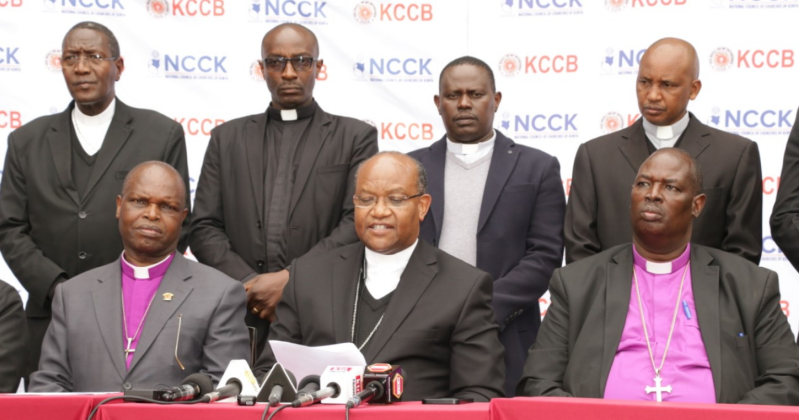
Two of Kenya's leading Christian organizations have called on lawmakers to review and amend the Finance Bill 2026, warning that some of the proposed measures could deepen economic hardships for households and businesses and undermine efforts to stimulate economic growth.
The National Council of Churches of Kenya (NCCK) and leaders of the Anglican Church of Kenya (ACK) presented their concerns to the National Assembly's Departmental Committee on Finance and National Planning during public participation hearings on the bill.
Their interventions come nearly two years after widespread youth-led protests forced the government to withdraw the Finance Bill 2024 and fundamentally reshaped Kenya's debate over taxation, public spending and citizen participation in economic policy.
In a memorandum submitted to the parliamentary committee on May 29, NCCK argued that Kenya's fiscal challenges cannot be solved through increased taxation alone and urged the government to prioritize economic expansion, investment and job creation.
"The Government should prioritize growing the economy rather than increasing taxes," NCCK said in its memorandum to Parliament, signed by the General Secretary, Rev Canon Chris Kinyanjui.
The church body noted that the Finance Bill 2026 is being considered alongside a proposed national budget estimated at approximately KSh 4.78 trillion (USD 37.7 billion) and expressed concern about the country's growing expenditure obligations and financing needs.
According to NCCK, lawmakers should focus on measures that encourage enterprise, expand employment opportunities and support long-term economic development.
"The Finance Bill should support economic growth, development and job creation," the memorandum states.
The council further argued that efforts to raise additional revenue should be accompanied by stronger measures to improve efficiency in public spending, reduce waste and strengthen accountability in the management of public resources.
Church leaders said the burden of economic adjustment should not fall disproportionately on ordinary citizens who continue to face rising living costs, high unemployment and persistent economic uncertainty.
Increasing tax burden
The Anglican Church of Kenya also raised concerns during its appearance before the committee.
Archbishop Jackson Ole Sapit, who led the ACK delegation, reportedly opposed several provisions contained in the proposed legislation and cautioned against introducing measures that could increase financial pressure on families and businesses.
Media reports from the committee hearings quoted church leaders as urging lawmakers to carefully consider the cumulative effect of taxation on citizens who are already grappling with the cost of living.
“The Church recognizes that the Finance Bill 2026 seeks to strengthen domestic revenue mobilization at a time when Kenya is facing increasing fiscal pressure arising from high public debt, widening budget deficits, and rising expenditure demands,” the Archbishop stated.
“Hon. Chair and Members, however, taxation must be viewed as a moral and social issue that directly impacts the dignity and livelihoods of Kenyans,” he added.
The submissions by NCCK and ACK add to a growing list of stakeholders seeking to influence the shape of the Finance Bill before it proceeds through Parliament.
Every year, the Finance Bill serves as the government's primary legislative tool for introducing tax measures and amending revenue laws. The bill typically outlines changes affecting income tax, value-added tax, excise duty and other government revenue streams.
The Finance Bill 2026 is intended to support the government's budget plans for the upcoming financial year and help generate revenue needed to fund public services, infrastructure projects and development programs. However, discussions around taxation have become particularly sensitive in Kenya following the events of 2024, when proposed tax measures triggered an unprecedented wave of public protests.
The Finance Bill 2024 initially contained a range of revenue-raising proposals that many Kenyans viewed as likely to increase the cost of living at a time when households were already struggling with economic pressures. What began as online criticism quickly evolved into a nationwide protest movement driven largely by young people.
The movement became widely associated with Generation Z activists, many of whom argued that government policies were placing an unfair burden on young people facing unemployment, high living costs and limited economic opportunities.
As public opposition intensified, demonstrations spread across multiple counties and drew growing national and international attention. The most dramatic moment came on June 25, 2024, when protesters breached sections of Parliament during demonstrations against the bill.
Facing mounting public pressure, President William Ruto declined to sign the Finance Bill 2024 into law despite its passage by Parliament. Instead, he referred the legislation back, effectively withdrawing the bill and signaling a major policy reversal.
Against that backdrop, stakeholders participating in discussions on the Finance Bill 2026 have repeatedly emphasized the need for lawmakers to listen carefully to public concerns and avoid measures that could trigger renewed public dissatisfaction.
For church organizations, the debate extends beyond questions of revenue collection. NCCK's memorandum argues that economic policy should balance fiscal responsibility with the need to protect vulnerable citizens and create conditions that encourage investment and employment.
The council maintains that sustainable revenue growth ultimately depends on expanding economic activity rather than placing additional burdens on taxpayers.
Parliament's Finance and National Planning Committee is expected to review submissions from religious organizations, business associations, professional bodies, civil society groups and members of the public before preparing its report on the bill. The committee's recommendations will help shape the final version of the legislation before it is debated and voted on by the National Assembly.