
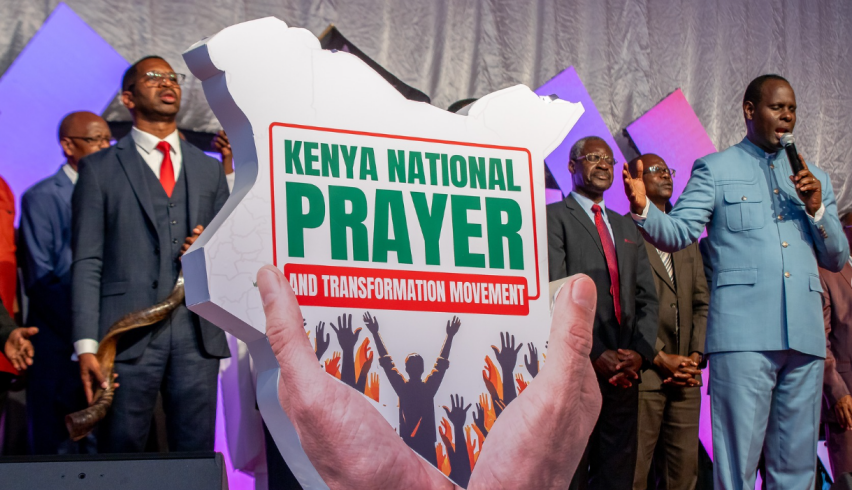
Evangelical church leaders in Kenya have launched the Kenya National Prayer and Transformation Movement (KNPTM) calling for prayer, repentance, unity and responsible citizenship ahead of the country’s 2027 General Election.
The movement, launched on May 4 in Nairobi under the theme “My Country, My Responsibility, ” brought together bishops, pastors, intercessors and Christian leaders from multiple evangelical denominations and ministry networks. Organizers stated the initiative aims to establish a sustained national prayer and transformation framework operational across all 47 counties and mobilize over 1 million intercessors to pray for the country.
In a comprehensive written communique issued during the gathering, participating church leaders stated that Kenya is facing mounting economic hardship, political tension, corruption and increasing social anxiety among many citizens, particularly young people affected by systemic unemployment and rising living costs.
“This is a spiritual commissioning and a national call,” stated the leaders. “It is the Church rising into her God-given responsibility over Kenya, stepping into her prophetic assignment, and embracing her priestly duty for the healing of the land.”
The leaders from different evangelical networks, framed Kenya’s current social and economic challenges as a crises requiring both deep spiritual reflection and active civic responsibility.
“As we discern the times, we recognize that Kenya is facing moral decline, economic strain, political division, corruption, and growing hopelessness among the youth,” the communique read. “These are not only social or political issues; they reflect deeper spiritual conditions requiring a spiritual response.”
According to Rev. Joseph Kamau, a spokesperson involved in coordinating the launch, the movement intends to establish county prayer coordinators, regional intercessory networks, weekly prayer gatherings and household-level prayer structures. The goal is to create continuous national intercession that extends beyond periodic, election-related prayer events.
Apostle Peter Kinyanjui, one of the evangelical conveners present during the launch, said participating churches hoped the initiative would encourage long-term spiritual and moral engagement rather than short-term political mobilization.
“We are not launching a political movement but a spiritual responsibility movement for the nation,” Kinyanjui said during the gathering. “The evangelical churches and ministry leaders participating in this initiative believe the Church must remain prophetic, prayerful, and morally grounded as Kenya approaches another election season.”
Organizers described the initiative as a long-term movement that seeks to unite Christians across denominational lines through prayer and civic engagement at a time when political temperatures in Kenya are beginning to rise ahead of the next election cycle.
“Not only are we concerned about the nation, we are also convinced that through prayer and active participation, we can actually make a difference and turn the nation in a different way,” said Bishop Calisto Odede of Christ Is The Answer Ministries (CITAM) during the launch.
Odede said the movement was rooted in the belief that prayer has historically played a role in national transformation and urged Christians to remain engaged in the country’s future rather than retreat from public life.
“So we are gathered here together, brothers and sisters, ladies and gentlemen, clergy and laity alike,” he said. “We are not going into 2027 afraid, because 2027 is not the end. We are looking far ahead to the years to come.”
The event featured worship sessions, prayers for the nation and speeches from Christian leaders who challenged believers to become more involved in matters of governance and accountability.
Christian civic duty
Professor Tim Kiruhi, vice chancellor of International Leadership University, told attendees that Christians could not afford to remain silent on issues affecting the country.
“We are saying it is our responsibility,” Kiruhi said. “Politics, especially on governance, affect our lives.”
He called on Christians to hold leaders accountable and actively participate in decision-making processes at local and national levels.
“It is the responsibility of all of us,” he said. “We cannot afford not to be involved. It is not a choice.”
Kiruhi also criticized political leaders for failing to address ordinary citizens’ struggles and said citizens must demand better leadership.
Concurrently, church leaders involved in the initiative acknowledged public concerns regarding the credibility of some Christian institutions. They used the platform to call for internal repentance, accountability, integrity and unity within national church leadership structures.
“Renewal must begin within the household of God,” the communique stated, quoting 1 Peter 4:17. “Only a united, purified, awakened, and spiritually disciplined Church can effectively minister healing, hope, and transformation to a nation in need.”
The launch of the movement comes amid escalating economic pressure across Kenya following recent spikes in fuel prices and the baseline cost of living. According to data from the Energy and Petroleum Regulatory Authority (EPRA), petrol prices in Kenya increased by 15% while diesel went up by 23% between April and May.
A nationwide strike called by the association of public transporters triggered protests in different cities and towns in the country as public frustration mounted over the rising fuel costs and economic hardships. The Associated Press also reported that global supply disruptions linked to ongoing conflict in the Middle East have directly contributed to the fuel increases affecting several African economies, including Kenya.
Political historians and peacebuilding organizations have previously documented the pivotal role that churches and faith-based groups have played in peace campaigns and reconciliation efforts ahead of Kenyan elections. This role became particularly critical following the 2007–2008 post-election violence, which left more than 1,000 people dead and displaced hundreds of thousands.
From election-related prayers to long-term discipleship
Several leaders participating in the KNPTM launch noted that previous national prayer efforts in Kenya had often been temporary or heavily concentrated around immediate election windows, failing to develop long-term discipleship and civic engagement structures.
Ahead of the 2022 General Election, church groups across denominations organized national prayer meetings calling for peace during the highly contested polls. Similar prayer initiatives were also held before the 2013 and 2017 elections, periods marked by concern over ethnic tensions and political instability.
Religious leaders played a particularly visible role following the 2007-2008 post-election violence, when churches and interfaith organizations organized peace prayers and reconciliation meetings across the country amid efforts to restore national unity.
The National Prayer Breakfast, an annual event attended by political leaders, has also historically served as a symbolic meeting point between faith and politics in Kenya, often drawing speeches centered on reconciliation, integrity and national direction.
The communique also addressed political leaders directly, urging public officials to govern “with integrity, humility, justice, and reverence for God,” while encouraging young people to rise as “a generation of courage, moral clarity, truth, and transformational influence.”
The gathering concluded with participating evangelical leaders expressing hope that Kenya could achieve national healing, peace and social renewal despite its current structural challenges.
“We declare that God is not finished with Kenya,” the communique concluded. “We anticipate revival that will not be confined to buildings but will transform hearts, families, systems, and generations.”








