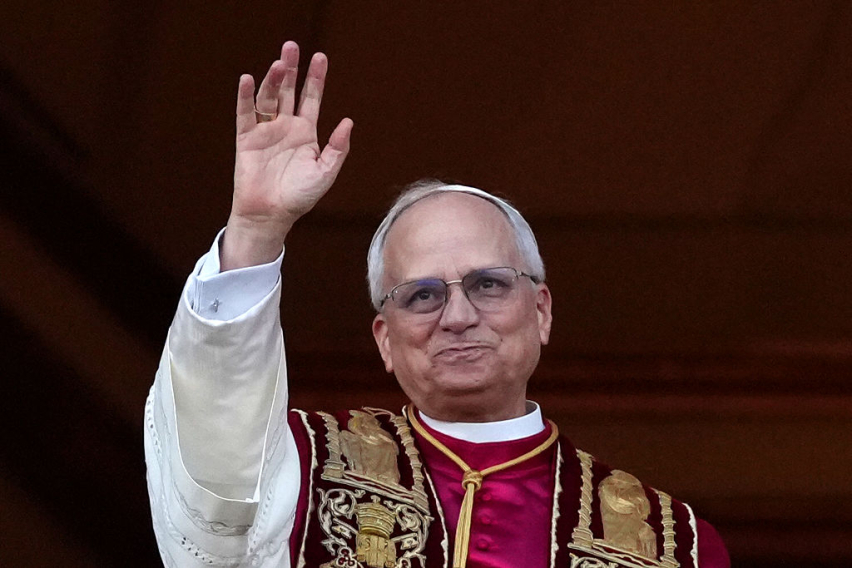
An Italian evangelical pastor and theologian has offered a wide-ranging assessment of Pope Leo XIV's first year in office, describing a pontiff who has emerged as a combative global voice on peace while carefully managing divisions within the Roman Catholic Church.
Writing for Vatican Files, Leonardo De Chirico — pastor of Breccia di Roma church and director of the Reformanda Initiative, an organization that equips evangelical leaders to engage with Roman Catholicism — said it remains too early for a definitive verdict on Leo's papacy but that certain patterns are now clearly visible.
De Chirico, who holds a doctorate from King's College London and has written extensively on post-Vatican II Catholicism, said the most striking development of Leo's first year has been his willingness to engage in direct, unfiltered public confrontation — most notably with U.S. President Donald Trump.
According to De Chirico, Leo's criticism of the Trump administration's handling of undocumented migrant deportations set the stage for a broader clash over the war in Iran. The pope has responded to Trump's attacks directly rather than through traditional Vatican diplomatic channels, a choice De Chirico described as unexpected given Leo's otherwise reserved and controlled temperament.
"For months now, the Trump vs. Leo dynamic has dominated the global political narrative, casting the pope as Trump's ultimate opponent in the name of 'peace,'" De Chirico wrote. He noted that Leo's popularity has grown considerably among secular audiences as a result.
Leo's international travel — to Turkey, Lebanon and across Africa — has reinforced what De Chirico characterized as contemporary Catholicism's focus on the Global South, where the Catholic Church is navigating competition from both Islam and growing evangelical movements.
Internal balancing act
Within the Catholic Church itself, De Chirico said Leo has acted as a pragmatic bridge-builder rather than a reformer or a traditionalist defender. Francis, his predecessor, left behind unresolved tensions over "synodality" — a contested vision of shared church governance — and a church marked by significant internal conflict.
In response, De Chirico wrote, Leo has sought to lower the temperature: holding a firm line on questions such as same-sex unions without breaking with more progressive factions, and moderating enthusiasm for synodality without extinguishing it. No sweeping appointments to senior church positions have been made.
"On the domestic front, Leo has proven himself to be a seasoned and experienced political figure," De Chirico wrote, describing him as someone focused on preserving Catholic institutional integrity rather than driving change.
Distant from evangelicals
De Chirico's analysis in Vatican Files gives particular attention to Leo's ecumenical priorities — and what he sees as evangelicals' effective absence from them.
He wrote that Leo's ecumenical focus tilts toward Eastern Orthodoxy and the Oriental Churches, with a secondary interest in Islam, while liberal Protestant bodies have received a cooler reception. As evidence, he pointed to what he described as a bureaucratic welcome given to the Archbishop of Canterbury during a visit to Rome.
As for evangelicals, De Chirico said they barely register in Leo's thinking. Unlike Pope Francis, who maintained personal friendships with evangelical leaders in Argentina, Leo is said to have cultivated no such relationships — a pattern that reportedly predates his election and goes back to his time as bishop in Peru.
De Chirico described Leo's theological framework as a Catholic Augustinianism shaped by the post-Vatican II tradition, drawing on themes of peace, grace and Mariology.
Vatican Files is a project of the Reformanda Initiative, which is based in Rome and works to help evangelical churches understand and engage with Roman Catholic theology and practice.