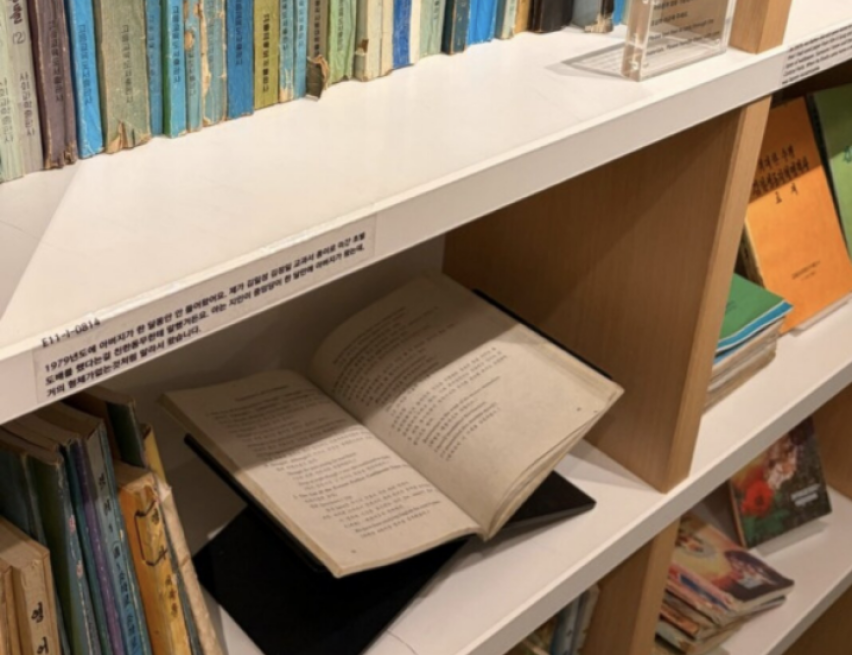
A New Testament and a hymnal said to have been copied out by hand by a North Korean believer are among the items in a new exhibition that opened to the public Sept. 21 at the Database Center for North Korean Human Rights (NKDB).
The exhibition, "Life Beyond the Study," draws on more than 500 North Korea-related books and records collected by the Rev. Lim Chang-ho. Lim donated the collection to NKDB in June in support of its aim to establish a future North Korean Human Rights Museum.
Alongside the manuscripts are North Korean textbooks, music books, picture books and cookbooks. Someone once read these books, underlined them and kept them close at hand.
NKDB displays the donated items next to testimonies it has documented from North Korean residents. The exhibition looks at both the official world found in the books and the lives of the people who read them, learned from them and lived with them.
The records passed through many hands before coming together in Lim's study. Now they have moved to a new study: the North Korean Human Rights Exhibition Hall. Key items from the donation are shown in a small special-exhibition corner of the hall.
Books that could not be published, scripture passed on by hand
The donated items include a New Testament, responsive readings and a hymnal said to have been copied out by hand by a North Korean believer. The materials reached Lim through various routes, and he kept them for many years.
The exhibition presents the main manuscripts alongside NKDB testimonies on religious persecution.
According to NKDB, people in North Korea can face severe punishment for owning a Bible or taking part in religious activity. In NKDB's "2025 White Paper on Religious Freedom in North Korea," 589 of the 15,303 North Korean escapees surveyed, or 3.9%, said they had seen a Bible in North Korea.
"Visitors can copy out by hand the hand-copied Bible — evidence of a faith preserved in spite of persecution — and reflect on the meaning of faith and freedom," NKDB said.
The world learned from books, and the life the books left out
North Korean textbooks teach mathematics, science, language and the arts. According to NKDB, they also teach loyalty to the leader, collectivism, class consciousness and defense of the socialist system.
This political-ideological education appears not only in subjects such as revolutionary history, NKDB said. It also shows up in the reading passages, exercises and songs of general subjects, including Korean language, English, morals and music.
The exhibition places textbooks, music books and picture books alongside testimonies from people who went to school in North Korea. One North Korean escapee testified that there were not enough textbooks for even half of the students. Students also had to supply firewood, furnish their classrooms and pay various school fees.
Visitors can see both the official values the books teach and the realities residents faced while learning from them, NKDB said.
Beyond the cookbooks, lives sustained by 'speed-battle rice cake'
The donation also includes North Korean cookbooks, among them "Korean Cookery Collection," "Korea's Regional Cuisine," "Tteok: Korea's National Food" and "Home Cooking Class."
Not every resident, however, could make and eat the dishes in these books. The exhibition shows cookbooks full of rich dishes next to testimonies about sokdojeon tteok, or "speed-battle rice cake," made quickly by mixing corn flour with water.
One person testified, "Puffed corn flour was my wealth and my very life."
From one person's study to a future museum
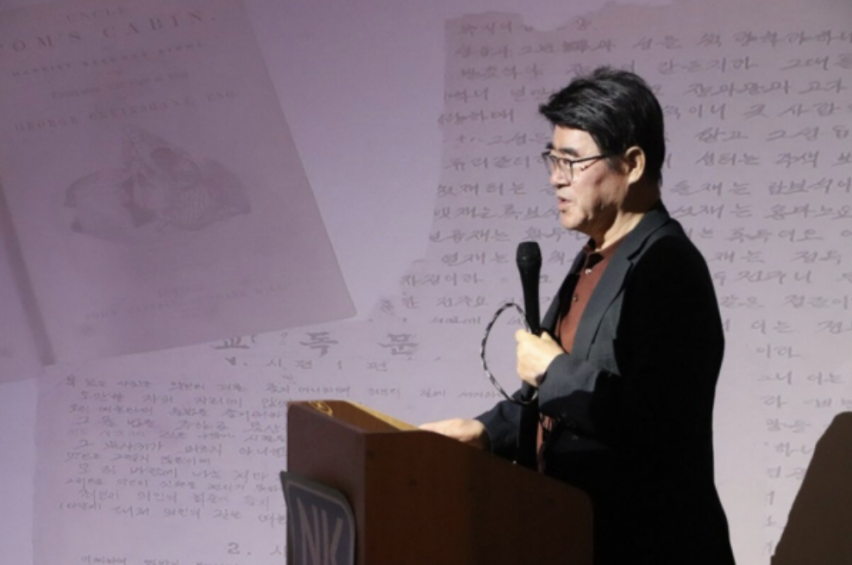
Lim is a minister, educator and North Korean human rights activist. He is principal of Jangdaehyun School, a middle and high school for young people of North Korean escapee background. He founded the school in 2014, and it has since supported the learning and independence of its students.
Lim previously served as a professor in the Department of Christian Education and as vice president for academic affairs at Kosin University. He began working for North Korean human rights and the resettlement of escapees around 2000, after encountering the testimonies of North Korean escapees.
Lim and others attended an opening and donation ceremony on Sept. 18. There, he described how he collected and kept the materials over some 20 years and explained why he decided to donate them for the future museum.
NKDB runs the exhibition hall to share with the public the North Korean human rights records and testimonies it has gathered over some 20 years. Its permanent exhibition, "Her Day in North Korea," has drawn more than 1,600 domestic and international visitors since it opened in April.
That exhibition follows one North Korean resident's home and daily life. NKDB says it presents North Korean human rights as concrete stories of life rather than as institutions or statistics.
NKDB describes "Life Beyond the Study" as an effort to turn one person's records into a shared public resource. It also offers an early look at the collection, preservation, research and exhibition work the future museum will carry out.
NKDB plans to keep using the special-exhibition corner after this show. It intends to periodically present records held by members of the public, as well as work by artists and collaborators from various fields who reinterpret North Korean human rights. The goal is to draw public attention to human rights violations that are still continuing in North Korea.
"In addition, by creating spaces where citizens take part as messengers who remember and pass on the voices of victims, we intend to sustain ongoing attention and solidarity until the day the human rights situation in North Korea improves and the violations stop," NKDB said.
Original reporting by Christian Daily Korea.