
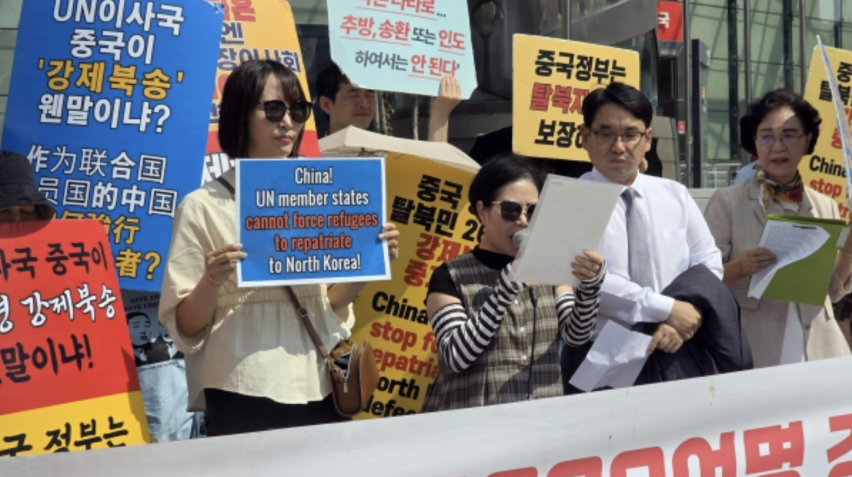
A coalition of South Korean civic and Christian organizations gathered outside the Chinese Embassy in Seoul on Monday to demand that Beijing immediately halt the forced repatriation of North Korean defectors, calling the practice a violation of international law and an affront to basic human dignity.
The National Coalition Against Forcible Repatriation of North Korean Defectors held the press conference in front of the Seoul Central Post Office near the Myeong-dong embassy, issuing a declaration that China's treatment of North Korean border crossers was "not merely a matter of illegal entry or border management," but "a grave human rights issue involving the lives of those who crossed the border risking their lives to escape North Korea's extreme political oppression, economic deprivation, food shortages, and human rights violations," Christian Daily Korea reported.
The coalition — which includes the Esther Prayer Movement, the General Federation of North Korean Christians, the North Korean Human Rights and Unification Alliance, and other organizations — said China refuses to recognize North Korean border crossers as refugees, classifying them instead as illegal economic migrants. As a result, no individual refugee status screening takes place, and the UN High Commissioner for Refugees is denied access, the declaration stated.
China is a party to the UN Refugee Convention, the Refugee Protocol and the UN Convention Against Torture, the coalition said, and therefore bears a legal obligation to honor the principle of non-refoulement, which prohibits returning people to places where they face persecution or torture.
Those repatriated to North Korea face beatings, torture, prolonged detention and forced labor, the declaration stated. Defectors found to have sought contact with South Koreans or Christians face even harsher punishment, potentially including execution. Women returned while pregnant are subjected to forced abortion and infanticide, the coalition alleged.
"Is crossing the border in search of human rights and freedom a crime deserving to be sent back to death?" the declaration asked. "Is it truly the conduct befitting a responsible member of the international community to send people back to North Korea knowing they will face the risk of torture, imprisonment, and execution?"
The coalition further alleged that China has mobilized its security and surveillance apparatus to locate and arrest defectors, and that it punishes Chinese citizens, ethnic Korean residents, missionaries and human rights activists who offer them help — effectively cutting off, in the coalition's words, "the last remaining safety net" for defectors.
"North Korean defectors are not objects, nor subjects of diplomatic negotiation," the declaration stated. "Each and every one of them is a human being of dignity who must have their human rights and freedom protected."
Addressing Beijing's standing in the international community, the coalition said China, as a permanent UN Security Council member and member of the Human Rights Council, must prove its responsibility "not merely through economic and military power, but through actions that respect universal human rights and human dignity."
The declaration called on the South Korean government to deploy all available diplomatic means on behalf of North Koreans detained in China and to press Beijing, together with the international community, to allow them safe passage to South Korea or a country of their choosing.
"There is no place for partisan politics or ideology when it comes to saving the lives of North Korean defectors," the coalition said. "Not sending a single person back to a land of death is not a matter of political choice, but the most basic principle concerning human dignity and universal human rights."
The coalition set out four specific demands: that China comply with the principle of non-refoulement and end all forced repatriations; that Beijing release detained North Korean defectors and permit free UNHCR access and individual refugee screening; that the South Korean government pursue active diplomacy to prevent repatriation and ensure safe passage; and that the United Nations and the broader international community establish a cooperative framework for the protection of North Korean defectors.








