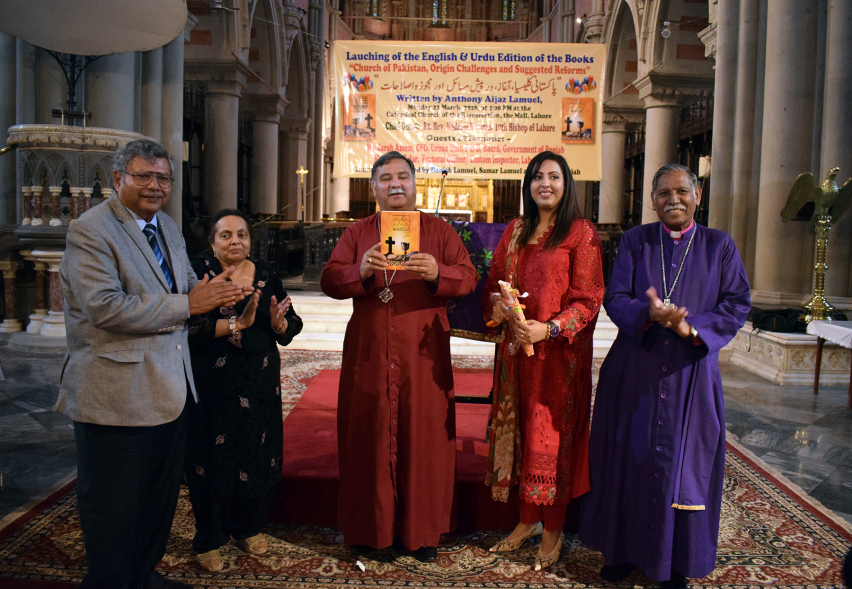
A book calling for accountability and renewal within the Protestant church in Pakistan was launched in Lahore, as church leaders and theologians warned of deepening institutional challenges confronting the country’s largest Protestant denomination.
Titled “Church in Pakistan: Origin, Challenges and Suggested Reforms,” the book by Anthony Aijaz Lamuel was formally unveiled by Bishop of Lahore Diocese, Rt Reverend Nadeem Kamran at the Cathedral Church of the Resurrection on Monday, March 23, drawing clergy, academics and lay Christians from across the city.
Lamuel, a veteran church administrator and Bible scholar, has served as general secretary of the Synod of the Church of Pakistan and held key positions within its Lahore Diocese. He also spent more than four decades working with the Pakistan Bible Society, an experience that gave him broad exposure to diverse Christian denominations and ecclesial practices across the country.
Speaking at the launch, Lamuel said the book was written at a time when the church is “facing problems falling into crisis one after the other,” underscoring the urgency of both spiritual renewal and structural reform. He emphasized that the church must critically examine its internal dynamics if it is to remain relevant and faithful to its mission.
The 16-chapter volume combines biblical teaching, historical analysis and contemporary critique in a structured and accessible manner. Early chapters explore the theological foundations of the church and draw lessons from early Christianity, while later sections examine the development of Christianity in South Asia and the evolution of the Church in Pakistan.
The concluding chapters present a set of proposed reforms based on qualitative research, including 46 interviews with clergy, lay members, students, lawyers and journalists, offering a broad cross-section of perspectives.
Concerns over leadership & accountability
A central concern highlighted in the book, and echoed by several speakers at the launch ceremony, was the concentration of authority within church leadership and its implications for governance, transparency and institutional credibility.
Drawing on interview findings, Lamuel notes that many church members perceive leaders as being more focused on institutional control, personal status and building fortunes than on service and pastoral responsibility. He warns that such tendencies risk undermining the church’s moral authority and weakening its witness in society.
Citing British historian Lord Acton, the author underscores the dangers of unchecked power, arguing that meaningful reform must include stronger mechanisms for transparency, accountability and shared leadership. He calls for a return to servant leadership rooted in biblical principles and modeled on humility and service.
Lamuel further emphasizes the role of the church as a spiritual community, invoking the words of third-century Christian theologian Cyprian of Carthage to stress the importance of belonging to and actively participating in the life of the church. “You cannot have God for your Father unless you have the church for your Mother,” Cyprian famously stated, a theme the author uses to highlight the centrality of the church in nurturing faith.
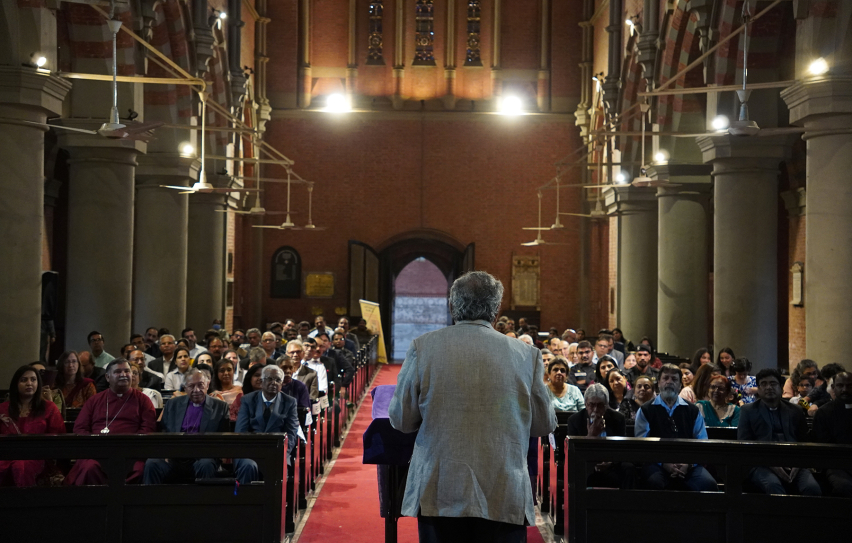
Church leaders and theologians attending the launch described the book as both timely and necessary, particularly in light of the challenges currently facing Christian institutions in Pakistan.
Dr. Liaquat Qaiser, principal of the Full Gospel Assemblies Theological Seminary, said the author had provided a strong biblical and theological framework while addressing contemporary issues with clarity and depth.
Rt. Rev. Irfan Jamil, former bishop of the Lahore Diocese, said the book offers a comprehensive treatment of the church’s biblical, theological and historical dimensions in an accessible and well-documented format.
Dr. Kenneth Pervaiz, assistant professor at Forman Christian College University, said Lamuel’s work effectively traces the development of Christianity in the subcontinent while identifying both institutional weaknesses and possible solutions grounded in research.
Dr. Julius Qaiser, director of the Open Theological Seminary, described the book as a “courageous and thought-provoking contribution” that addresses sensitive issues with analytical rigor and pastoral concern.
A timely book for reflection
The Church of Pakistan was established in 1970 as a united Protestant body, bringing together Anglican, Methodist, Presbyterian and Lutheran traditions in an effort to promote Christian unity in the country.
Its origins lie in 19th-century missionary activity during British colonial rule in the Indian subcontinent, when churches, schools and hospitals were established across the region. Following the creation of Pakistan in 1947, Protestant communities initially remained divided before moving toward unification, culminating in the formation of the Church of Pakistan as a national ecclesial body.
Today, the church oversees dioceses in major urban centers and continues to play a significant role in education, healthcare and social services, particularly among marginalized communities. At the same time, it operates within a broader context in which Christians often face social and legal challenges, adding further complexity to its institutional responsibilities.
However, internal governance and corruption issues, combined with external pressures, have intensified calls for reform within the church, making the themes addressed in Lamuel’s book particularly relevant.
A call to renewal
In his concluding remarks, Lamuel urged church leaders and members to embrace both institutional reform and spiritual renewal, calling on the church to reclaim its role as a faithful witness to Christian belief and practice in society.
“The church must move beyond internal divisions and focus on integrity, accountability and service,” he said, stressing the need for unity and purpose.
The book is expected to contribute to ongoing conversations within Pakistan’s Christian community and among international funding organizations about the future of the Church of Pakistan and the evolving role of faith-based institutions operating in challenging social and political environments.