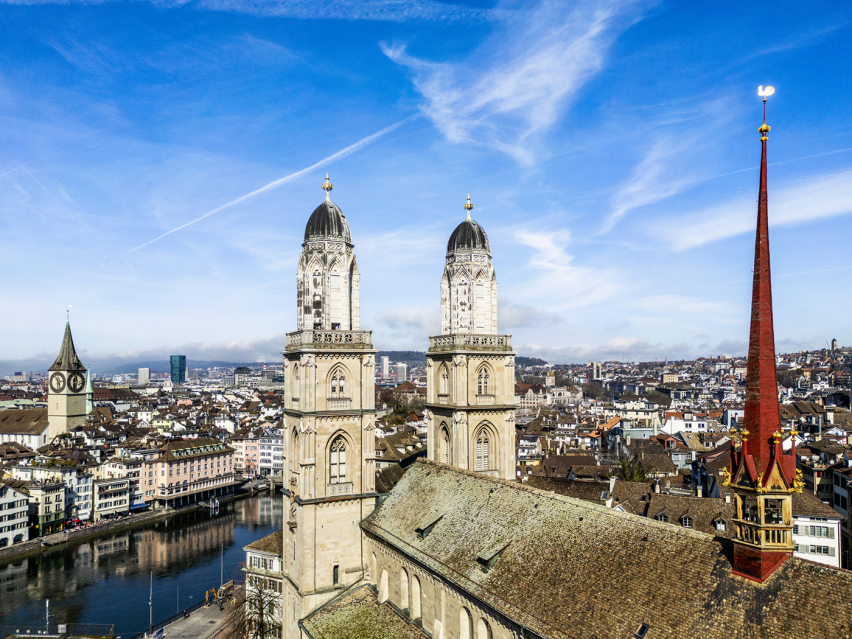
Members of the Evangelical Reformed Church of the Canton of Zurich have voted to write climate targets into the church's constitution, including net-zero greenhouse gas emissions from church buildings by 2035. The counterproposal to the church's Creation Initiative passed Sunday with 52.7% of the vote, the Swiss Reformed news portal ref.ch reported.
The result ends a dispute that divided the church's Synod for months. The disagreement was less about whether the church should care for the environment than about who decides how: the cantonal church bodies, or the parishes that own the buildings and pay for their upkeep. Opponents warned that climate work could take precedence over preaching and pastoral care, while supporters said parishes would keep room to choose their own measures.
Across the canton the margin was slim. Support was far stronger in the district of Zurich, which covers the city itself, where more than 70% of voters said yes, according to ref.ch.
What the vote changes
The amendments to the Church Ordinance set the 2035 net-zero goal for church buildings and create a legal basis for environmental management in the parishes. That framework includes certification under the "Grüner Güggel," or Green Rooster, environmental label. Ecological questions are also to receive more weight in theology, education and spiritual life.
The Green Rooster is administered by oeku – Kirchen für die Umwelt, a Bern-based church environmental association, and is modeled on the European Union's EMAS environmental management standard. Its name comes from the rooster weather vane found on many Reformed steeples in Switzerland. The symbol recalls the Gospel account of Peter's denial of Christ and has traditionally set Protestant churches in the country apart from Catholic ones.
In a statement, the church's executive Church Council welcomed the outcome. It said responsibility for the preservation of creation was now anchored as a binding obligation in the Church Ordinance, giving the church a foundation for environmental and climate work that goes further than what the state requires.
Reactions from both campaigns
Tobias Adam, president of the initiative committee, told ref.ch that the unusually high turnout showed climate protection mattered to church members. "In view of the escalating climate crisis around the world, today's vote gives hope," he said.
Adam rejected the idea of a split between city and countryside, saying the rural vote was evenly balanced. He also said approval would not impose obligations the parishes could not shape themselves. "The counterproposal is committed to ensuring that the parishes retain their autonomy and can take individual measures," he said.
The opposing committee said it was disappointed. In a statement, it said parishes could in future be forced to put climate protection ahead of proclamation, diaconal ministry and other core church tasks. The committee said it doubted parishes "will allow themselves to be patronized in this way."
Objections raised before the vote
The No campaign was led by a group of Synod members who wanted Green Rooster certification to remain voluntary, as previously reported by Christian Daily International ahead of the ballot. They argued that the label places heavy demands on parish boards and staff, requires recertification every four years and carries costs that fall on local congregations.
By that committee's count, 27 parishes, about a quarter of the canton's total, had been certified despite several years of encouragement from the Church Council. The opponents based much of their case on subsidiarity, the Swiss principle that decisions should be made as close to the local level as possible. They also pointed to a September 2025 cantonal ballot in which Zurich voters rejected a revision of the energy law that would have set a net-zero date in cantonal legislation.
Both campaigns presented their positions as matters of Christian responsibility. Supporters described the earth as God's creation, which people share responsibility for preserving. Opponents framed care for the environment around Christ as the sustainer of creation and argued it is best carried out by vital local congregations.
From theme week to ballot
The Creation Initiative grew out of a church theme week on climate justice in 2022. Church climate activists submitted it the following year with about 1,600 signatures, making it the first successful popular initiative in the history of the Zurich cantonal church, ref.ch reported.
The Church Council answered with a counterproposal that took up the initiative's main demands. Debate in the Synod was contentious. Some members said the church bore responsibility for climate protection, while others warned against centralization and overburdening parishes, and critics used labels such as "environmental religion" and "Güggel compulsion."
The Synod adopted the counterproposal by 54 votes to 45, and the initiators withdrew their original text in its favor. A referendum was then called against the counterproposal, sending the question to the church's members, all of whom may vote from age 16.
The Zurich church is one of Switzerland's Landeskirchen, churches recognized under cantonal public law that govern their own affairs. It belongs to the Evangelical Reformed Church in Switzerland, a federation of 24 cantonal Reformed churches and a member of the World Council of Churches.
Swiss Reformed cantonal churches are generally regarded as theologically liberal, but the leaning varies from parish to parish. Some local Reformed parishes identify as evangelical and are members of the Swiss Evangelical Alliance alongside free churches and independent evangelical congregations.