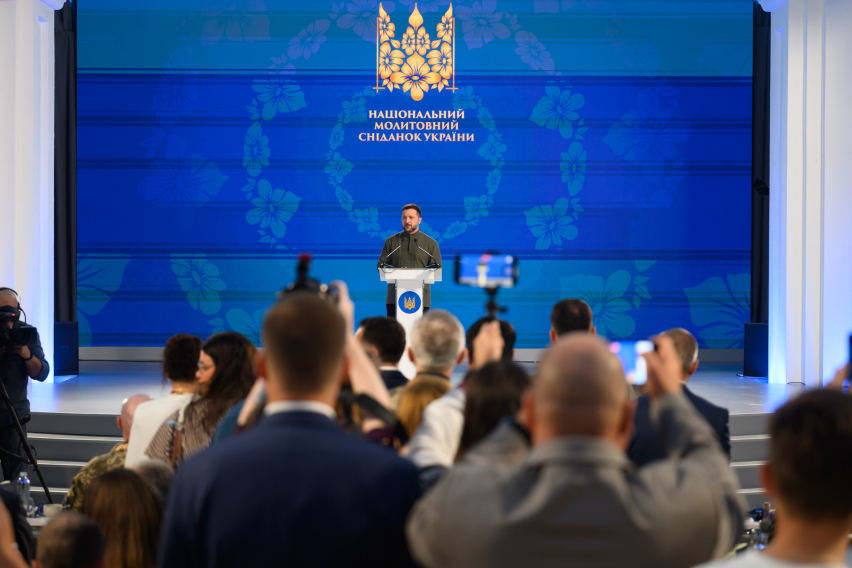
A delegation of evangelical leaders from across Europe stood with more than 1,500 participants from 17 countries at Ukraine's third National Prayer Breakfast on Sunday, Aug. 23, offering prayers of solidarity with a nation still at war four and a half years after Russia's full-scale invasion, as it prepares to mark 35 years of independence.
World Evangelical Alliance Secretary General Rev. Botrus Mansour offered a prayer in Arabic at the gathering, held in Kyiv under the patronage of President Volodymyr Zelenskyy. Praying on behalf of the worldwide evangelical community, Mansour asked that those who support Ukraine would not grow weary and would continue to pray and work toward peace.
"The greatest danger now is not fatigue at the front, but the world getting used to it," Zelenskyy told participants, according to a statement from the presidential office.
The event drew heads of state from neighboring countries, senior United States political figures, military chaplains, families of fallen soldiers, and representatives of charitable organizations. President Gitanas Nausėda of Lithuania, Estonian Prime Minister Kristen Michal, and members of the U.S. Senate and Congress were among those present.
Zelenskyy spoke to that breadth of attendance in his opening remarks. "Today is an important day. Today, in one hall, side by side, are different people, people of different faiths, political views, professions, and nationalities. But important events like this underscore that any differences between us do not matter when it comes to what matters most. Truth. Peace. And how prayer, in difficult moments, unites us all," he said, according to reporting by Rubryka.
Ukraine on Monday marks the 35th anniversary of its independence — and the end of Soviet occupation — a milestone Zelenskyy framed as inseparable from the current war. "Today marks the 1,642nd day of the full-scale war," he said, according to the presidential statement. "Russia has pursued several objectives. One of them is to make faith a matter of permission — to have Putin decide who is allowed to gather for prayer and who is not, which church may exist and which must disappear. Our entire struggle is also about this."
The breakfast, which continues a tradition established in the United States in 1953, centered on three specific intercessions the president named from the podium. "Please let us pray today for three important things. For those in captivity — that they all may make it through. For those in battle — that they may return. And for peace for Ukraine, that it may come — a just peace, a lasting peace, strong as our people are strong, and just," Zelenskyy said, Rubryka reported.
War seen up close: delegation visits Bucha, Irpin, Lviv
Rev. Mansour traveled to Ukraine as part of a ten-member evangelical delegation organized by Rev. Alan Donaldson, Secretary General of the European Baptist Federation. The group also included Rev. Jan Wessels, General Secretary of the European Evangelical Alliance. Over two days before the breakfast, the delegation visited the western city of Lviv, then the Kyiv suburbs of Irpin and Bucha where Russian forces carried out a massacre in the early weeks of the full-scale invasion in 2022.
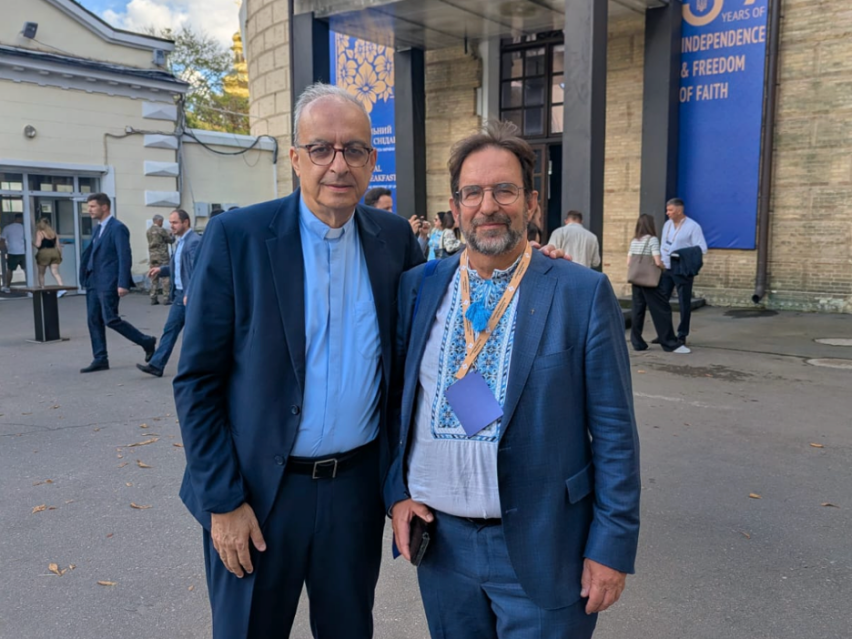
The war intruded even in the capital. While in central Kyiv, air raid sirens forced the group to shelter in a metro station, Mansour told Christian Daily International.
"This was not a regular trip. It was a trip to a country at war," Mansour said after the visit. "We visited the cities of Lviv and Irpin, witnessing the signs and impact of the war. We then visited Bucha, where a massacre was committed by ruthless Russian soldiers."
The experience combined grief with hope, Mansour said. "The initial impression is a combination of deep sadness at what war produces in terms of severe suffering, and encouragement at hearing how the Lord is using the evangelical church in Ukraine during these dark years. Above all, we live in hope that peace and justice will prevail."
Beyond the breakfast itself, the delegation met with Ukrainian evangelical pastors. "We went to encourage them, but despite the grief and the difficulty of their situation, it was we who came away encouraged — by their perseverance, their love for Christ, their faithfulness, and the work they are doing for His kingdom," Mansour said.
He appealed to Christians worldwide: "Please join us in praying for the Ukrainian people in general and for the church in particular."
Ukrainian officials call war a struggle of good against evil
At the breakfast, Chairman of the Verkhovna Rada Ruslan Stefanchuk offered a prayer for those carrying Ukraine through the war. "Today's prayer in unconquered, golden-domed Kyiv, which did not fall in February 2022 and will never fall, has very special power and significance," he said.
Prime Minister Sergii Koretskyi tied the 35th anniversary of independence directly to what Ukraine now faces. "Russia came to our land with a war rooted in contempt for human life, freedom, and dignity," he said. "Russian troops are destroying Ukrainian churches, devastating cultural heritage, and persecuting religious communities in the occupied territories. Therefore, this war is also a war of worldviews, a struggle between good and evil, light and darkness, freedom and enslavement."
Pence: Ukraine is winning, but needs air defenses before winter
Former U.S. Vice President Mike Pence also addressed the gathering, invoking the biblical promise that where the Spirit of the Lord is, there is freedom. He affirmed that Ukraine would never surrender and that an occupying force may seize territory, but cannot conquer a people whose faith remains unbroken.
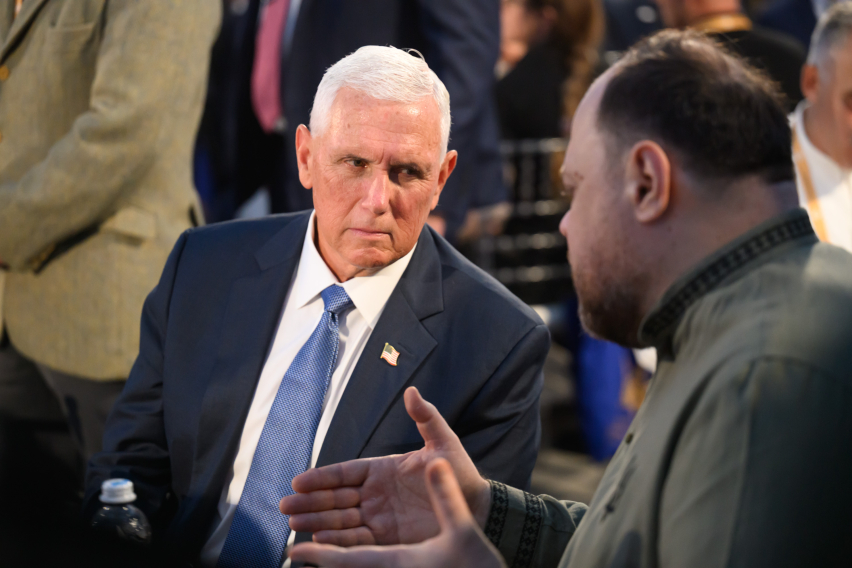
Following the breakfast, Pence spoke to NewsNation after a private meeting with Zelenskyy. Among the first observations he offered was the determination he had witnessed in Kyiv.
"Four and a half years after that brutal and unprovoked invasion by Russia, I sense that the will and commitment to defend their freedom is even greater today than the day that the Russian tanks first rolled," he said.
Pence described a war in which Ukraine had fundamentally changed the dynamics of modern combat. "They've essentially reinvented warfare," he said. Drone strikes deep into Russian territory, the sinking of Russian naval vessels in the Black Sea, and a largely held front line in the Donbas region all pointed, in his assessment, to a conflict Russia was losing on the battlefield.
But the nature of Russian attacks has shifted. With a stalemate on the ground in Donbas, Pence said, Moscow has turned to cruise missiles and high-arc ballistic missiles — weapons that require Patriot batteries or THAAD interceptor technology to defeat, systems Ukraine currently lacks in sufficient numbers. Zelenskyy, he said, reiterated in their meeting that Ukraine urgently needs access to U.S. Patriot interceptor resources.
"Stopping those ballistic missile attacks will in many ways take the last fighting tool out of Vladimir Putin's hands," Pence said. Without that protection, he added, Putin would use the missiles to destroy Ukraine's energy infrastructure before winter — as he has already shown willingness to do, targeting a children's hospital and a shopping mall in recent days.
On the wider international picture, Pence called on the United States to continue its historic role as the arsenal of democracy. He noted that while direct U.S. aid under the current administration had stopped, Washington had not blocked European allies from purchasing weapons and making them available to Ukraine. He also welcomed the Senate's passage of the Lindsey Graham Sanctions Act and called on allies to make their own interceptor systems available.
For all the urgency, Pence closed on a hopeful note, saying: "We may well be on the road to a just and lasting peace."