
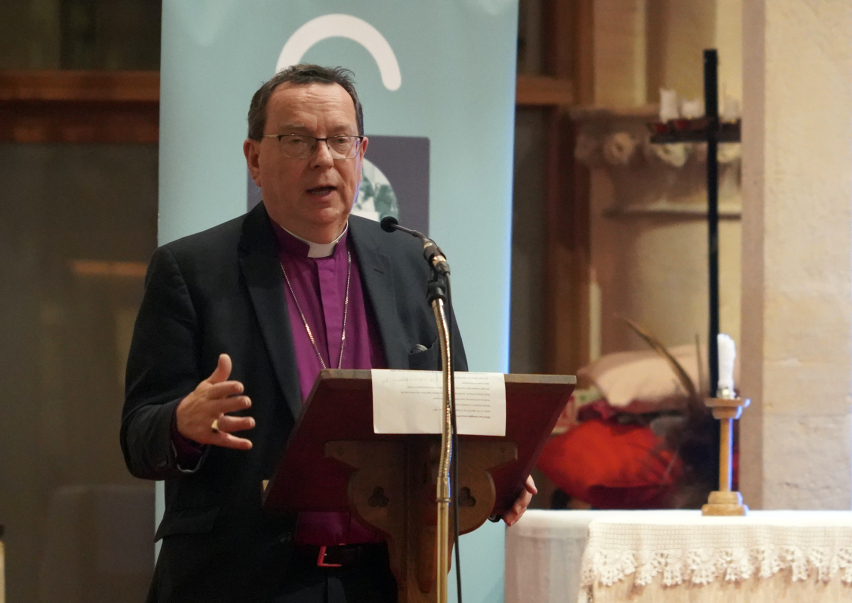
The global push for freedom of religion or belief has gained visibility since the publication of a landmark 2019 review commissioned by the U.K. government. But worsening conditions for religious minorities and declining political momentum threaten to undermine progress, according to Philip Mounstephen, former Bishop of Truro and author of the influential report.
Speaking at a two-day consultation on gender-specific religious persecution held April 17–18 in Marcham, U.K., and organized by the Gender and Religious Freedom (GRF) network, Mounstephen urged advocates, policymakers and church leaders to renew their commitment to defending religious freedom “for everybody,” warning that selective or politicized approaches risk eroding the principle altogether.
His remarks, delivered in both an afternoon panel discussion and an evening address, as well as in a subsequent interview with Christian Daily International, framed religious freedom not as a niche concern for faith communities but as a foundational human right with broad implications for global stability, social cohesion and justice—particularly for women and girls.
A report that reshaped the conversation
Mounstephen’s 2019 Independent Review for the U.K. Foreign Secretary of FCO Support for Persecuted Christians—often referred to as the Truro Report—outlined 22 recommendations aimed at strengthening the Foreign and Commonwealth Office’s response to the persecution of Christians worldwide. The report marked one of the most comprehensive government-backed examinations of religious persecution in recent years and helped elevate freedom of religion or belief (FoRB) within foreign policy discussions.
At the Marcham gathering, participants repeatedly referenced the report as a practical tool that has shaped advocacy strategies over the past decade, particularly in highlighting the intersection between religion and gender-based abuses such as forced marriage, trafficking and sexual violence.
The bishop himself acknowledged the report’s influence but emphasized that its greatest value lies not in the document itself but in how it has been used to sustain long-term advocacy.
Progress on the agenda—but not necessarily in reality
Reflecting on developments since 2019, Mounstephen said the issue of religious freedom has achieved greater visibility at both national and international levels. Governments are now less able to dismiss or ignore it outright.
“I think freedom of religion or belief is on the agenda in a way that it hasn’t been before,” he said during the panel discussion.
He pointed to initiatives such as the international Article 18 Alliance—a coalition of nearly 40 countries committed to advancing religious freedom—as evidence of growing institutional recognition.
Yet this increased awareness has not always translated into improved conditions on the ground. On the contrary, Mounstephen said, the global situation for religious minorities has deteriorated.
“Globally, the situation is getting worse,” he said, warning that there is a sense that the political will required to address persecution risks “losing momentum.”
Earlier high-profile international gatherings that received significant attention have seen diminishing follow-through, he said, noting that major conferences on religious freedom have become smaller and less influential in recent years. And although there is strong rhetoric in some circles, he suggested, tangible implementation has lagged.
Rising authoritarianism and shrinking space for minorities
According to Mounstephen, the “single most significant factor” threatening religious freedom today is the global rise of authoritarian, nationalist and often religiously aligned political regimes. These governments, he said, tend to marginalize minority groups, restrict dissent and conflate national identity with dominant religious or cultural norms.
“Twenty years ago, the situation in India and China was very different than it is today,” he said, pointing to tightening restrictions and growing hostility toward minority communities.
While such dynamics affect entire populations, he stressed that minorities—especially women and girls—bear a disproportionate burden. The phenomenon also undermines broader societal well-being, he added, as the erosion of minority rights often signals a wider decline in freedoms for all citizens.
“What’s happening to religious minorities is a real bellwether of what’s happening more broadly in society,” he said in the interview.
Gender and religion: a critical intersection
A central focus of the Marcham+10 consultation was the intersection of gender and religious persecution. The issue has gained increasing attention since the original Marcham conference in 2016, and Mounstephen credited engagement with advocates in this space for deepening his own understanding of how gender amplifies vulnerability.
“The people who suffer most from the denial of freedom of religion or belief are women and girls far more than men,” he said, adding that this reality requires targeted attention and effective policy responses.
He also noted that emphasizing gender-specific impacts can help elevate the issue politically, particularly in Western contexts where policymakers may be more responsive to protecting women’s rights rather than to religious freedom alone.
From persecution to “moral injury”
In his evening address, Mounstephen expanded on the human impact of persecution, introducing the concept of “moral injury” to describe the profound damage inflicted when individuals’ trust and belief systems are violated.
“People’s lives are lived within frameworks of trust, and moral injury breaks those frameworks,” he said. Abuse—whether perpetrated in the name of religion or because of it—causes long-term psychological and social harm.
He connected this concept to his broader work addressing abuse within church contexts, noting that the consequences of religiously framed harm extend beyond immediate victims. It also goes on to affect communities and institutions.
That reality underscores why defending religious freedom is not merely about protecting rights but about safeguarding human dignity and social cohesion, he argued.
A call for consistency: defending freedom for all
Throughout his remarks, Mounstephen repeatedly emphasized that religious freedom must be upheld universally “for everybody” rather than selectively.
In the interview, he offered theological and practical arguments for this position, starting with Jesus’ command to “love your neighbor” as a basis for defending the rights of people of all faiths—or none.
“We should not be for one minute in the business of putting barriers up,” he said, arguing that freedom of belief inherently includes the freedom not to believe. He also warned that attempts to prioritize one group—whether Christians or others—risk undermining the credibility and effectiveness of advocacy efforts.
These concerns have increasingly emerged in political contexts, where religious freedom rhetoric has been linked to nationalistic agendas or used to justify preferential treatment for majority faith groups, and in some cases, this includes Christians.
Mounstephen distanced himself from these approaches, emphasizing that genuine religious freedom must be impartial and grounded in universal human rights.
Challenging narratives in the West
While much of his work has focused on international persecution, Mounstephen acknowledged in his evening remarks that concerns about religious freedom are also relevant within Western societies—though in different forms.
He cautioned against equating the experiences of Christians in countries like the U.K. with those of persecuted minorities elsewhere, calling such comparisons misleading.
At the same time, he expressed concern about rising antisemitism and anti-Muslim sentiment in Europe, describing these as genuine threats to religious freedom.
“I think we need to be awake to the abuses that are happening now in this country,” he said, pointing to growing hostility that affects the safety and dignity of minority communities in the U.K.
He also highlighted the emergence of “Christian nationalism” and misogyny as troubling trends, suggesting that these phenomena may be interconnected and contribute to broader challenges facing pluralistic societies.
Advocacy, citizenship and political engagement
Asked what individuals and churches can do to advance religious freedom, Mounstephen emphasized the importance of active citizenship and sustained advocacy. He pointed to grassroots engagement—such as writing to elected representatives—as a key factor in shaping political priorities.
“If it matters to MPs’ constituents then it’s going to matter to the MPs,” he said, pointing to the strong attendance of lawmakers at events like the annual World Watch List launch as evidence.
He encouraged Christians and others to stay informed, engage with credible organizations and consistently raise concerns about religious persecution in both political and public spheres.
A decade of advocacy on gender-specific religious persecution
The Marcham+10 consultation marked a decade since the original 2016 gathering that first sought to define and address gender-specific religious persecution—a concept that has since gained wider recognition in academic, policy and advocacy circles.
As previously reported by Christian Daily International, participants at this year’s event highlighted both progress and persistent gaps, noting that many forms of abuse remain underreported and inadequately addressed.
Mounstephen echoed this assessment in his address. Yet, despite the concerns about some of the negative global trends, he concluded his evening remarks on a note of cautious optimism, urging participants not to lose hope.
“If we are not motivated by hope, then we will give up,” he said, encouraging participants to keep pursuing the vision of a world that is “open, plural, tolerant [and] peaceful.”
Such a vision, he said, requires sustained effort, collaboration and a commitment to principles that transcend political and cultural divides.
Freedom of religion or belief is a critical test of societies’ commitment to human rights and the common good, Mounstephen argued. “This isn’t just an issue of concern to a few religious people. This touches on really big-ticket issues of geopolitical significance,” he said.
Where religious freedom is denied, he argued, broader patterns of injustice and instability are likely to follow.








