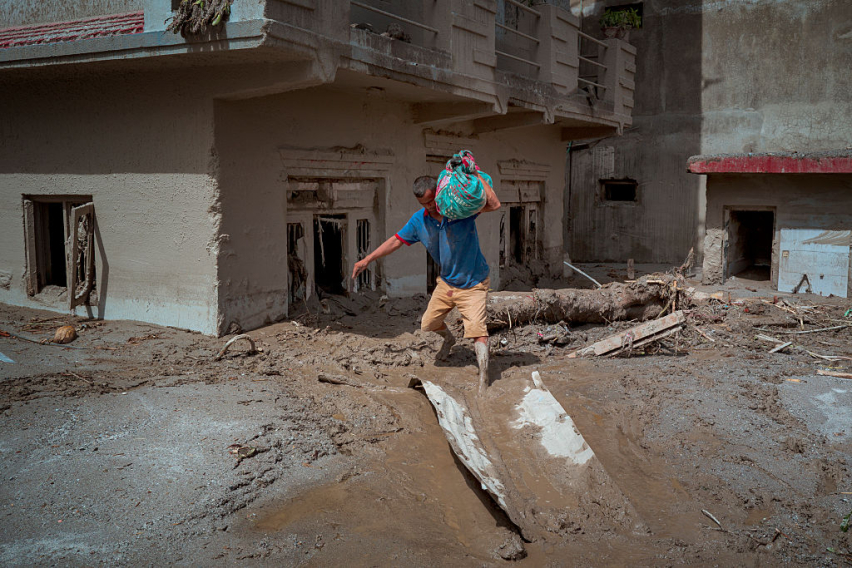
Christian relief teams have begun moving into remote valleys of northern Nepal after a torrent of water, mud, rock and ice swept through Himalayan river settlements on Aug. 26, killing hundreds of people and leaving more than 1,400 missing across Nepal and the Tibet region of China.
Nepal's foreign minister, Shisir Khanal, described the flooding as one of the worst disasters the country has faced in recent memory, telling reporters that entire towns had been erased within a couple of hours.
Nepali churches and international Christian agencies working through them have begun moving food, water and shelter materials into the district. Roads and bridges across the affected area have been destroyed, and several communities can now be reached only by air.
Church networks respond from Kathmandu
The World Evangelical Alliance reported that floods and landslides struck Nepal's Rasuwa district hardest, particularly around Timure and Syabrubesi, damaging homes, roads, bridges and other infrastructure.
Of six churches previously recorded at Timure, two were reportedly swept away, the WEA said, citing church and relief leaders. Relief updates circulating among those networks cited more than 125 deaths among believers, though officials said confirmation remained pending while search and assessment work continued.
Two national bodies — the National Churches Fellowship of Nepal and the Nepal Christian Society — launched response efforts from Kathmandu. Three assessment teams travelled toward the affected areas on mountain bikes, and a rescue team was equipped to provide medical assistance. Local leaders were working to obtain district-level approvals to widen relief operations. The WEA said that funds raised for the response are channeled through its two member organizations.
The Rev. Dilli Ram Paudel of the Nepal Christian Society called for prayer for families of the missing, for those who have lost relatives, for the safety of rescue and medical workers, and for churches and households in the affected communities.
Access remains the central obstacle. Thousands have been affected by communication breakdowns, with many areas left without electricity or reliable mobile and radio service, church leaders said. They also reported that more than 40% of roads in the affected areas have been destroyed or badly damaged.
Supplies moving before dawn
Send Relief, the humanitarian arm of the Southern Baptist Convention in the United States, said it is responding through partner churches already based in the affected districts. The organization reported that food bags containing rice, lentils, cooking oil and salt were being packed and loaded onto trucks, along with first aid supplies including gauze, disinfectant, paracetamol and soap, and that simple tents were being purchased for families whose homes were destroyed.
Trucks were leaving before dawn to reach the furthest communities still accessible by road while there was daylight, the organization said. Supplies are being delivered to partner churches, whose members then distribute them and assess further needs.
Samaritan's Purse said it had sent a team of disaster relief specialists to Nepal to work with Christian partners it had also worked with after the 2015 earthquake. The group said it would focus on emergency feeding and was preparing an airlift of tarpaulins, blankets, solar lights and hygiene kits.
Franklin Graham, the organization's president, wrote on Facebook on Aug. 26 that stranded residents were being lifted off rooftops by helicopter and asked readers to pray for families waiting for news of relatives. His post cited casualty figures that have since been overtaken by official counts.
World Relief said it was mobilizing to connect with local partners to deliver food, water and supplies.
A flood without rain
What set the disaster apart was the absence of a downpour. Narendra Pariyar, chief district officer of Rasuwa, said officials were caught off guard because there had been no heavy rainfall.
Khanal said the government had received preliminary information that an avalanche occurred on the morning of Aug. 26. Landslides in the area produced shaking strong enough to register initially as a magnitude 5.2 earthquake, according to the U.S. Geological Survey.
A group of geologists and glaciologists concluded in an initial assessment that the flooding was probably triggered, at least in part, by a large mass of ice breaking from a glacier and falling thousands of feet to the valley floor. The impact would have released enough energy to pulverize the ice into a vast volume of water, the scientists said. The 2021 collapse of a Himalayan glacier in the northern Indian state of Uttarakhand, which killed about 100 people, followed a similar pattern.
The waters rushed down the Trishuli River valley, which straddles the border between Tibet and Rasuwa.
Hundreds of foreign travellers among the missing
Several hundred foreign tourists were among those missing in Nepal, the country's disaster management authority said, including travellers from Australia, Britain, Malaysia and the United States. Chinese nationals were also missing in Nepal, according to China's Foreign Ministry, and foreign nationals were among those missing in Tibet, Chinese state media reported. India's foreign ministry also reported Indian nationals missing in the flood-struck areas of Nepal.
Nepal is prone to landslides and flooding where monsoon systems meet the Himalaya. Floods and landslides killed hundreds across the country in 2024, including around the capital, Kathmandu.