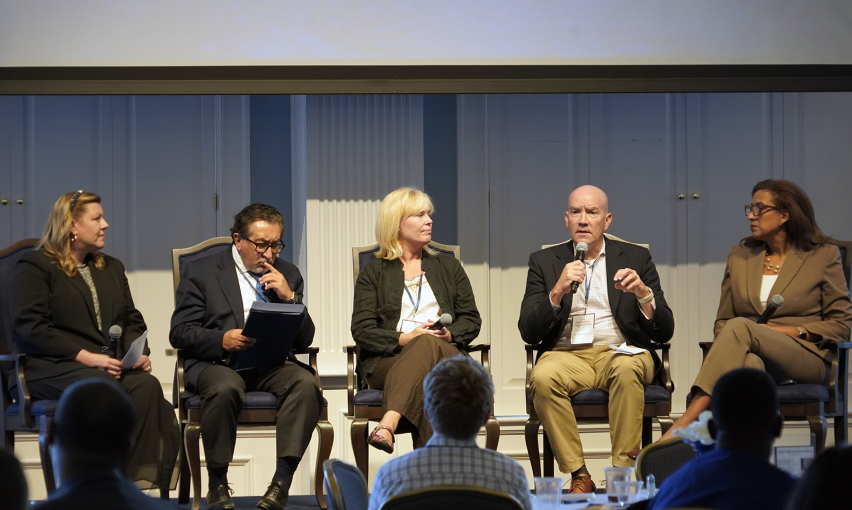
Religious nationalism tends to exclude more people the longer it holds power and often serves authoritarian governments, panelists told the Global Religious Freedom Gathering in Dallas on Tuesday (Sept. 29). They also acknowledged that growing debate over Christian nationalism in the United States complicates American efforts to confront the problem abroad.
The afternoon session, moderated by Anna Lee Stangl of Christian Solidarity Worldwide, included speakers from Freedom House, the George W. Bush Institute, Dallas Baptist University and Brigham Young University. Their discussion centered on how religious nationalism grows, why Christians in the West should resist it at home as well as overseas, and what the panelists proposed in its place.
A circle that keeps shrinking
Stangl said religious freedom advocates have spent decades watching countries fuse national identity with a single faith, from Hindu nationalism in India to Buddhist nationalism in Myanmar and Sri Lanka. In her experience, the boundaries of who belongs rarely hold steady once that fusion begins.
"Inevitably that net gets smaller and smaller," she said. Russia, she noted, spoke two decades ago about its Christian heritage but now emphasizes a specifically Orthodox identity. Iran was founded not simply as an Islamic republic but a Shiite one, she said, while Pakistan defines itself around Sunni Islam, leaving other believers outside. Even members of the favored faith can find themselves excluded, Stangl added.
Gerardo Berthin of Freedom House described the same process from the perspective of governance. In countries that move from minimal democracy toward authoritarian rule, he said, one of the first steps is to assert the supremacy of a religion. The legal system then becomes the tool for embedding that supremacy, a shift he said can take years or decades but advances steadily.
Berthin placed this within broader trends tracked by Freedom House, which he said has recorded 20 consecutive years of global decline in rights and liberties. Most countries the organization rated partly free in 2005 are now rated not free, he said, and few countries that fall into that category ever recover.
Nicole Bibbins Sedaca, a fellow at the George W. Bush Institute, said religious nationalism is best understood as "a very real subset" of a wider wave of autocracy. She made the point in response to an audience question that challenged whether the term was precise enough to guide policy.
In some countries religion is used as a tool, Bibbins Sedaca said, pointing to what she described as Russian President Vladimir Putin's instrumentalization of the Russian Orthodox Church to support his war against Ukraine. In others, such as Iran, she said the religious conviction behind the state is deeply held. Either way, she said, the result in democracies is a "pincer effect" that erodes trust both in democracy and in the idea that religion can thrive peacefully within it.
An objection rooted in faith
For Jack Goodyear, dean of the College of Humanities and Social Sciences at Dallas Baptist University, the appeal of religious nationalism lies in its simplicity. Democracy demands that people with different beliefs work together, he said, and many find that uncomfortable. A nation defined by one faith offers an easier story in which belonging to the right group is enough.
Goodyear said authoritarian leaders then rely on academics and lawyers to reinterpret constitutions and laws in ways that justify stripping away freedoms. He invoked the 17th-century minister Roger Williams, who he said taught that religion is not destroyed by persecution but by being co-opted by the state and becoming the persecutor.
His objection, Goodyear said, does not depend on which party holds power. "I'm going to be opposed to Christian nationalism because it's a distortion of my faith," he said.
Stangl said that position is now harder for American advocates to carry abroad. While working in Brussels in the 2000s, she said, she watched a sophisticated lobbying effort persuade many center-right members of the European Parliament that India's Bharatiya Janata Party was little different from Europe's Christian Democrats.
Today, she said, some people in the U.S. government and on mainstream media present Christian nationalism as a legitimate option. That raises a question she put to the panel: how can advocates tell India or Pakistan that their form of religious nationalism is wrong?
Bibbins Sedaca said the United States has never spoken about democratic values from a position of perfection and should not stop now. American advocates need "both the humility and the confidence in those values," she said. At home, she argued, Americans must recover two founding commitments together: that government may not establish a religion, and that religion is protected in public life. When people embrace only one of those principles, she said, the country swings between favoring one faith and pushing faith out of public life altogether.
Goodyear agreed that humility is required. He pointed to slavery, segregation laws and the internment of Japanese Americans during World War II as moments when the nation contradicted its own ideals. Acknowledging those failures, he said, should not keep Americans from speaking up.
Pluralism built on shared standards
Hannah Clayson Smith, associate director of the International Center for Law and Religion Studies at Brigham Young University, offered a way around the credibility problem. Her center does not try to export the U.S. First Amendment, she said, because circumstances in other countries differ too much.
Instead, Smith said, the center appeals to the Universal Declaration of Human Rights and the treaties that followed it, which she said informed most national constitutions written after World War II. Advocates can then ask governments why they are not upholding standards the world has already accepted, rather than asking them to copy the American model.
Those standards include the right to change one's religion, to practice faith in public and to protection for religious minorities, Smith said. Holding them up to government officials, she said, gives leaders a basis for finding "the moral courage" to protect pluralism, even when religious nationalism is popular.