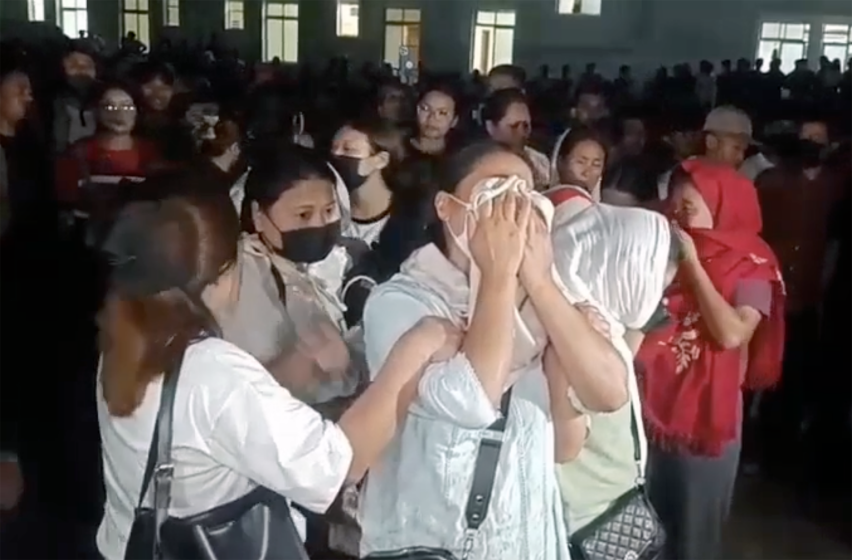
Six Naga men taken hostage in India's northeastern state of Manipur, two of them pastors, were found dead on June 10, their remains reportedly mutilated. More than a week later, their bodies have still not been handed over to their families.
The six were seized in retaliation after gunmen killed three Baptist pastors in an ambush. More than five weeks later, the wider crisis that ambush set off shows no sign of ending.
This week alone has brought a tense hospital standoff, an intensified security crackdown, and the disputed killing of Lenminsang Haokip in Henglep, whose family is still waiting to bury him.
The crisis sits on top of an older, deeper split.
Manipur is divided between a fertile central valley and the surrounding hills. The valley is home to the Meitei, who are mostly Hindu. Although Meiteis occupy roughly 10 percent of the state's land, they hold 40 of Manipur's 60 state assembly seats.
The hills are home to two predominantly Christian tribal communities: the Naga in the north and the Kuki-Zo in the south.
The state has been gripped by violence between the Meitei and the Kuki-Zo since May 2023. Kuki-Zo communities have borne the brunt of the displacement from that conflict and lost access to Imphal's airport, the state's only one. Churches belonging to Kuki-Zo, Naga and even some Meitei Christians were burned in the violence. More than 300 churches have been destroyed across the state since 2023.
Tensions between the Naga and the Kuki-Zo, two communities that share the Christian faith, had already been rising since clashes in February this year. The May 13 ambush turned that tension into open crisis.
As Christian Daily International previously reported, Rev. Dr. Vumthang Sitlhou, Pastor Kaigoulun Lhouvum and Pastor Paogoulen Sitlhou were shot dead on May 13 while returning from a peace conference in Churachandpur.
They led the Thadou Baptist Association India. Thadou is one of the largest communities within the broader Kuki-Zo grouping, though Thadou organizations have pushed for their own distinct administrative classification.
A Cycle of Hostages
Within hours of the ambush, armed groups on both sides began seizing civilians in Kangpokpi and Senapati districts. Police later said that while 48 people were taken hostage in total, 28 were released within two days.
One group of 18 came from Konsakhul, a Naga village, stopped at a barricade in the neighboring Kuki village of Leilon Vaiphei while returning from a wedding. Twelve women and a child from that group were among those freed within the first two days, released in the early hours of May 15.
That left 20 hostages still unaccounted for from both communities: the six Konsakhul men, and 14 Kuki-Zo civilians held separately in Senapati district.
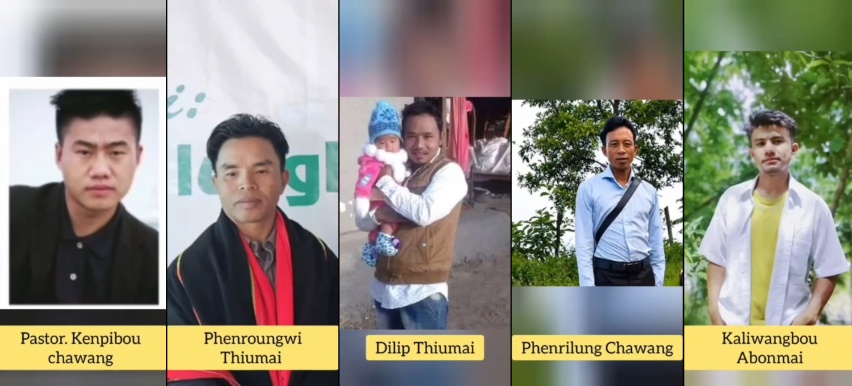
The six missing Naga men were Rev. Dr. Manu Thiumai, pastor of Leimakhong Baptist Church; his brother Dilip Thiumai; Pastor Kenpibou Chawang; Phenrongwi Thiumai; Kaliwangbou Abonmai; and Ch. Phenrilung.
Kacheaklungliu Thiumai, Rev. Dr. Manu Thiumai’s wife, and Winiliu Thiumai, the wife of his brother Dilip, were both among the women released. Both spoke separately to Christian Daily International about their ordeal.
Both women said they were blindfolded, threatened at gunpoint, and moved through the jungle for more than a day, while the men were beaten and driven away separately.
Winiliu Thiumai, who had her two-year-old daughter with her, said her own blindfold was periodically removed, which she believes was because her captors judged a mother with a small child would not try to escape.
Both women said independently that they heard a single gunshot on the night of May 13, which they now believe, was when the men were killed, though this has not been independently confirmed.
Professor Ajailiu Niumai, a Naga academic who has closely followed the crisis, told CDI that many of the women later recognized their captors as residents of Leilon Vaiphei from whom they had once bought vegetables, a familiarity that made the experience harder to bear. She said the women had cooperated, hoping their husbands and sons would be released safely.
Separately, Wilson Thanga, a resident of Dolang village and belonging to the Chiru community, a small Manipur tribal group, was killed on May 13 in Joujangtek. The attack also left his wife injured. The United Naga Council (UNC), the main civil society body representing Naga tribes in the state, later alleged, in a formal charter of demands, that the same armed group accused in the hostage killings was also responsible for his death.
Church Leaders Intervene
Christian leaders moved quickly to mediate. On May 18, a ten-member delegation from the Manipur Baptist Convention (MBC), the Council of Baptist Churches in North East India (CBCNEI), the Asia Pacific Baptist Federation (APBF) and the Baptist World Alliance (BWA) met Manipur’s chief minister.
They then traveled to meet both the UNC and Kuki Inpi Manipur (KIM), its Kuki-Zo counterpart.
The four bodies jointly appealed for “the immediate, safe, and unconditional release of the hostages,” urging both sides toward reconciliation. By then, the 28 hostages released in the first two days were already home. The appeal was aimed at the 20 who remained, the six Naga men and the 14 Kuki-Zo civilians, who stayed in captivity for three more weeks, into June.
At the funeral of the three slain pastors in Motbung, attended by thousands, Haominlun Sitlhou, son of Rev. Dr. Vumthang Sitlhou, publicly forgave his father’s killers, echoing his father’s own efforts at reconciliation in the weeks before his death.
Niumai told CDI that she had appealed publicly from the earliest days of the crisis for hostages on both sides to be freed, calling for “peace as Christian brothers” between the two communities.
Hope Turns to Grief
On June 9, Naga village guards, informal, village-organized defense groups, released the last 14 Kuki-Zo hostages, who had been held in Senapati district for 27 days.
UNC president Ng. Lorho said the release came on humanitarian grounds, citing appeals from church bodies including the BWA. Both the Evangelical Fellowship of India (EFI) and the National Council of Churches in India (NCCI) welcomed the news and continued praying for the six Naga men that were still missing.
That hope did not last. The next day, June 10, security forces recovered six bodies near Leilon Vaiphei believed to be the missing Naga men.
EFI’s general secretary, the Rev. Vijayesh Lal, said in a statement that “hope has now turned to grief,” and noted that two pastors were among the dead. NCCI said the killings had “no place in any civilized society, particularly in a predominantly Christian region.”
The Manipur Baptist Convention thanked the Naga community for its earlier restraint, saying Baptists had hoped for “a similar spirit and reciprocal gesture,” and called the alleged mutilation of the bodies a “gross violation of the God-given dignity and sanctity of human life.”
CBCNEI, the BWA and the APBF also condemned the killings and demanded a swift, impartial investigation. The United Christian Forum of North East India said the loss was “felt even more acutely” because two of the dead were pastors.
Catholic leaders responded as well. Archbishop Linus Neli of Imphal later called for an inclusive peace accord he termed as “Manipur Agreement 2026.” Archbishop emeritus Dominic Lumon told AsiaNews there was “a loss of humanity” in the cycle of revenge.
Paisho Thiumai, brother of Rev. Dr. Manu Thiumai, told the media, “I forgive them, but this must stop.”
Niumai, reacting to how the remains were handled, told CDI they were “kept in plastic bags and sacks, which is beyond human dignity.” She questioned why search teams that had reportedly covered the same ground for weeks did not recover the remains until immediately after the Kuki release.
Expressing deep shock and grief at her husband and loved ones mutilated bodies, Winiliu Thiumai told CDI, “they have treated us [Nagas] badly; butchering them like an animal.”
Relatives described a community marked since by deep trauma. Niumai informed CDI that many of the women are struggling to process what happened, caught between grief, fear and unanswered questions.
Demands and Denials
The United Naga Council has refused to accept the remains. In a charter of demands, sent to Union Home Minister Amit Shah on June 12, the council accused the Kuki National Front-President group (KNF-P), an armed faction party to a long-running ceasefire with the government known as the Suspension of Operations (SoO) agreement, of carrying out the killings.
It also named the chief of Leilon Vaiphei, the Kuki village where the Naga civilians were first stopped and abducted, other villagers, and a serving Manipur police officer, Thanggilian Vaiphei.
The council demanded that KNF-P be declared a terrorist organization, that the SoO agreement be scrapped, and that Deputy Chief Minister Nemcha Kipgen be removed from office, citing her marriage to the group’s president.
On June 14, Deputy Chief Minister Losii Dikho, who is Naga, became the first government official to publicly assign blame, telling reporters that an SoO-affiliated Kuki group was responsible. He appealed to Prime Minister Narendra Modi to rein in such groups. Kuki Inpi Manipur has denied the allegations.
As of June 15, Manipur’s home minister said identification of the six bodies was complete, but that handover was delayed while the government weighed the UNC’s demands.
The state handed both the May 13 killings and the abduction cases to India’s National Investigation Agency, a federal anti-terrorism body, in late May. Four arrests followed in the abduction case, but no one has yet been arrested over either the original ambush or the deaths of the six Naga men.
Violence Spreads to the Fringes
The killings have set off a wider cycle of violence beyond the villages of Leilon Vaiphei and Konsakhul.
On June 9, a Kuki-Zo farmer, Haogin Lhouvum, was shot dead while working in a paddy field near Lasan, on the Kangpokpi-Tamenglong border. Kuki civil society groups blamed Naga armed groups.
Four days later, during Lhouvum’s funeral, a Kuki-Zo village volunteer, Jangngam Hangshing, was killed and two others wounded in a separate ambush nearby. Kuki groups attributed the attack to the National Socialist Council of Nagalim, Isak-Muivah faction, a longstanding Naga insurgent organization that has held a ceasefire with the Indian government since 1997, known as NSCN-IM, and an allied faction.
On June 11, two Kuki men, a church deacon and a youth leader, were killed and homes burned in Kultuh village, Kamjong district.
The Henglep Dispute and a Hospital Standoff
On June 15, gunfire near the border of Leilon Vaiphei and Konsakhul left three young Kuki-Zo men wounded. Kuki Inpi Manipur blamed NSCN-IM and an allied faction for the shooting; Naga residents said they had been fired on while working in their fields and that a village guard had returned fire.
The three wounded men became the center of a standoff after they were taken first to a military hospital and then to the Regional Institute of Medical Sciences in Imphal.
Crowds, including Meitei and Naga residents, gathered outside the hospital for two nights running, alleging the men were militants and demanding they be handed over. Security forces used tear gas and baton charges after protesters tried to storm the building and threw smoke bombs inside.
The hospital said treating all patients “irrespective of their background or circumstances” was a professional and ethical duty. Early on June 17, the three were quietly moved under heavy security to a hospital in Churachandpur, a Kuki-majority district.
A separate, still-disputed killing has compounded the tension. On June 16, a joint patrol of the Assam Rifles, a federal paramilitary force, and the Indian Army exchanged fire with suspected militants between Molphei and Songkong villages in Henglep, Churachandpur district. Police said one militant was killed and that an assault rifle, ammunition and explosives were recovered from the scene.
The Songkong Village Authority and a local coalition called the Joint Kuki CSOs Henglep disputed that account entirely. They identified the dead man as Lenminsang Haokip, a local resident who they said had stayed home that day due to illness and alleged he was shot after fleeing what they described as a drone and mortar strike on the village.
Both groups, along with Henglep’s Member of Legislative Assembly (MLA), Letzamang Haokip, alleged that after he was shot, his civilian clothing was removed, his body was dressed in military fatigues, and he was taken away by security forces, raising what MLA Haokip called serious questions about whether the death was staged to resemble an encounter with a militant. He has demanded a judicial inquiry.
Where Things Stand
Thousands gathered in Senapati, a Naga-majority district, on June 16 for a candlelight vigil for the six slain Naga men. Naga People’s Organisation president Kuba Peter told the gathering the men “were beheaded, cut into pieces, and left beyond recognition.”
Security forces have intensified operations across Manipur this week. Police reported dismantling 61 illegal bunkers and checkpoints across several districts in a 36-hour operation that ended June 18, including a sweep through the villages of Leilon Vaiphei and Konsakhul, and said four people had been detained for questioning.
Three years into Manipur’s broader ethnic conflict, which has killed at least 217 people by official count, with broader estimates exceeding 260, and displaced more than 58,800, the killing of church leaders from both communities, men once devoted to reconciling them, has only deepened the wounds they hoped to heal.
Timeline
May 13 — Three Baptist pastors ambushed and killed near Kangpokpi. Retaliatory abductions begin; 48 civilians taken hostage from both communities.
May 15 — 28 hostages released, including 12 women and a child from Konsakhul. Twenty remain captive: six Naga men, 14 Kuki-Zo civilians.
May 18 — A joint Baptist delegation appeals to both sides for release of the remaining hostages.
June 9 — The 14 Kuki-Zo hostages are released after 27 days.
June 10 — Security forces recover the bodies of the six missing Naga men.
June 11 — Two Kuki men killed in Kultuh village, Kamjong district.
June 12 — UNC submits a charter of demands, naming KNF-P and Deputy CM Kipgen.
June 14 — Deputy CM Losii Dikho publicly blames an SoO-affiliated Kuki group.
June 15 — Gunfire near Leilon Vaiphei wounds three Kuki-Zo men; they are admitted to RIMS, sparking protests.
June 16 — Thousands gather in Senapati for a candlelight vigil for the six slain Naga men. Separately, Lenminsang Haokip is killed in Henglep in a disputed security operation.
June 17 — The three wounded men are moved to Churachandpur amid hospital unrest.
June 18 — Security forces report dismantling 61 bunkers across multiple districts.