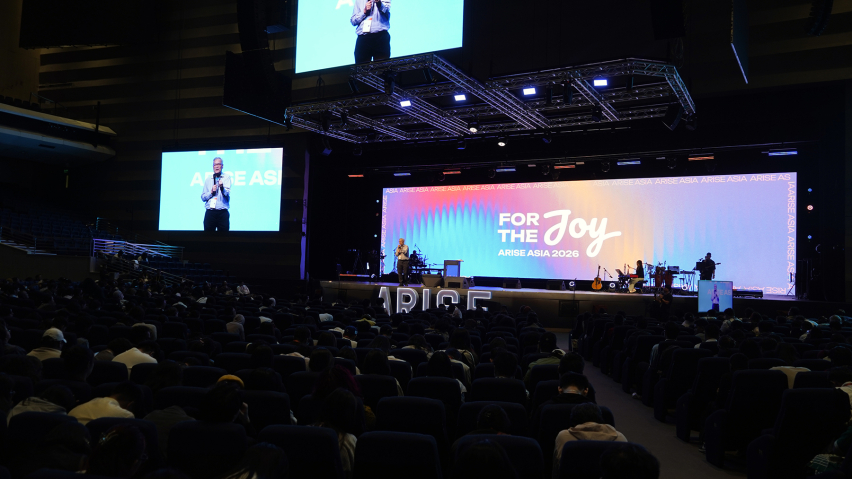
Speaking with Christian Daily International following the closing session of the Arise Asia 2026 Congress, Rev. Dr. David Ro said he believes the global missions world is at the beginning of a shift that will see missionaries from challenging context going out to share the gospel in hard-to-reach places.
"The mission worker is different now than in the last five, ten, fifteen, twenty years," Ro told CDI. "In fact, the last hundred years."
Ro, co-founder and executive director of Arise Asia, was reflecting on five days of gatherings that drew more than 4,000 young leaders from 64 countries to Christ's Commission Fellowship Central in Manila, Philippines. Among the 341 who stepped forward to commit to long-term cross-cultural mission, what struck Ro most was the contexts they were stepping out from — and what those contexts said about where the movement is heading.
The new missionary, in Ro's view, will be younger, predominantly non-Western, and drawn disproportionately from places that have known conflict, poverty, and persecution. That origin, he argued, is precisely what will qualify them for the task.
"Those challenging places will actually raise up people to go to challenging places," he said. "It's easier for someone from a challenging place to go to a challenging place rather than someone from a comfortable place to go to a difficult one."
His clearest example was one of the countries currently experiencing war. Despite the ongoing conflict, the Arise movement there has produced what Ro described as his most encouraging development of the past three years. "If you can just see the national Arise movement there now, they're actually doing it," he said. "Seventeen, eighteen-year-old girls are now missionaries in another tribe. And they're not just running conferences, they're actually going. And that comes out of a context of war."
"I don't shy away from war, poverty, and persecution," Ro added. "Those are the places where it's most alive."
What the week had already shown
Ro's observation after the congress was a reflection of the week’s theme, "For the Joy," which was drawn from Hebrews 12:2, For the joy set before him [Jesus] endured the cross, scorning its shame, and sat down at the right hand of the throne of God. It emphasized that in the Bible, joy and suffering always go together.
On the first night, Pastor Wayne Chen, director of Radius Asia and a former missionary to the Biem people of Papua New Guinea, told the congress that "all the easy places have heard about the gospel." When a people group has no access to the gospel, he said, "it's usually because there's some sort of difficulty or hardship waiting for the gospel messenger." He urged delegates not to settle for a smaller joy than the one found in obeying that call.
On the third morning, Patrick Fung, Chair of the Arise Asia Global Board and Director Emeritus of OMF International, pressed the same point theologically. "For followers of Jesus," he told the congress, "joy and suffering always coexist." He pointed to Acts 5:41, where the apostles left after being flogged "rejoicing because they had been counted worthy of suffering disgrace for the Name." Joy and suffering, he said, are not opposites. They are traveling companions. "The happiest people in the world are not those without suffering, but those who are not afraid of it."
That evening, Andrew Brunson gave a very personal account of what that looks like from inside. The American missionary, who spent 23 years planting churches in Turkey before two years in a Turkish prison on charges of espionage and terrorism, told delegates he had broken badly in custody — emotionally, physically, spiritually. God's presence, which he had expected to sustain him, went silent. What he found instead, alone in his cell, was that the test of his faith was not whether God showed up, but what he would say when God did not.
"Even if you're silent, I still love you," he told the congress he had said to God. He had learned to dance in his cell — not because he felt anything, but because Christ commanded rejoicing in persecution, and love meant obeying even that. Nowadays, "there are things Jesus and I don't have to talk about," Brunson said, "because we understand each other. There is a side of Jesus we cannot know apart from tasting suffering."
The following morning, Joshua Bogunjoko, Global Director for Regions of the Lausanne Movement and International Director Emeritus of SIM, brought the same theme from a different angle. He arrived as a voice from Africa — a continent the world has long perceived through the lens of need. His message was illustrated through the stories of Nigerian surgeons staying in a city in a hostile country after foreign missionaries had to evacuate due to terrorists, of missionaries returning to the Sahel even after miraculously surviving armed checkpoints, and of a church in Ethiopia collecting blood donations to fund their next missionary.
What the church and mission world needs to prepare for
For Ro, stories like these reflect the emerging norm in the context of cross cultural missions today — and a sign that the mission world's assumptions about who is qualified to go, and from where, needed to catch up with what God was already doing.
"The mission world and the church world — we need to prepare for that new wave of harvest workers who are going to come from those contexts," he told CDI. "That's how God's working."
The 2026 Congress was the largest Arise Asia has held, with the next Asia-wide gathering planned in three years. In the interim, Ro said the movement plans to extend its reach into Africa, Latin America, the Middle East and North Africa, and Central Asia — regions where he said conversations with local leaders are already underway.
Read Christian Daily International's full reporting on Arise Asia 2026.