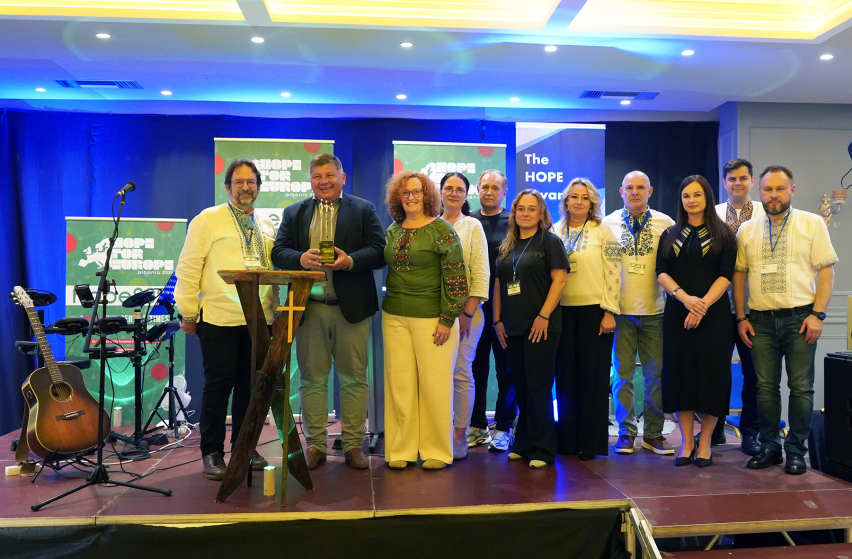
The European Evangelical Alliance on Thursday evening (Oct. 8) presented its 2026 Hope Award to Ukraine’s evangelical Protestant churches. Alliance leaders said the churches had kept their doors open through years of war, turning their buildings into shelters and aid centers while their pastors stayed with those who could not flee.
The award was presented at Hope for Europe 2026, a five-day gathering of about 250 evangelical leaders from across the continent held under the theme “Hope in Uncertain Times.” Connie Main Duarte, co-general secretary of the alliance, said this year’s recipient differed from past ones because it was neither a single person nor one organization or project.
“For most of us, uncertainty means economic pressure, cultural change, or churches growing smaller,” Main Duarte said. “For this year’s recipient, uncertainty means sirens by day and by night.”
The entire Ukrainian delegation went on stage for the presentation. Igor Bandura, general secretary of the Ukraine Council of Protestant Evangelical Churches, accepted the award on the council’s behalf and thanked European believers for their prayers and practical support.
“The world must never grow accustomed to the war in Ukraine,” Bandura said.
Award honors work that inspires hope
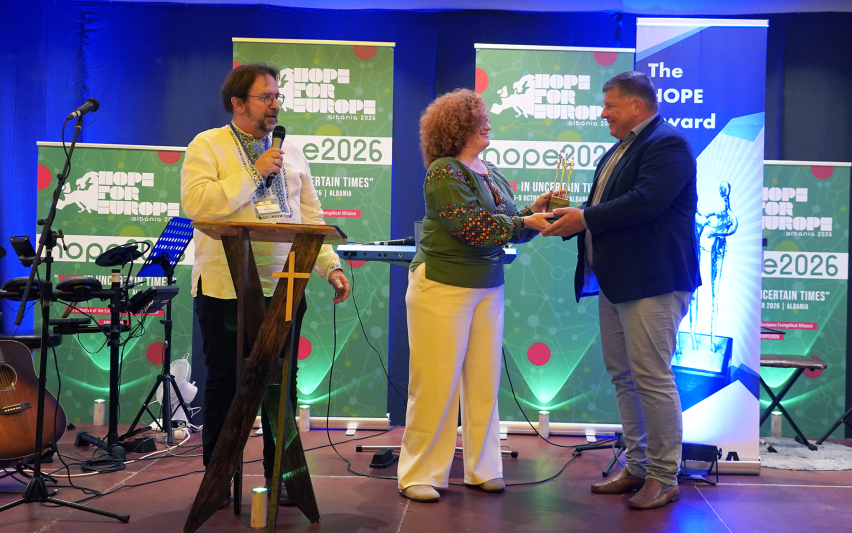
The Hope Award originated in the Hope for Europe movement, whose networks continue to oversee it. Main Duarte said it carries no money and is given as a sign of honor to a person, group or project in Europe that reflects biblical hope along with partnership, networking, transformation and integrity.
The alliance also hopes the stories behind the award will travel across borders and prompt similar work elsewhere, she said.
Jan Wessels, who shares the general secretary role with Main Duarte, listed earlier recipients. They include the creation care organization A Rocha, the Greek Evangelical Alliance for its work with refugees in 2016, Home for Good for its care of children without homes, among others. At the last gathering, held in Sarajevo, the award went to Israel Olofinjana for his work on intercultural unity. Olofinjana now leads the One People Network that launched this week, as Christian Daily International previously reported.
Daily reality of air alerts
Wessels told participants he visited Ukraine in August for a national prayer breakfast and events marking 35 years of the country’s independence. He said he saw buildings and homes destroyed by bombing.
During a guided tour of a historic city center, an air raid alert ended the visit and sent the group looking for shelter, he said. For him it was a single alert, Wessels said, but for Ukrainian believers such interruptions have been part of daily life for years.
“And yet at that prayer breakfast, I heard people pray with the faith and the hope that humbled me,” he said.
Main Duarte described how Ukrainian congregations responded once the war began. According to her, church basements served as bomb shelters and church buildings stored food, medicine and generators, while youth groups organized as volunteer teams. Many pastors chose to remain with elderly people, frightened residents, and soldiers and their families, she said, and some of them were killed.
War brought unity across traditions
Wessels pointed to cooperation among Ukraine’s Protestant traditions as a reason for the award. Baptists, Pentecostals, Adventists, Lutherans, Reformed believers, Messianic Jewish congregations and others found that their shared faith in Christ outweighed their differences, he said, and they now address their government and society together.
Main Duarte said churches elsewhere in Europe had also been changed by welcoming Ukrainian refugees and hearing their accounts. Through that experience, she said, European churches were reminded what it means to suffer alongside others and to persevere.
The engraving on the award honors the council for inspiring churches in Europe and beyond and for showing the hope of Christ “through love, resilience, unity and sacrificial leadership in the midst of suffering.”
A reality of ‘two sides’
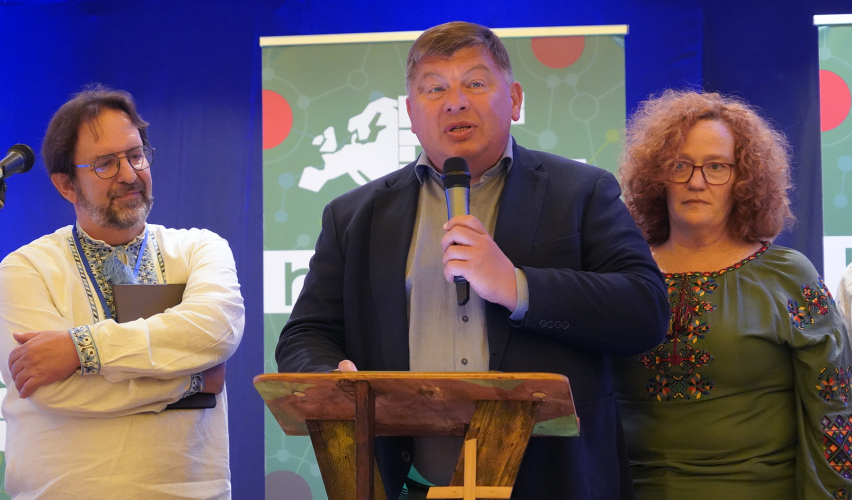
In his acceptance remarks, Bandura described the stark reality of the war. While Ukrainians are often called strong and resilient, he said, “We are being methodically and systematically killed day after day and the world is watching mostly in silence.”
He warned that if Ukraine does not prevail, the war would spread to other European countries. “If Ukraine falls, the advance of the gospel will suffer profound damage,” he said.
Bandura cited attacks from the previous day. He said a missile strike on an apartment building in the northern town of Pryluky killed 22 civilians, including five children, and wounded more than 50. Another strike that day on passenger buses killed 33 people, according to Bandura, and attacks on power infrastructure left Kyiv and four surrounding regions without electricity and water.
He also criticized those who continue to discuss trade and business with Russia while Ukrainians are dying from missile and drone attacks.
Bandura then turned to what he described as the other side of the story. In the churches represented by the council, he said, more than 40,000 people have been baptized during the war, and more than 2,000 pastors and deacons have been ordained, even though hundreds of others now serve in the armed forces and many have left the country with their families.
Hundreds of churches have been lost in occupied territories, Bandura said, but more new ones have been planted elsewhere in Ukraine. He added that Ukrainian refugees have started more than 400 groups and churches in 25 European Union countries, along with outreach programs, kindergartens and schools.
He thanked the gathering for the award and appealed to participants to “stay with Ukraine and pray for Ukraine.”
Networks, labs and prayer for nations
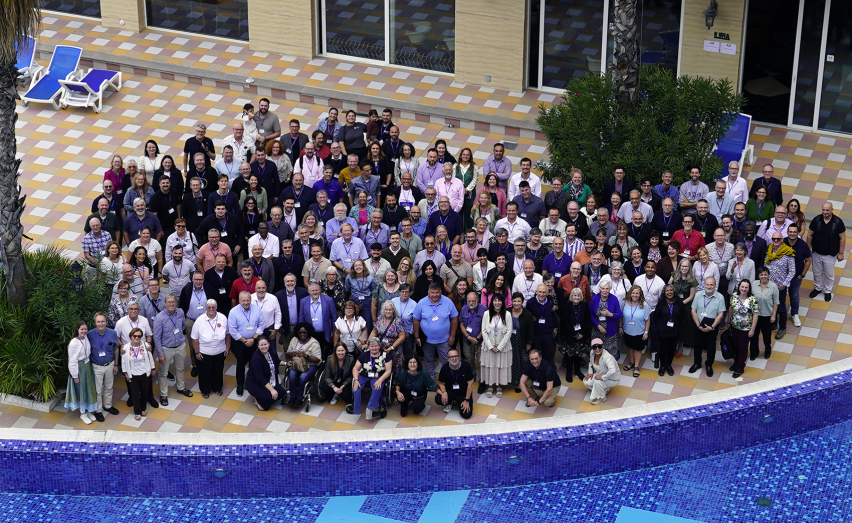
Hope for Europe 2026 concluded Friday morning. It was the movement’s fifth major gathering since 2002 and followed the 2022 meeting in Sarajevo.
Much of the week was given to networking and collaboration. From Tuesday through Thursday, organizers held 18 networking streams, each meeting once. Topics ranged from children’s ministry, prayer and peace and reconciliation to Roma ministry, refugees and the arts, and from disability and creation care to orphan care and ministry among Muslims.
Participants also took part in “Hope Labs,” small-group sessions on themes including family and identity, digital mission, faith in the public square, leadership and mission paradigms.
On two “Hope for the Nations” evenings, delegations from across Europe described conditions in their countries and shared prayer requests. Participants moved from table to table to listen and pray. Delegates wore traditional dress and served treats from their home countries.