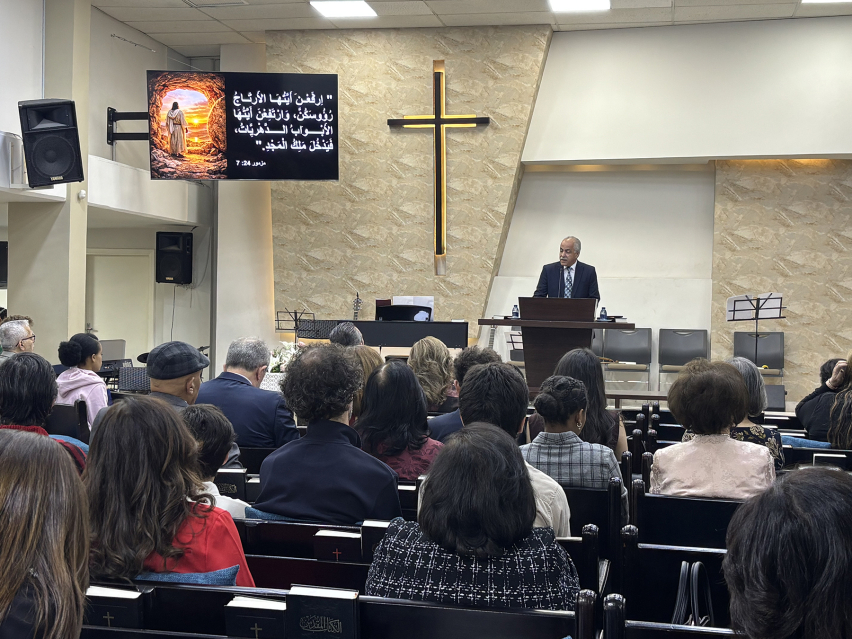
Christians in Jordan were joined by churches in parts of Israel and the West Bank in celebrating Easter together across denominational lines on April 12, an unusual occurrence globally as Catholic, Protestant and Orthodox churches typically observe the holiday on different dates.
The divergence in Easter observance dates back centuries, rooted in differences between the Western Gregorian calendar, adopted by the Roman Catholic Church in 1582 and later by most Protestant traditions, and the Eastern Julian calendar, which continues to be used by many Orthodox churches. As a result, Easter is often celebrated on different Sundays across Christian traditions.
In Jordan, however, Catholics, Protestants and evangelicals have marked Easter on the same day, alongside Orthodox Christians for decades. Churches in several Israeli and Palestinian cities including Nazareth and Ramallah also aligned their observances this year, celebrating Good Friday, Holy Fire Saturday and Easter Sunday according to the same calendar.
Rev. Botrus Mansour, Secretary General of the World Evangelical Alliance, who attended today's Easter service at his local Baptist church in Nazareth, commented to Christian Daily International that he supported joint Christian holidays, especially regions with fewer Christians. “I think it reflects a positive stance that expresses Christian unity towards the whole world. Our numbers are already small in the East, and the division during holidays makes us vulnerable to ridicule,” Mansour said.
However, celebrations in Jerusalem and Bethlehem remained divided, as churches there are required to follow the strict religious calendar arrangements codified under the 19th-century Ottoman-era Status Quo agreement governing holy sites, which formalized longstanding arrangements among Christian denominations regarding worship times and control of shared sacred spaces.
1973 agreement established unified Christian holidays in Jordan
The move to unify holidays in Jordan follows an agreement worked out in 1973 and signed by Christian laypersons, organizations and churches. The agreement, established by the Committee for Unifying Christian Holidays in Jordan and Palestine, stipulates that all Christian denominations celebrate Christmas on Dec. 25 each year according to the Gregorian calendar, and Easter according to the Eastern Julian calendar.
The signatories justified their decision by stating that the continued practice of different churches and denominations in the Hashemite Kingdom of Jordan and the West Bank celebrating Christian holidays on separate dates harms the reputation of Christians, weakens their image, and undermines the splendor of the holidays and celebrations.
The 1973 agreement has been followed continuously in Jordan, with the government recognizing Christmas Day (Dec. 25) and New Year’s Day (Jan. 1) as national holidays. Jordanian Christians are granted paid leave on Palm Sunday, Easter Sunday and Easter Monday, and public and private universities are instructed not to schedule exams on those days in respect of Christian observance.
Former Jordanian MP Omar Anton Al-Naber told Milhilard.org, a local Christian website, that his family’s charitable organization, the Al-Naber Family Association, helped organize meetings bringing together Christian families from northern and southern Jordan, as well as from the West Bank, to advance the unification of holiday observances. Committees were established to coordinate with Palestinian Christians and church leaders.
He said that popular support and sustained pressure throughout 1972 and 1973 were crucial to achieving unification. “With all due respect to the heads of the churches at that time, the lay committee followed the popular will; they did not lead it. Those who led it were individuals who agreed that unity among all denominations was in the best interest of Christians.”
In his interview, Al-Naber said the unification was driven by the view that differences in the timing of religious holidays were due to non-essential factors rather than core Christian doctrine. He added that differing celebrations harmed the unity, interests and public image of Christians. The document was signed by more than 500 prominent Christian figures, with families affixing their seals at the Al-Naber Association.
Jordanian engineer Nidal Qaqish, a member of the administrative board and central council of the Orthodox Society, told Christian Daily International that the unification reflected leaders committed to the message of Jesus Christ, including love, generosity and respect for all people. “Jordan remains the only country where Christians celebrate their holidays together, a practice that continues to this day despite attempts by some to reverse this important decision,” he said.
Early grassroots efforts paved the way for unification
The genesis of the unification idea began years earlier, according to Rev. David Rihani, head of the Assemblies of God Church of Jordan. Rihani told Christian Daily International that the Rihani family from the town of Al-Husn in the Irbid Governorate played a key role in initiating the unification of holidays.
“The Rihani clan was the first to privately implement the unification of Christian holiday celebrations within the family in the mid-1950s,” he said.
This private initiative by the extended Rihani family took place despite initial ecclesiastical and sectarian reservations. “Despite opposition from the churches, the effort was well received and proved its social and humanitarian success over time, gradually spreading to other families in Al-Husn, and then to various regions of Jordan, until it became a widely accepted and prevalent practice,” Rihani said.
A document outlining the initial bylaws of the Al-Rihani Cooperative Society for Mutual Benefit, detailing this commitment, was written by engineer Amjad Ta’meh Al-Rihani and sent to the Vatican’s documentation department in 1958, informing them of what Rihani described as a pioneering social experiment.
Global efforts toward a unified Easter
A 2025 report by Vatican News stated that the Vatican—under Pope Francis and continuing under Pope Leo XIV—is actively pursuing a unified date for Easter with the Orthodox Church. Church leaders are seeking “a permanent solution to celebrate the Resurrection together,” viewing it as a crucial step toward greater Christian unity, the Vatican publication said.
No comparable formal discussions are currently taking place within the global evangelical movement, where the emphasis has traditionally been placed more on the meaning of the Resurrection than on the timing of its observance.
In many Orthodox-majority countries, evangelical churches often align their Easter celebrations with the Orthodox calendar for practical and social reasons, even in the absence of formal agreements. Catholic communities in such contexts may also adopt the Orthodox date for pastoral reasons, while Orthodox churches themselves typically maintain their traditional Easter observance even in Western-majority countries where the wider society follows a different calendar.
Yet while the global landscape may be more complex and fluid, the longstanding practice in Jordan stands out as a structured compromise, where churches across traditions have agreed to celebrate Christmas on the Western date and Easter according to the Orthodox calendar, offering a unified Christian witness in society.