Rights activists this week called for an investigation into an alleged “blasphemy business group” accused of exploiting Pakistan’s blasphemy laws to target citizens, including Christians.
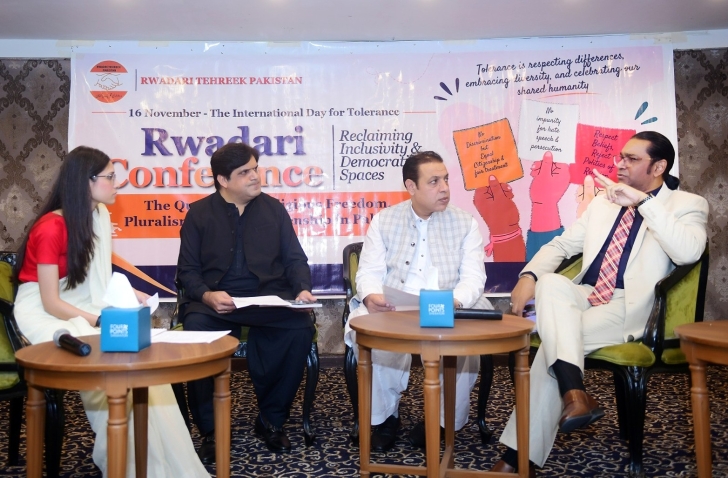
Calling also for comprehensive legislation to criminalize the forced conversion of non-Muslim children, the advocates made the demands at a national conference organized by Rwadari Tehreek (Movement for Equality) on Tuesday (Nov. 17) to mark International Day for Tolerance, where participants highlighted threats to religious freedom, including false blasphemy accusations, mob violence and forced conversions of underage Christian and Hindu girls and boys.
Held under the theme “Reclaiming Inclusivity and Democratic Spaces: Religious Freedom, Pluralism & Equal Citizenship in Pakistan,” the conference brought together human rights advocates, religious leaders, academics, policymakers, journalists and civil society representatives to discuss challenges to religious freedom and democratic participation.
In a declaration adopted at the conference, the participants urged the government to convene a “grand dialogue” in parliament on the misuse of blasphemy laws and ways to prevent false accusations, lynchings, mob violence and attacks on religious minorities.
They also called for a judicial inquiry commission to investigate the so-called blasphemy business group, alleging that organized elements have exploited blasphemy accusations for ulterior motives and contributed to the persecution of vulnerable citizens.
The proposed commission should also investigate major incidents of violence against religious minorities, including the burning of the Christian village of Shanti Nagar in 1997, the August 2023 attacks on Christian homes and churches in Jaranwala, and the 2024 mob lynching of an elderly Christian man, Nazeer Masih, in Sargodha, the declaration said.
The participants said false blasphemy allegations and the misuse of the laws had been used to target citizens and fuel attacks on individuals, homes, property and places of worship. They called for investigations, accountability and effective safeguards against such abuses.
The declaration also urged the government to introduce comprehensive legislation criminalizing the forced religious conversion of minor girls and boys belonging to Christian, Hindu and other religious minority communities. The speakers expressed disappointment over the repeated rejection of proposed legislation intended to protect religious minorities.
The conference speakers emphasized that tolerance, pluralism and equal citizenship were essential to peaceful coexistence and sustainable development, stressing that democratic spaces must remain open and accessible to all communities.
Speaking at the event were Samson Salamat, chairman of Rwadari Tehreek; Deedar Ahmad Mirani, the organization’s vice chairman; scholar and writer Jami Chandio; Irfan Mufti, convener of the Joint Action Committee; and Asad Butt, chairperson of the Human Rights Commission of Pakistan (HRCP). Other speakers included Ali Abdullah Khan, president of the Progressive Students Collective; journalist Mubashir Bukhari; researcher Ali Raza; human rights advocate Kheta Ram; and Laiba Imran, an organizer of Rwadari Tehreek.
The declaration also called on state institutions to remain within their constitutionally defined roles and respect freedom of expression, association and peaceful assembly. It also urged political parties and other stakeholders to work toward a more inclusive, people-centered political system.
The participants called for action against hate speech and discriminatory material in educational curricula, print and electronic media, and online platforms. They recommended making peace education, critical thinking, respect for diversity and nonviolent conflict resolution priorities in schools.
The declaration further urged an end to impunity for groups promoting extremist ideologies, spreading hatred or inciting violence against religious minorities, calling for such organizations to be prohibited and prosecuted in accordance with the law.
It emphasized that reversing violent trends and building an inclusive society would require sustained efforts across education, community engagement, legislation, media and governance.
Rwadari Tehreek’s leadership reiterated its commitment to advocating religious freedom, pluralism and inclusive democratic spaces, urging citizens, state institutions, public representatives, media and civil society to work together to ensure intolerance is neither normalized nor allowed to escalate into violence.